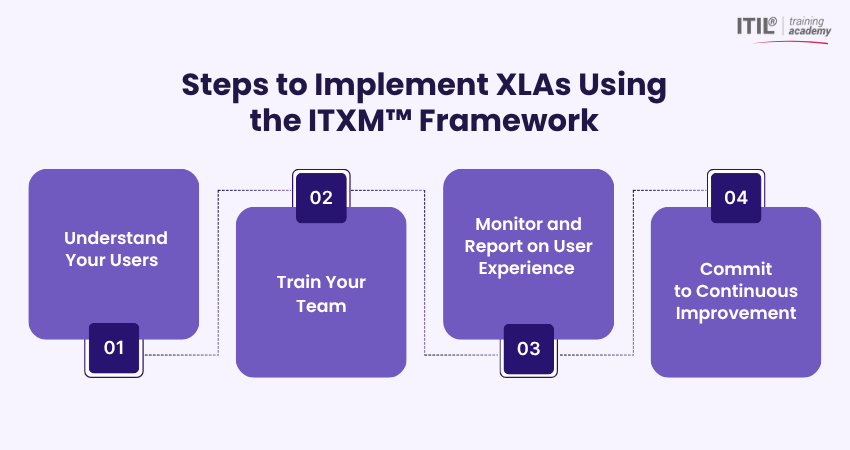
Start by really getting to know your users. Interact with them regularly, gather feedback and observe how they use IT services in their day-to-day work. When you clearly understand their needs and pain points, you can tailor your services to deliver a better and more meaningful experience.
Moving to an XLA-driven approach is about processes as well as mindset. Your service desk team must be trained to focus on empathy, clear communication and understanding the user’s perspective. When your team values the user experience, every interaction becomes positive and impactful.
To make XLAs effective, you need to track how users feel about the services they receive continuously. This means using tools to collect real-time feedback, measuring satisfaction levels and analysing trends. Regular reporting helps organisations identify gaps and take action to improve the overall experience.
Experience Level Agreements require ongoing attention. So, regularly review feedback and performance metrics to find areas for improvement. This could involve refining processes, introducing new tools or upskilling your team. The goal is to keep evolving so you can consistently exceed user expectations.
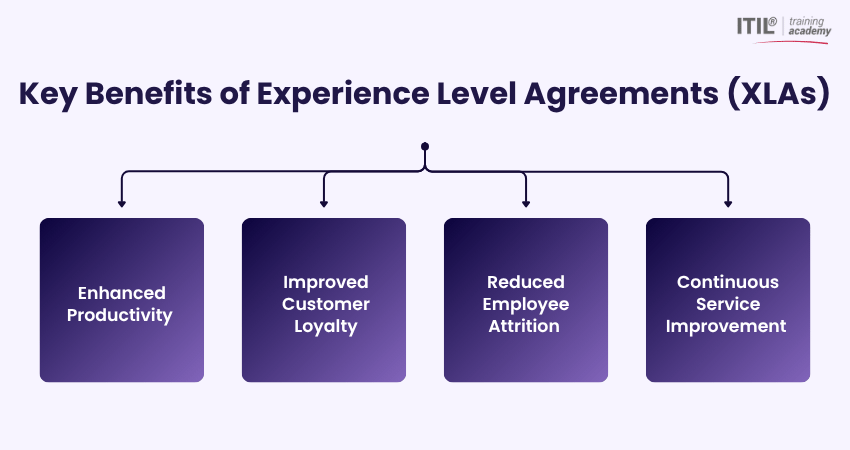
When organisations focus on improving experiences and delivering meaningful interactions for both customers and employees, several valuable outcomes emerge. These include the following benefits:
1) Enhanced Productivity
Poor employee experiences often stem from issues like unavailable applications or underperforming devices that slow down daily work. XLAs help organisations better understand these challenges by capturing real user feedback. With these insights, organisations can take targeted actions to remove obstacles and create an environment where employees can work efficiently.
2) Improved Customer Loyalty
A positive employee experience often contributes to better customer experiences. Experience Level Agreements help organisations understand the factors that influence customer satisfaction and identify opportunities to improve service quality. By continuously enhancing these experiences, organisations can strengthen customer loyalty and encourage repeat business.
3) Reduced Employee Attrition
When employees feel heard and valued, they are more likely to stay with an organisation. XLAs play a key role in identifying what matters most to employees and ensuring those areas are continuously improved. Organisations that focus on improving employee experience, whether through flexible work arrangements, reliable tools or regular support systems, are better positioned to retain talent.
4) Continuous Service Improvement
XLAs encourage organisations to regularly measure, review, and improve user experiences rather than treating
ITIL Service Delivery as a one-time effort. By continuously monitoring experience data and responding to feedback, organisations can adapt to changing user needs, refine their services, and enhance service quality.
Measuring Success with XLAs: The Metrics You Need
Measuring success with Experience Level Agreements can be more complex than with traditional SLAs. XLAs require a broader approach that blends quantitative data with qualitative insights to truly understand the user experience. Here are the metrics you need:
1) Net Promoter Score (NPS)
Net Promoter Score (NPS) is a widely used metric to gauge user loyalty and willingness to recommend a service to others. This provides a strong indication of how well the service meets expectations. NPS is especially helpful for identifying long-term trends and understanding whether improvements are positively impacting user perception.
2) Customer Satisfaction (CSAT) Scores
Customer Satisfaction (CSAT) scores offer a more immediate view of user experience. After interacting with the service desk, users rate their experience, usually on a simple scale. This provides quick feedback on how well the team is performing and helps highlight specific areas that may need improvement.
3) Employee Satisfaction (ESAT) Score
Employee Satisfaction (ESAT) scores are gathered through surveys and feedback tools to measure how employees feel about the digital tools, IT support, and workplace services they use. High satisfaction scores indicate that technology is effectively supporting employees in their daily work.
4) Digital Experience Score
A Digital Experience Score combines multiple factors, such as device performance, application reliability, system responsiveness, and user feedback, to provide an overall measure of the
Digital Employees Experience. This metric helps organisations identify trends and prioritise improvements that have the greatest impact.
Practical Examples of Using XLAs
The following examples show how organisations can use XLAs to measure and improve user experiences alongside traditional SLAs:
1) IT Service Desk Support
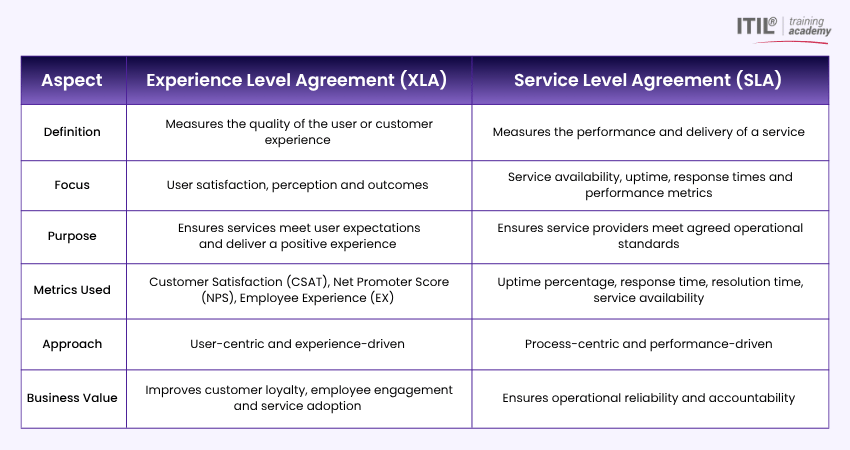
A company may have an SLA stating that support tickets must be resolved within four hours. However, an XLA measures how employees feel about the support they receive. For example, the organisation could track a target such as "90% of employees rate their support experience as satisfactory or higher." This ensures the focus is not just on speed, but also on service quality and user satisfaction.
2) Employee Digital Workplace Experience
When rolling out a new collaboration platform, an SLA might measure system uptime and response times. An Experience Level Agreement, however, could measure whether employees can complete key tasks easily and efficiently. For example, the target could be "85% of employees report that the platform helps them work more productively." This links IT performance directly to employee experience and business outcomes.
Common XLA Challenges
Here are a few challenges associated with implementing and managing Experience Level Agreements:
1) Organisational Culture
Implementing XLAs often requires a significant cultural shift. Many organisations are accustomed to measuring success through technical metrics and SLAs, making it difficult to adopt a user-centric mindset. Employees and leaders must embrace the idea that service quality is defined not only by performance metrics but also by user experience and satisfaction.
2) Cross-team Collaboration
XLAs typically span multiple departments, including IT, Human Resources (HR), customer service and business teams. Without strong collaboration and shared objectives, it can be difficult to gather meaningful experience data and act on insights. Improving collaboration across teams enables organisations to respond quickly to user feedback and implement lasting improvements.
3) Inaccurate Measurements
Measuring experience is more complex than tracking technical performance. User feedback can be subjective, inconsistent, or influenced by individual perceptions. If organisations rely on limited or poorly designed metrics, XLAs may not accurately reflect the real user experience, leading to misguided decisions and improvement efforts.
4) Lack of Commitment to XLAs
Some organisations treat XLAs as a simple replacement for SLAs rather than a long-term improvement strategy. Without leadership support, regular reviews, and a commitment to acting on feedback, XLAs can become just another reporting metric rather than a tool for amplifying experiences.
Conclusion
Experience Level Agreements are transforming how organisations measure service success by shifting the focus from technical performance to real user experiences. By combining XLAs with SLAs, businesses can gain much deeper insights into productivity and value delivery. As customer and employee expectations continue to evolve, adopting XLAs can help create more user-centred services that drive long-term success.



 Back to
Topics
Back to
Topics