


 Back to
Topics
Back to
Topics




Author-Availability Management in ITIL

Last updated-Jul 11, 2026
Availability is the silent force behind every reliable IT service. It marks the difference between IT services that stay available around the clock and others that experience frequent disruptions. When systems stay online, users stay productive; but achieving that consistency takes more than luck. Availability Management in Information Technology Information Library (ITIL) provides a structured approach to ensuring services meet agreed uptime and performance targets.
In this blog, you will learn what Availability Management is, its core principles, approaches, roles and responsibilities, examples, benefits and challenges for improving service availability in an ITIL environment. So read on and take the next leap in IT service excellence!
What is Availability Management in ITIL?
Availability Management, as defined in ITIL® 4, is all about making sure IT services are available when customers and users need them, and that they consistently meet the agreed service levels. Simply put, availability refers to an IT service's ability to perform its intended function whenever it is required.
To achieve this, organisations need the right combination of plans, processes, people, and technology to support both current and future availability needs. Availability Management also focuses on identifying and mitigating risks that could lead to service disruptions or outages.

Objective of Availability Management in ITIL
ITIL Availability Management aims to ensure that IT services remain reliable and accessible across all business needs. Its key objectives include:
1) Developing and Maintaining an Availability Plan: This plan must reflect both current business requirements and future growth expectations.
2) Providing Guidance and Expertise: The process should offer guidance to business and IT teams on availability-related matters, helping them make informed decisions.
3) Ensuring Service Availability Targets are met or Exceeded: When targets are not achieved, Availability Management supports the investigation, diagnosis, and resolution of related incidents and problems.
4) Assessing the Impact of Changes: This involves gauging the impact on service availability and proactively identifying opportunities for improvement, especially where the benefits justify the associated costs.
Scope of Availability Management in ITIL
Availability Management covers the entire lifecycle of an IT service, including its design, implementation, measurement, management, and continuous improvement. It focuses on the availability of the service itself and also on the underlying components that support it. This includes infrastructure, applications, networks, and external service dependencies that collectively enable ITIL Service Delivery.
The process begins as soon as the availability requirements of a service are identified and defined. From that point onward, Availability Management remains an ongoing activity. It only concludes when the service is formally decommissioned or retired.
Throughout this lifecycle, Availability Management ensures that agreed service levels are consistently met, risks are proactively managed, and improvements are continuously implemented to enhance service performance and user satisfaction.
Availability Management Approaches
Effective Availability Management typically combines proactive planning, rapid response, and a preventive mindset to ensure IT services remain available when users need them. These approaches work together to improve service reliability, minimise downtime, and support consistent service delivery. Here are the main approaches:
1) Proactive Availability Management
Proactive Availability Management focuses on designing and building availability into IT services from the very beginning. The goal is to anticipate potential risks and put measures in place to prevent service disruptions before they occur. At this stage, enterprise architects define availability requirements and controls, while solution designers incorporate these controls into the overall service design. Common examples include:
a) Load balancers
b) Redundancy mechanisms
c) Automatic failover capabilities
Service continuity teams perform business impact analyses to determine which services are most critical and require stronger resilience measures. These availability controls are then implemented during software development and through the configuration of infrastructure and platforms.
2) Reactive Availability Management
Despite the best planning efforts, disruptions can still occur. Reactive Availability Management focuses on responding to incidents quickly and restoring services as efficiently as possible. Several Information Technology Service Management (ITSM) practices contribute to this approach:
a) Incident Management is responsible for responding to service disruptions and restoring availability in the shortest possible time.
b) Problem Management investigates the root causes of outages, identifies workarounds and known errors, and develops permanent solutions that are implemented through Change Management.
c) IT Service Continuity Management comes into play during major disruptions or disasters, ensuring that critical services can be recovered and restored.
d) Continual Improvement captures lessons learned from incidents and uses them to strengthen processes, increase resilience, and prevent similar issues in the future.
Better IT services begin with better knowledge. Lay a strong foundation for your IT career with our ITIL® 4 Foundation Training - Sign up now!
3) Prevention Over Cure
Availability Management is most effective when it is proactive rather than reactive. However, many organisations tend to prioritise availability improvements only after an outage has occurred.
The principle of "prevention is better than cure" perfectly reflects the desired mindset. It is generally easier, less risky, and more cost-effective to build availability controls into a service during its design and implementation phases than to retrofit them later.
Moreover, once a service develops a reputation for being unreliable, rebuilding user trust can be challenging. By investing in preventive measures early, organisations can reduce downtime, improve user satisfaction, and maintain confidence in their IT services.
Principles and Basic Concepts of Availability Management in ITIL
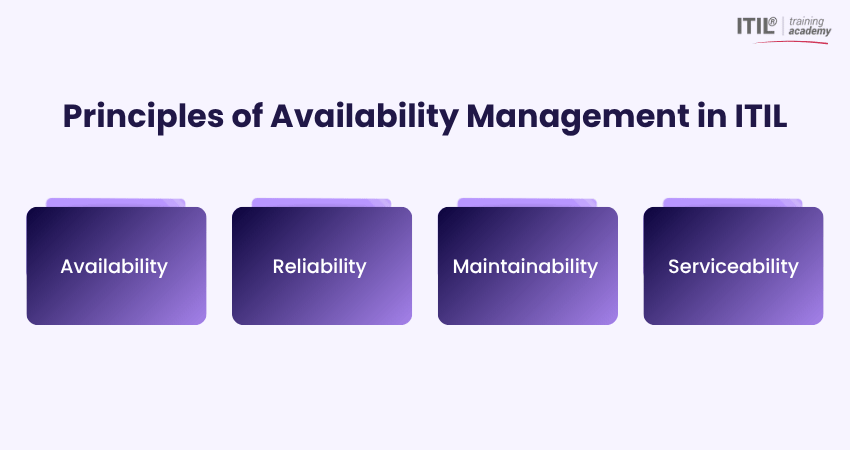
To effectively manage availability, organisations focus on four key concepts that directly influence service performance and the business perception of reliability:
1) Availability
Availability refers to the ability of a service, component, or configuration item to perform its agreed function whenever it is needed. Simply put, it measures whether a service is accessible and operational when users require it.
2) Reliability
Reliability measures how consistently a service or component can perform its intended function without interruption over a given period. A highly reliable service experiences fewer failures and provides a more consistent user experience. Higher reliability reduces unexpected downtime and improves overall service stability. ITIL Problem Management can contribute to reliability by addressing the root causes of repeated failures.
3) Maintainability
Maintainability is a measure of how quickly and efficiently a service or component can be restored after a failure occurs. The faster a system can be repaired and returned to normal operation, the higher its maintainability. This is often supported by well-defined support processes, skilled teams, and efficient diagnostic tools.
4) Serviceability
Serviceability relates to the performance of external suppliers or vendors. It measures their ability to meet agreed contractual commitments, including targets for availability, reliability, and maintainability. Strong serviceability ensures that third-party services support the organisation's overall availability objectives. Effective vendor management and clear Service Level Agreements (SLAs) play a key role in ensuring strong serviceability.
Learn how to design, build, deliver, and improve products that create lasting business value with the ITIL® 5 Product Certification Course - Sign up now!
Benefits of Availability Management in ITIL
Proper Availability Management delivers significant value to both IT teams and the business by ensuring that services remain accessible, reliable, and resilient. Some of the key benefits include:
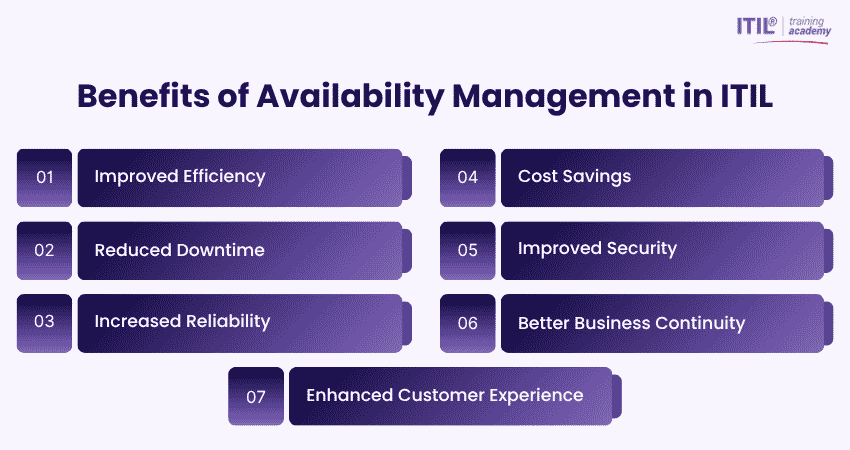
1) Improved Efficiency: Availability Management helps organisations address potential issues before they escalate into major problems. By reducing unexpected disruptions, IT teams can focus more on delivering value.
2) Reduced Downtime: By continuously monitoring infrastructure health, Availability Management enables teams to detect and resolve issues early. This proactive approach helps keep critical systems available and running smoothly.
3) Increased Reliability: Availability Management ensures that services perform consistently and meet agreed service levels. Reliable systems boost the user experience and build confidence in IT services.
4) Cost Savings: Reducing service outages and minimising downtime can lead to substantial cost savings. Organisations spend less on emergency fixes, system recovery efforts and unplanned maintenance.
5) Improved Security: Availability Management contributes to a stronger security posture by continuously monitoring systems for risks that could impact service availability. Early detection and prompt resolution of potential threats help protect business-critical services.
6) Better Business Continuity: By identifying availability risks and implementing appropriate resilience measures, Availability Management helps organisations maintain critical services during unexpected events.
7) Enhanced Customer Experience: When services are consistently available and perform as expected, users can work without interruption. This leads to improved customer satisfaction and a stronger reputation for the organisation.
Challenges of Availability Management in ITIL
Although Availability Management is essential for delivering reliable IT services, it comes with its own set of challenges.
1) Managing High Business Expectations: Today, businesses expect IT services to be available almost all the time. In many cases, stakeholders assume close to 100% availability and expect services to recover quickly whenever an outage occurs.
2) Making Sense of Large Amounts of Data: Modern IT environments generate huge volumes of monitoring and performance data. One of the biggest challenges is collecting, consolidating and analysing this information in a way that provides meaningful insights.
3) Driving Collaboration Across Teams: Availability requires coordination among infrastructure, application, network, security, operations, and vendor teams. However, Availability Management teams may not always have the authority or influence needed to drive changes across all these groups.
4) Balancing Availability and Cost: Higher availability often comes at a higher cost. Features such as redundancy, failover mechanisms, disaster recovery solutions, and advanced monitoring tools require significant investment.
5) Keeping Up with Change: IT environments are constantly evolving with new applications, upgrades, cloud migrations, and infrastructure changes. Each change has the potential to impact service availability.
Already ITIL® 4 certified? It's time to bridge the gap to ITIL® Version 5. Sign up for our ITIL® Version 5 Foundation Bridge Training now!
Examples of Availability Management in ITIL
Here are some common areas where Availability Management plays an important role:
1) Architectural Design: Designing resilient IT infrastructure with redundancy, failover mechanisms, and scalable components to minimise service disruptions.
2) Problem Management: Identifying the root causes of recurring incidents and implementing permanent solutions to improve long-term service availability.
3) Site Reliability Engineering (SRE): Applying Engineering principles, performance monitoring, and automation to maintain highly reliable and scalable services.
4) Information Security Strategy Development: Developing security strategies that protect systems from threats while ensuring critical services remain continuously available.
5) Information Security Management: Implementing security controls, monitoring risks, and maintaining secure environments without compromising system uptime.
6) Data Administration: Managing databases, backups and data recovery processes to ensure information remains accurate and available when needed.
7) DevOps: Using automation, continuous monitoring, and streamlined deployment practices to improve application reliability and minimise downtime.
Roles & Responsibilities in Availability Management
Availability Management involves several roles working together to ensure IT services remain accessible and aligned with business requirements:
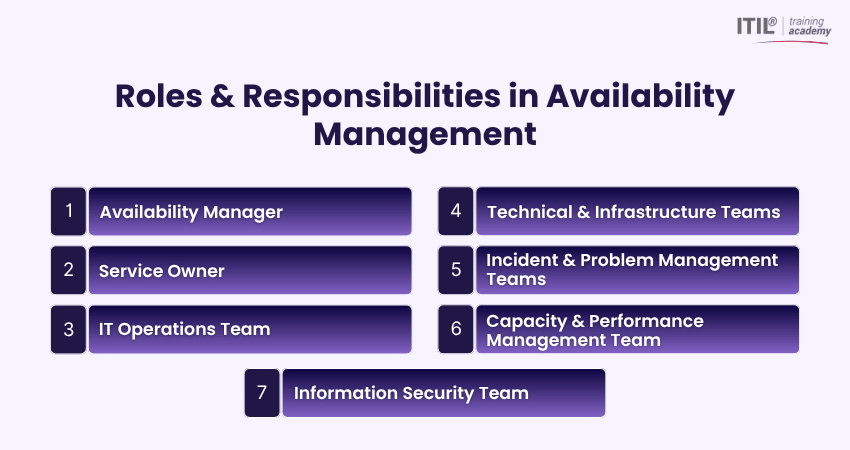
1) Availability Manager: The Availability Manager oversees the entire Availability Management practice. They define availability requirements, create availability plans, monitor service performance, analyse trends, and recommend improvements to ensure agreed service availability targets are consistently achieved.
2) Service Owner: The Service Owner is responsible for ensuring that individual IT services meet their agreed availability targets. They work closely with technical teams, coordinate improvements, and ensure services continue to support business needs.
3) IT Operations Team: The IT Operations team monitors infrastructure and services, responds to operational issues, performs routine maintenance, and restores services quickly during outages to minimise downtime.
4) Technical and Infrastructure Teams: Technical specialists design resilient infrastructure, implement redundancy and failover solutions, maintain hardware and software components, and resolve technical issues that could affect service availability.
5) Incident and Problem Management Teams: These teams investigate service interruptions, restore services as quickly as possible, identify root causes of recurring incidents, and implement permanent fixes to reduce future availability issues.
6) Capacity and Performance Management Team: This team ensures IT resources have sufficient capacity and performance to meet current and future business demands. They monitor resource utilisation, forecast growth and recommend upgrades before performance affects availability.
7) Information Security Team: The Information Security team protects services from cyber threats by implementing security controls, managing risks, and supporting secure system availability without compromising business operations.
Conclusion
Availability Management is the backbone of dependable IT services as it helps organisations minimise downtime, improve resilience and meet business expectations every time. By following ITIL principles and adopting proactive practices, businesses can boost user satisfaction. Investing in it today builds a stronger, more reliable IT environment for tomorrow.
Upgrade your IT Service Management expertise and stand out in a competitive job market. Start your journey with our ITIL® Foundation Level Training - Sign up now!
Frequently Asked Questions?
Availability Management activities include:
a) Defining availability requirements
b) Monitoring service performance
c) Analysing downtime
d) Identifying availability risks
e) Creating availability plans
f) Improving system resilience
g) Reporting on service availability
In ITIL, the Availability Management practice is responsible for managing the availability of IT services. It ensures services consistently meet agreed availability targets by monitoring performance, improving resilience, reducing outages and supporting reliable service delivery aligned with business needs.
Most Recent
Date - Aug 1, 2026
Date - Jul 18, 2026
Date - Jul 11, 2026