


 Back to
Topics
Back to
Topics


40% OFF Offer Ends Soon
Claim Now
About Course Information
The ITIL® (Version 5) Managing Professional (MP) Transition Course explores how updated ITIL practices support organisations in delivering reliable, value-driven services while responding to rapid technological change and increasing business demands.
The Learning Curve
The ITIL® (Version 5) Managing Professional Transition Certification explores how organisations manage digital products and services across the lifecycle. It focuses on value creation and experience management within modern digital environments. The course also introduces key ITIL concepts, value chain activities, and AI-enabled service management practices.
This instructor-led training builds practical understanding of the ITIL Product and Service Lifecycle. It covers discovery, design, transition, operation, delivery, and support activities alongside experience management and AI governance concepts. The course also highlights how ITIL®, DevOps, and PRINCE2® support effective digital service management.
We support delegates throughout their learning journey to build confidence in applying ITIL® 5 practices within organisational environments. The course strengthens decision-making and improves experience-focused service delivery capabilities. It enables professionals to contribute effectively to digital transformation and continual service improvement initiatives.
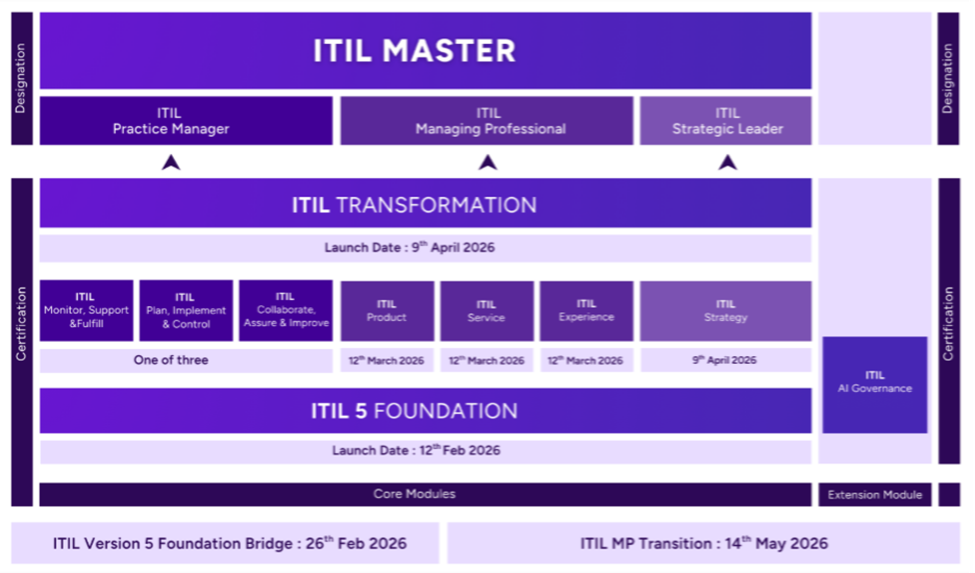
Here is the launch schedule for ITIL® (Version 5) Courses:
1) ITIL® 5 Foundation: 12 February 2026
2) ITIL® 5 Foundation Bridge: 26 February 2026
3) ITIL® 5 Product, ITIL® 5 Service, ITIL® 5 Experience: 12 March 2026
4) ITIL® 5 Strategy: 9 April 2026
5) ITIL® 5 Transformation: 9 April 2026
6) ITIL® 5 Managing Professional (MP Transition): 14 May 2026

Delegates must have completed the ITIL® Version 4 Managing Professional (MP) Transition Certification or be working in a managerial-level IT service management role before attending this course. This prior experience helps professionals understand the updated practices, governance concepts, and value-driven approaches introduced in the ITIL® Version 5 framework.
Module 1: Key ITIL terms and definitions
-
Key Concepts of ITIL
- Explain the ITIL Guiding Principles
- Understand the ITIL Product and Service Lifecycle
- Describe the ITIL Four Dimensions of Product and Service Management
- Explain the components and purpose of the ITIL Value System (ITIL VS)
-
Introduction to Digital Products and Services
- Understand the Key Concepts of Digital Products and Services
- Characteristics of Digital Products
- Characteristics of Digital Services
- How Digital Products and Services Create?
- Scope and Purpose of the ITIL Product and Service Lifecycle Model
- Lifecycle Management Activities of a Digital Product
- Lifecycle Management Activities of a Digital Service
- How an Organisation's Value Chain Activities Support the ITIL Product and Service Lifecycle?
-
ITIL Product and Service Lifecycle Management Activities
- Purpose of each of the ITIL Product and Service Lifecycle Management Activities
- Benefits of each of the ITIL Product and Service Lifecycle Management Activities, from a Product Vendor Perspective
- Challenges of Each of the ITIL Product and Service Lifecycle Management Activities, from a Product Vendor Perspective
- Benefits of each of the ITIL Product and Service Lifecycle Management Activities, from a Service Provider Perspective
- Challenges of each of the ITIL Product and Service Lifecycle Management Activities, from a Service Provider Perspective
-
Key Concepts of Experience
- Understand Experience as Human Responses
- Explain Digital Experience and the ITIL Experience Model
- Understand Anticipation, Perception and Evaluation in the Context of Experience Management
Module 2: The Value Chain Activities
-
Key Concepts and Practices
- Understand the Key Concepts of Each of the Value Chain Activities
- Practices Enabling Each Activity and Their Role in that Activity
- How Vision, Positioning, and Portfolio inform Discovery
- Difference Between Acquisition of Technology, People, and Third-Party Services
- Integration of Design into 'Build' Activity
- Service Delivery in the Product Lifecycle
- How Service Delivery Activities Enable Value Co-Creation
-
Execution Steps and Outputs
- Describe the Typical Outputs of Each Activity
- Apply the Steps of Each Activity
-
Success Factors and Metrics
- Explain the Critical Success Factors (CSFs) and metrics of each activity
- Apply Recommendations for Effective/Successful Discovery
- Apply Recommendations for Effective Design
- Apply Recommendations for Effective Acquisition
- Apply Recommendations for Effective Build
- Apply Recommendations for Effective Transition
- Apply Recommendations for Effective Operation
- Apply Recommendations for Effective Delivery
- Apply Recommendations for Effective Support
-
Managing the End To-End Lifecycle
- Describe how Operating Models Distribute Responsibilities
- key Concepts of the Product Vendor's Value Streams
- key Concepts of the Service Provider's Value Streams
- how Value Streams Integrate Lifecycle Stages
- Apply Principles of Organisational and Technology Enablement Across the Lifecycle
- Digital Product Management Success Factors
- Digital Service Management Success Factors
- Apply an Appropriate Organisational Structure to Support Successful Product Management
- Apply an Appropriate Organisational Structure to Support Successful Service Management
Module 3: ITIL Experience
-
Experience and the ITIL Four Dimensions
- Explain How Experience Integrates/Influences/is Reflected in all ITIL Four Dimensions
- Understand How to Improve Experience Through each of the ITIL Four Dimensions
- Apply the ITIL Four Dimensions as a Governance Lens for Experience Improvement
-
Experience in the ITIL Product and Service Lifecycle
- Explain How the Value Chain Activities (Discover, Design, Acquire, Build, Transition, Operate, Deliver, Support) Create Experience Moments
- Explain functional and relational interactions
- Apply Stakeholder Role Mapping to Identify Differing Trust Requirements Across the Journey Steps
- Differentiate Functional vs Relational Interactions
-
Key Concepts of Experience Capture
- key Experience Stakeholders’ Roles: Consumer and Provider, and the Provider Consumer Tensions
- Consumer Stakeholders’ Roles: Users, Customers, and Customer Sponsors, as Well as the Consumer-Side Tensions
- Explain the Provider Stakeholders’ Roles: Agent, Principal, Provider Sponsor, Enabler, as well as the Provider Side Tensions
- Concept of Experience Capture
- Why Experience Capture is Partial and How Metrics are Hypotheses?
- Four Experience Domains: Personal, Functional, Relational, Contextual
-
Experience Evidence
- Describe the Types and Sources of Experience Evidence
- Describe the Three Tiers of Data and Numerical and Narrative Signals
- Understand Direct, Indirect, and Synthetic Capture Techniques
- Understand How to Assess the Quality of Experience Data
- Apply Trustworthiness and Coherence Criteria to Evaluate Experience Evidence BL
- Common Anti Patterns in Experience Capturing
- Roles for Capturing Experience
- Tools for Capturing Experience
-
Service Relationships, Agreements, and Journeys
- Understand Service Relationships and Types of Service Relationships from the Experience Perspective
- Understand Service Agreements and Types of Agreements from the Experience Perspective
- Identify the Four Experience Domains: Personal, Functional, Relational, Contextual
-
Organisations
- Understand the Service Journey from the Experience Perspective
- Understand How Relationship Types Influence the Service Journey
- Seven Steps of The Service Journey from The Service Consumer’s and the Service Provider's Perspectives
-
Stakeholders
- Purpose and the Structure of the Stakeholder Journeys
- Consumer Stakeholder Journey, the Concerns, and the Common Anti Patterns in Each Journey
- Practical Implications for Consumers for Each Journey Type
- Provider Stakeholder Journey, the Concerns, and the Common Anti-Patterns in Each Journey
- Describe the Practical Implications for Providers for Each Journey Type
- Apply the ITIL Service Journey Model to Map Experience Signals Across Provider and Consumer Perspectives
-
Digital Experience Improvement
- Apply the Notice – Interpret – Hypothesize – Experiment Loop within the ITIL Continual Improvement Model
- Differentiate Improvements by the System Versus Improvements to the system
- Role of Trust and Psychological Safety in Experience Improvement
Module 4: ITIL and AI
-
AI Governance
- Understand the ITIL AI Capability Model
- how AI Governance Supports Experience
-
Use of AI within the ITIL Context
- How AI and Automation affect methods and tools used for product management?
- How the Use of AI can Support Product Management?
- How the Use of AI can Support Service Management?
- How AI and Automation Affect Methods and Tools used for Service Management?
- How the use of AI can Benefit Experience Management?
- Relationship Between AI Governance and Digital Ethics in Experience Management
Module 5: ITIL and other frameworks
-
ITIL and DevOps
- Understand How ITIL and DevOps can be used Together
- How ITIL and DevOps are Complementary in the Management of the Product and Service Lifecycle?
-
ITIL and PRINCE2
- Understand why Project Management is Important in ITIL
- How ITIL and PRINCE2 are Complementary in the Management of the Product and Service Lifecycle?
- Understanding the key updates introduced in the ITIL® Version 5 framework
- How modern service management practices support value-driven service delivery
- Approaches for aligning service management with governance and organisational strategy
- Methods for improving service performance and operational efficiency
Course Highlights
-
 Duration: 2 Days
Corporate Training
Train you team with ITIL® (Version 5) Managing Professional (MP) Transition Certification Course aligned to your business goals. Enhance performance, drive efficiency, and scale IT capabilities across your organisation.
Upcoming Batches
Manchester(2 Days)
Mon 12 Oct 2026
Tue 13 Oct 2026


Bristol(2 Days)
Mon 12 Oct 2026
Tue 13 Oct 2026
Belfast(2 Days)
Mon 12 Oct 2026
Tue 13 Oct 2026
Dublin(2 Days)
Mon 19 Oct 2026
Tue 20 Oct 2026
Mon 2 Nov 2026
Tue 3 Nov 2026
(2 Days)
Virtual Training
Manchester( 2 days)
Mon 12 Oct 2026
Tue 13 Oct 2026
Bristol( 2 days)
Mon 12 Oct 2026
Tue 13 Oct 2026
Belfast( 2 days)
Mon 12 Oct 2026
Tue 13 Oct 2026
Dublin( 2 days)
Mon 19 Oct 2026
Tue 20 Oct 2026
Trusted Across Globally

10,000+ Global Learners
Professionals across industries rely on us to advance their careers with confidence.

5,000+ Corporate Clients
Trusted by leading organisations to upskill teams, drive performance, and meet business goals.

40+ Industry-Leading ITIL® Courses
Covering IT, Service Management, Leadership, and more — all accredited and up to date.

190+ Countries & 490+ Locations
Seamless training delivery anywhere in the world — virtual or onsite.
What’s Included
Gain everything you need to succeed in your ITIL Certification journey, from expert instruction to Certification support and post-training access.
No data available
Virtual Classroom Training

Virtual Classroom
You can join live classroom training (virtual) while staying at your home and feel safe.

More Affordable
An affordable way of learning while saving your travel and accommodation expenses.

Expert Instructor Support
A dedicated instructor will be assigned throughout the training, to guide for any issues.

More Convenient
A more convenient way of learning from any location with extra comfort.
Not Sure Which Course Is Right for You? Let Our Experts Guide the Way
Do you have questions about Certifications or Training formats? Our experts are here to help you make the right choice for your career.
Frequently Asked Questions?
The ITIL® (Version 5) Managing Professional (MP) Transition Course helps ITIL professionals update their knowledge to align with the latest evolution of the ITIL framework. It focuses on modern service management practices, value-driven service delivery, and updated lifecycle concepts.
The ITIL® (Version 5) Managing Professional (MP) Transition Course is scheduled to launch on 14th May 2026. To join the waitlist or receive updates, please contact our support team.
This course is suitable for experienced IT service professionals who want to update their knowledge according to the latest ITIL framework. It is particularly relevant for IT Service Managers, Service Delivery Managers, IT Consultants, IT Operations Professionals, and other professionals responsible for managing IT-enabled services.
Yes. This course is designed for experienced ITIL professionals. Delegates are recommended to hold the ITIL® Version 4 Managing Professional Transition Certification or have equivalent managerial experience in IT service management.
The ITIL® (Version 5) Managing Professional (MP) Transition Course helps ITIL professionals update their knowledge to align with the latest evolution of the ITIL framework. It focuses on modern service management practices, value-driven service delivery, and updated lifecycle concepts.
This course is suitable for experienced IT service professionals who want to update their knowledge according to the latest ITIL framework. It is particularly relevant for IT Service Managers, Service Delivery Managers, IT Consultants, IT Operations Professionals, and other professionals responsible for managing IT-enabled services.
Yes. This course is designed for experienced ITIL professionals. Delegates are recommended to hold the ITIL® Version 4 Managing Professional Transition Certification or have equivalent managerial experience in IT service management.
This course covers ITIL value chain activities, digital products and services, experience management, AI governance, service relationships, and lifecycle management concepts. It also explores the integration of ITIL®, DevOps, and PRINCE2® within modern service management environments.
Completing this course helps professionals strengthen their understanding of modern IT service management practices. It also supports improved decision-making, enhanced service delivery, and effective contribution to digital transformation initiatives.
The course explains how ITIL® practices support organisational transformation through value-driven service delivery, lifecycle management, and experience-focused approaches. It also introduces AI governance concepts relevant to modern digital environments.
Yes. The course includes modules related to AI governance, automation, and the role of AI in product, service, and experience management. It explores how AI supports service optimisation and operational efficiency.
Yes. The course is highly suitable for Service Delivery Managers who want to strengthen their understanding of service lifecycle management, experience improvement, and digital service optimisation practices.
The course explains how ITIL®, DevOps, and PRINCE2® complement each other in managing digital products and services. It highlights how these frameworks support governance, collaboration, and continual improvement across service lifecycles.
Delegates can gain practical knowledge of ITIL lifecycle activities, experience management, service relationship management, and AI-enabled service practices. The course also develops governance, operational, and continual improvement capabilities.
This course can support roles related to IT service management, service delivery, IT operations, digital transformation, and service governance. It is beneficial for professionals aiming to progress into senior ITSM and digital service leadership positions.
Related Courses

ITIL® Training Academy is a premier destination for ITIL® courses. From beginners to seasoned professionals, we offer expert-led training across all levels.

Training
ITIL® Courses on this website are offered by The Knowledge Academy, an Accredited Training Organisation (ATO) of PeopleCert. ITIL® is a registered trade mark of PeopleCert. All rights reserved
© Copyright 2026 - Pentagon Training Limited - All Rights Reserved


Unlock up to 40% off today!