


 Back to
Topics
Back to
Topics



Author-Maria Thompson

Last updated-Aug 1, 2026
Think of a busy airport. Passengers expect flights to depart on time, baggage to arrive safely, and check-in counters to operate efficiently. Behind this smooth experience are two separate teams. One that maintains the runways, aircraft systems, and airport infrastructure and the other that manages passenger services, boarding, and customer support.
Modern Information Technology (IT) operates a lot in the same way. IT Operations Management (ITOM) keeps the technology infrastructure running reliably, and IT Service Management (ITSM) focuses on delivering high-quality IT services to users. Although both are essential areas of IT Management, they serve distinct purposes. In this blog, we'll compare ITOM vs ITSM, explore their key differences, and explain how they work together to support modern organisations. Read on!
Table of Contents
1) What Is ITOM?
2) What Is ITSM?
3) What are the Differences Between ITOM and ITSM?
4) Key Similarities Between ITOM and ITSM
5) How ITOM and ITSM Work Together
6) Conclusion
What is ITOM?
IT Operations Management (ITOM) is the practice of managing and maintaining an organisation's IT infrastructure, applications, systems, and operational resources. Its primary objectives are to monitor the availability, capacity, performance, and overall health of networks, servers, databases, storage systems, applications, and cloud environments.
Key Concepts of ITOM
ITOM keeps IT infrastructure stable and performing efficiently. Its core concepts include:
1) Proactive Monitoring: Rather than waiting for something to break, ITOM continuously tracks the IT environment to catch up on potential issues early before they disrupt users.
2) Automation and Orchestration: Routine ITOM tasks largely depend on automation, cutting down on manual work, reducing human error, and making it easier to scale.
3) Operational Visibility: ITOM gives you a clear view of your infrastructure, making it easier to identify possible blockages, use resources efficiently, and stay compliant.

Objectives of ITOM
ITOM aims to keep IT infrastructure reliable and efficient. Its key objectives include:
1) Maintain System Reliability: Keep infrastructure available and performing well while minimising unplanned downtime.
2) Optimise Resource Use: Ensure servers, storage, and networks are neither overprovisioned nor stretched too thin.
3) Increase Operational Efficiency: Reduce the amount of manual work required to keep systems running smoothly.
4) Support Scalability: Prepare infrastructure to support business growth without a proportional increase in operational strain.
Key ITOM Processes
ITOM includes several core processes that help monitor, manage and optimise IT infrastructure. The key processes include:
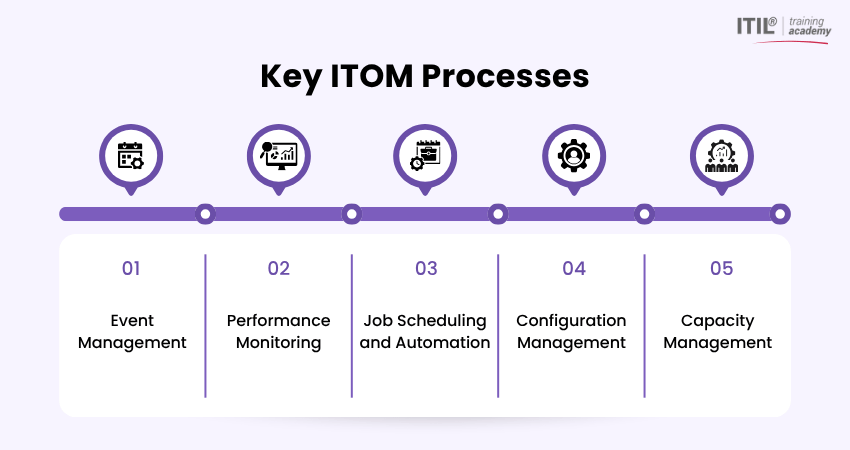
1) Event Management: Collecting and analysing signals from infrastructure to spot potential problems early.
2) Performance Monitoring: Tracking system performance and health to detect potential issues before they affect operations.
3) Job Scheduling and Automation: Handling repetitive maintenance tasks like backups and updates without manual intervention.
4) Configuration Management: Maintaining a proper record of IT assets and how they relate to one another.
5) Capacity Management: Forecasting future infrastructure needs, so systems aren't caught off guard by growth or demand spikes.
ITOM Example
Imagine a company that has an online shopping website. This website is running on a group of cloud servers. When the company launches a product, many people visit the website at the same time and the traffic is more than what the website gets in general.
A tool that watches over the website finds that the servers are using 90% of their available memory. The system sends out a warning and launches additional servers to handle all the extra people on the website. Nobody has to report a problem. Nobody complains because the website just works fine because ITOM is doing its job well.
What is ITSM?
IT Service Management (ITSM) is the practice of designing, delivering, managing, and improving IT services to meet the needs of users and organisations. ITSM treats IT not as a collection of tools and systems, but as a service that should be continually refined, much like any other business service. It is the layer that most employees interact with when filing a help desk ticket, requesting new software, or reporting that an application is not working.
Key Concepts of ITSM
ITSM practices are generally guided by three core concepts:
1) Service-centric Thinking: IT exists to serve the needs of users, whether that is employees, customers, or partners, and success is measured by how well those needs are met.
2) Structured Processes: ITSM relies on defined workflows for handling requests and incidents consistently, instead of addressing problems only after they occur.
3) Continuous Improvement: ITSM teams regularly review and refine their processes to adapt as the organisation's needs evolve.
Objectives of ITSM
ITSM aims to deliver high-quality IT services that meet user and business needs. Its key objectives include:
1) Improve Efficiency: Streamline how requests and issues move through the organisation.
2) Enhance the User Experience: Deliver services that are reliable, easy to access, and meet expectations.
3) Reduce Risk and Downtime: Resolve problems quickly and prevent them from recurring.
Key ITSM Processes
ITSM consists of several key processes that ensure IT services are delivered, managed, and improved effectively. These include:
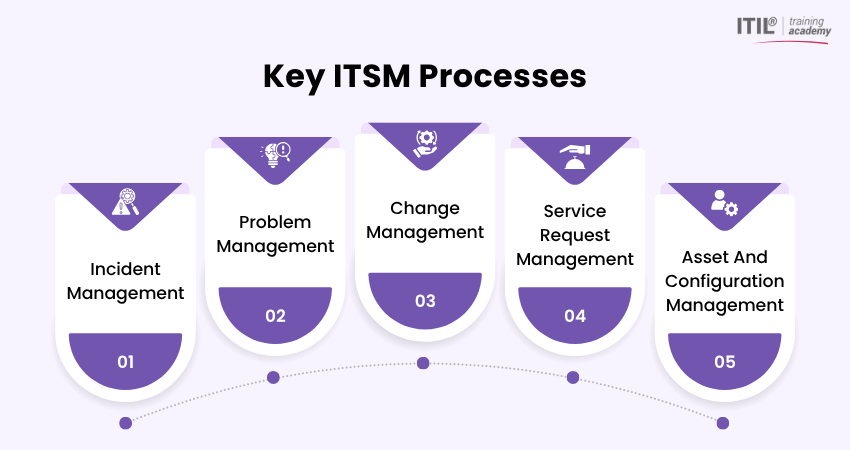
1) Incident Management: Restore normal service as quickly as possible when something goes wrong.
2) Problem Management: Find the root causes of recurring incidents to prevent them from happening again.
3) Change Management: Planning and testing changes to IT systems to avoid unintended disruption.
4) Service Request Management: Handling routine requests, like new software access or hardware provisioning.
5) Asset and Configuration Management: Keeping track of what IT assets exist and how they're used.
ITSM Example
Imagine an employee starts their workday only to find that their laptop isn't working. They report the issue to the company's IT help desk, providing details about the problem. The support team logs the request into an ITSM system, which helps them assess the issue, assign it to the right team, and track it until it is resolved.
The support team keeps the employee updated on the progress. Once the laptop is fixed, the issue is marked as resolved, and the company keeps a record of the issue for future reference.
Learn how to create efficient, user-focused IT services with ITIL® 5 Experience Certification Training – Sign up soon!
What are the Differences Between ITOM and ITSM?
Although ITOM and ITSM are closely related, they serve different purposes within an organisation. Understanding these differences helps organisations choose the right approach and ensure both their technology and services operate effectively.
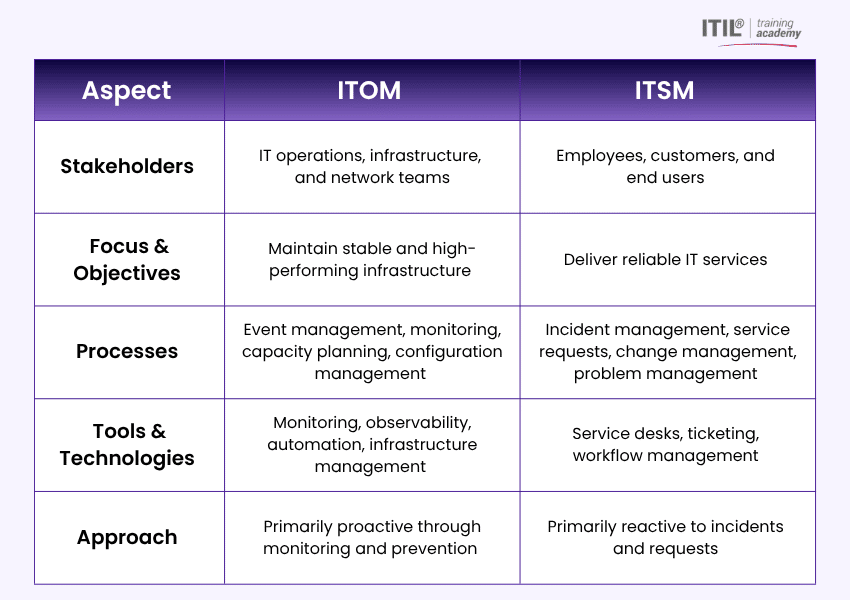
1) Stakeholders
ITOM is designed for teams responsible for managing IT infrastructure, including Infrastructure Engineers, operations teams, and Site Reliability Engineers (SRE) who need visibility into system health and performance. In contrast, ITSM is centred on the people using IT services, including employees, customers, and other end users who need a working laptop, access to applications, or timely support.
2) Focus and Objectives
ITOM focuses on managing the underlying IT infrastructure by keeping systems stable, scalable, and performing efficiently. ITSM, on the other hand, focuses on delivering high-quality IT services, aligning them with business goals, and ensuring a positive experience for users.
3) Processes
ITOM processes revolve around the technical foundation, including ITIL Event Management, performance monitoring, ITIL Capacity Management, and Configuration Management. ITSM processes revolve around user-facing needs such as Incident Management, Service Request Management, Change Management, and Problem Management. Overall, ITOM provides the groundwork that ITSM's processes depend on to deliver IT services.
4) Tools and Technologies
ITOM uses infrastructure monitoring, observability, automation, and configuration management tools to monitor system performance and maintain operational stability. In contrast, ITSM relies on service desk and ticketing platforms to handle incidents, service requests, and other user-facing processes. Although these tools serve different purposes, many modern platforms integrate both ITOM and ITSM capabilities.
5) Proactive vs Reactive
This is usually the clearest way to tell the difference between ITOM and ITSM. ITOM’s main goal is to find and fix problems before users even notice them. ITOM is really good at reducing the number of problems that ITSM teams have to fix. However, ITSM has always been about fixing things after they go wrong. It is mostly used to respond to problems and requests when they happen.
Develop the expertise to improve IT service delivery with ITIL® 5 Product Certification Training – Register today!
Key Similarities Between ITOM and ITSM
Despite their differences, ITOM and ITSM are similar in several important ways:
1) A Shared Goal: The main purpose of both ITOM and ITSM is to keep IT systems available, reliable and secure. This is what they are trying to do.
2) Overlapping Processes: Both include processes such as Incident Management, Problem Management, and Change Management. ITOM uses operational data to detect and prevent issues wherever possible, while ITSM manages incidents, service requests, and service improvements through structured processes.
3) A Shared Data Foundation: Both often use Configuration Management Databases (CMDB). This database helps both ITOM and ITSM understand how all the different IT assets work together. This is really important when they need to fix problems or figure out how a problem will affect things.
4) Automation: Both use automation extensively. They use it to make routine tasks easier and to make the system respond automatically when something happens.
5) Service Orientation: Although ITOM operates behind the scenes, both ITOM and ITSM ultimately aim to support reliable business services and ensure users can depend on IT systems.
How ITOM and ITSM Work Together?
ITOM and ITSM work together to keep both IT infrastructure and IT services running smoothly. ITOM continuously monitors systems, detects issues, and generates alerts. When it finds a problem that needs support, it can send the information to the ITSM system to create an incident.
The ITSM team then investigates the issue, keeps users informed, and works to resolve it. Together, ITOM helps prevent problems, while ITSM ensures any issues are managed quickly and efficiently.
Conclusion
ITOM and ITSM are both essential for delivering reliable and efficient IT services, but they play different roles. While ITOM focuses on keeping the underlying infrastructure stable and performing well, ITSM ensures users receive the support and services they need. Understanding how ITOM vs ITSM differ and work together helps organisations build a stronger IT environment and support long-term business success.
Build the skills to improve service quality with ITIL® 5 Service Certification Training – Join now!
Frequently Asked Questions?
Yes. ITOM supports IT Service Management (ITSM) and follows many of the best practices described in ITIL. While ITIL is a framework for managing IT services, ITOM focuses on the day-to-day operation, monitoring, and maintenance of the IT infrastructure that supports those services.
The traditional ITIL lifecycle defines five stages of IT Service Management (ITSM): Service Strategy, Service Design, Service Transition, Service Operation, and Continual Service Improvement. Together, these stages guide organisations in planning, delivering, operating, and continually enhancing IT services to meet business needs.
Neither ITSM nor ITOM is inherently better, as each serves a different purpose. ITSM prioritises delivering and improving IT services for users, while ITOM is responsible for managing and maintaining the underlying IT infrastructure. The correct decision depends on your career goals, skills, and areas of interest.
Most Recent
Date - Aug 1, 2026
Date - Jul 18, 2026
Date - Jul 11, 2026