


 Back to
Topics
Back to
Topics



Author-Maria Thompson

Last updated-Jul 18, 2026
Whether you're shopping online, attending a virtual meeting, or using a mobile banking app, you expect technology to work without interruption. The same expectation applies within organisations, where reliable IT services keep employees productive and customers satisfied. When these services fail, the impact can be immediate, affecting productivity, revenue, and customer trust.
This is where ITIL Service Management comes in. It provides proven best practices for delivering reliable, efficient, and customer-focused IT services. This blog explores its key features, importance, lifecycle stages, guiding principles, future trends, and key roles. Let's dive in and discover how it transforms modern IT service delivery.
What is ITIL Service Management?
ITIL Service Management is a framework of best practices that helps organisations plan, deliver, manage, and improve IT services effectively. It provides a structured approach to ensuring IT services support business objectives, meet customer expectations, and deliver consistent value.
By adopting Service Management in ITIL, organisations can improve service quality, increase operational efficiency, reduce risks, and support continual improvement. Its flexible approach enables businesses of all sizes to adapt to changing requirements while delivering reliable and customer-focused IT services.

Features of ITIL Service Management
ITIL Service Management provides a structured framework for delivering reliable, efficient, and customer-focused IT services. It helps organisations align IT services with business objectives while promoting continual improvement and operational excellence. Some of its key features include:
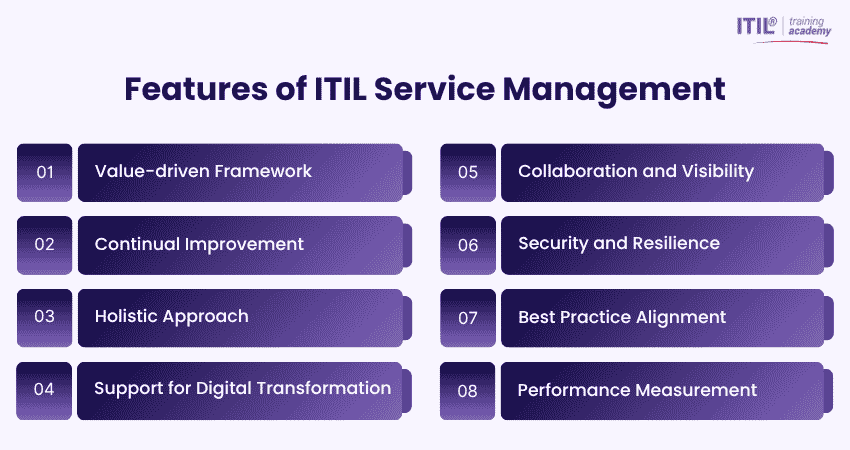
1) Value-driven Framework:
Helps organisations identify, plan, deliver, and support IT services that create value for customers and the business.
2) Continual Improvement:
Encourages regular review and enhancement of services, processes, and practices to meet changing business needs.
3) Holistic Approach:
Considers people, processes, technology, and partners to ensure effective Service Management.
4) Support for Digital Transformation:
Provides structured governance and change management to support digital initiatives and service improvements.
5) Collaboration and Visibility:
Promotes teamwork, stakeholder engagement, and transparency to improve decision-making and ITIL Service Delivery.
6) Security and Resilience:
Helps strengthen IT security, manage risks, and build resilient services that can withstand disruptions.
7) Best Practice Alignment:
Aligns IT services with recognised ITIL practices to improve consistency, governance, and efficiency.
8) Performance Measurement:
Uses defined metrics and KPIs to evaluate service performance and support continual improvement.
Take the next step towards IT excellence with the
ITIL® 5 Managing Professional (MP) Certification Path Training
– Sign up now!
Why is ITIL Service Management Important?
ITIL Service Management helps organisations align IT services with business objectives while delivering consistent value to customers. It improves service quality, reduces risks, optimises resources, and supports continual improvement. These benefits contribute to stronger business performance in several key areas:
1) Customer Satisfaction
ITIL places customer needs at the centre of service delivery by promoting consistent, reliable, and high-quality IT services. This helps organisations resolve issues faster, improve user experiences, and build stronger customer trust and loyalty. As a result, organisations can strengthen customer relationships and encourage long-term satisfaction.
2) Risk Management
ITIL helps organisations identify, assess, and manage potential risks before they affect business operations. Its structured practices reduce service disruptions, strengthen compliance, and improve overall business resilience. This helps organisations respond more effectively to unexpected challenges while minimising their impact.
3) Service Quality
ITIL establishes standardised practices for designing, delivering, and supporting IT services. This ensures services are reliable, efficient, and consistently meet agreed service levels and business expectations. It also helps organisations maintain consistent performance and continuously enhance service delivery.
4) Cost Efficiency
ITIL improves the use of IT resources by streamlining processes, reducing waste, and preventing unnecessary costs. This enables organisations to deliver high-quality services while making better use of budgets and available resources. Improved resource utilisation also supports sustainable business growth and operational efficiency.
5) Continuous Improvement
ITIL promotes a culture of continual improvement by encouraging organisations to regularly review service performance and identify opportunities for enhancement. This helps businesses adapt to changing technologies, customer expectations, and market demands while maintaining long-term service excellence.
ITIL 5 Service Management Lifecycle Stages
ITIL 5 Service Management adopts a unified Product and Service Lifecycle that guides organisations from identifying opportunities to delivering, supporting, and continually improving digital products and services. Its eight interconnected stages include:
1) Discover:
Identify business opportunities, customer needs, and market demands.
2) Design:
Create service designs, architectures, and user-focused solutions.
3) Acquire:
Obtain the tools, technologies, and resources required to deliver the service.
4) Build:
Develop, configure, and test products or services before deployment.
5) Transition:
Prepare and deploy services into the live environment with minimal disruption.
6) Operate:
Manage and monitor day-to-day service operations to ensure reliability.
7) Deliver:
Provide services consistently while meeting agreed service levels and customer expectations.
8) Support:
Resolve incidents, fulfil service requests, and provide ongoing assistance to maintain service performance.
Advance your Service Management career with the
ITIL® 5 Experience Certification Training
– Register now!
What are the Guiding Principles of ITIL Service Management?
The guiding principles of Service Management in ITIL are universal recommendations that help organisations improve decision-making, service delivery, and customer value. They can be applied across organisations of all sizes to support consistent, efficient, and customer-focused Service Management. These seven principles are:
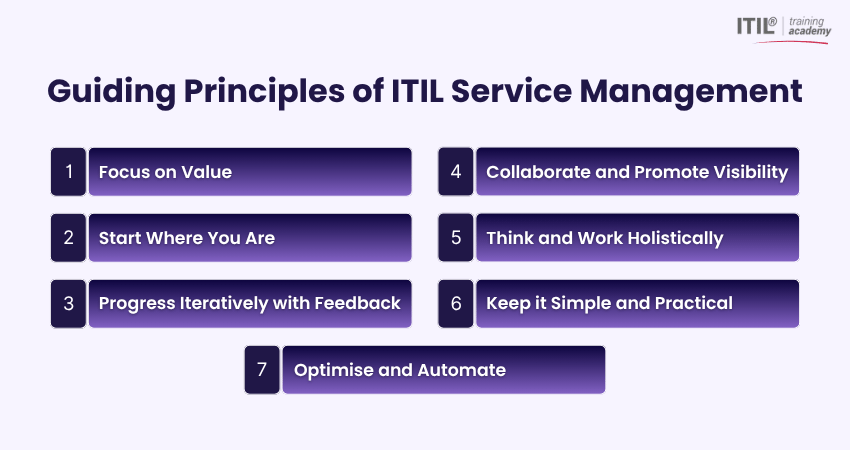
1) Focus on Value
The Focus on Value principle encourages organisations to ensure every activity delivers value to customers and stakeholders. By understanding customer needs and aligning services with business goals, organisations can improve satisfaction and achieve better outcomes.
2) Start Where You Are
This principle advises organisations to assess their existing processes, services, and resources before making changes. Building on what already works helps reduce unnecessary effort, minimise risks, and make better use of available capabilities.
3) Progress Iteratively with Feedback
ITIL recommends implementing improvements in small, manageable steps while gathering regular feedback from stakeholders. This approach reduces risks, supports continuous learning, and enables organisations to adapt quickly to changing requirements.
4) Collaborate and Promote Visibility
Effective collaboration and transparent communication help teams work towards common goals. Sharing information openly and involving stakeholders throughout the service lifecycle improves decision-making, builds trust, and leads to better service outcomes.
5) Think and Work Holistically
ITIL promotes an end-to-end approach to Service Management by recognising that people, processes, technology, and partners are interconnected. Considering the organisation as a whole leads to better collaboration and more effective service delivery.
6) Keep it Simple and Practical
This principle encourages organisations to remove unnecessary complexity and focus on solutions that deliver clear value. Simplifying processes improves efficiency, reduces waste, and makes services easier to manage and maintain
7) Optimise and Automate
Organisations should first optimise their processes before introducing automation. Combining efficient workflows with appropriate technologies helps improve productivity, reduce manual effort, and deliver more consistent services.
What are the Roles Within Service Management for ITIL?
Service Management in ITIL defines key roles that support the planning, delivery, and continual improvement of digital products and services. In ITIL (Version 5), these roles promote collaboration, accountability, and value creation while ensuring services meet business and customer needs. The key roles include:
1) Practice Owner
The Practice Owner is accountable for the overall success and continual improvement of an ITIL practice. They define the practice's vision, ensure it aligns with business goals, and oversee its governance, performance, and long-term development to maximise value and support organisational success.
2) Practice Manger
The Practice Manager is responsible for managing the day-to-day operation of an ITIL practice. They coordinate people, resources, and activities to ensure the practice operates efficiently and delivers consistent, high-quality outcomes that support business objectives and customer expectations.
3) Practice Practitioner
A Practice Practitioner carries out the activities and tasks within an ITIL practice. They apply best practices in their daily work, collaborate with other teams, and contribute to Continual Service Improvement by identifying opportunities to enhance services and processes while ensuring consistent and effective service delivery.
4) Service Owner
The Service Owner is responsible for the end-to-end management and performance of a specific service. They work with stakeholders to ensure the service meets business and customer requirements, monitor service performance, and drive improvements to maximise value throughout the ITIL Service Lifecycle.
Gain advanced ITIL skills to lead modern digital Service Management with confidence. Join for the
ITIL® 5 Product Certification Training
now!
What is the Future of ITIL Service Management?
The future of ITIL Service Management focuses on managing digital products and services through a unified lifecycle while creating greater business value. As digital transformation continues, ITIL is evolving to support AI, automation, and customer-focused Service Management. Key trends include:
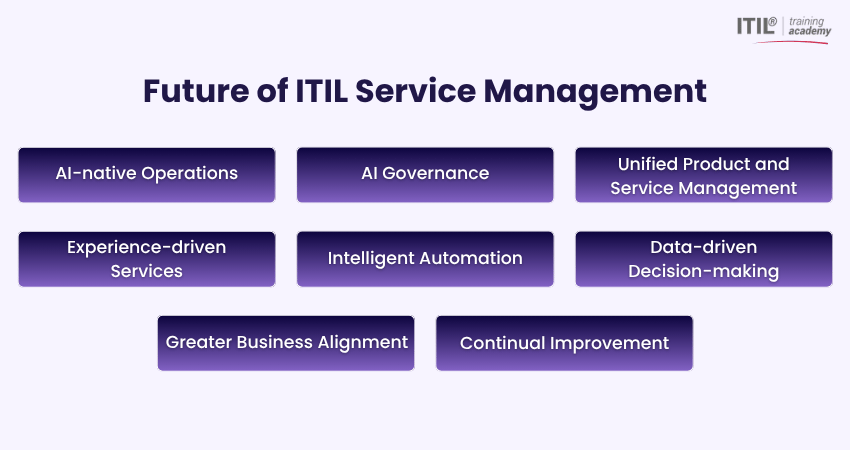
1) AI-native Operations:
AI will automate routine tasks, improve incident management, and support faster, data-driven decision-making.
2) AI Governance:
Organisations will adopt structured governance to ensure the responsible, secure, and compliant use of AI.
3) Unified Product and Service Management:
ITIL will integrate Product Development, service delivery, and operations into a single lifecycle.
4) Experience-driven Services:
Greater emphasis will be placed on improving customer and user experiences through continuous feedback and service enhancement.
5) Intelligent Automation:
Automation will streamline workflows, reduce manual effort, and improve operational efficiency.
6) Data-driven Decision-making:
Advanced analytics and real-time insights will help organisations monitor performance and make informed decisions.
7) Greater Business Alignment:
IT and business teams will collaborate more closely to deliver services that support organisational objectives.
8) Continual Improvement:
Organisations will continuously refine their products and services to adapt to evolving technologies and customer expectations.
Conclusion
Adopting ITIL Service Management helps organisations deliver reliable, customer-focused IT services while improving efficiency, governance, and continual improvement. By following its best practices and adapting to emerging technologies, businesses can enhance service quality, respond to changing demands, and create long-term value in an increasingly digital world.
Build practical IT Service Management expertise with the ITIL® Managing Professional Training – Register now!
Frequently Asked Questions?
IT Service Management improves customer experience by delivering reliable, efficient, and customer-focused IT services. It reduces downtime, speeds up issue resolution, and ensures consistent service quality. This helps organisations meet customer expectations, build trust, and increase overall satisfaction.
The four dimensions of Service Management are Organisations and People, Information and Technology, Partners and Suppliers, and Value Streams and Processes. Together, they help organisations deliver efficient, balanced, and customer-focused services while supporting continual improvement.
IT Service Management (ITSM) is the practice of designing, delivering, and managing IT services. ITIL is a globally recognised framework of best practices that helps organisations implement ITSM effectively. Simply put, ITSM is the approach, while ITIL provides the guidance to apply it.
Most Recent
Date - Aug 1, 2026
Date - Jul 18, 2026
Date - Jul 11, 2026