


 Back to
Topics
Back to
Topics



Author-Maria Thompson

Last updated-Jun 27, 2026
As an employee, there's nothing more frustrating than starting a workday with slow systems, confusing software and constant technical issues. We live in a digital-first world and technology plays a major role in shaping how employees feel and perform at work. This is where Digital Employee Experience (DEX) becomes essential. It’s about creating smooth, meaningful interactions between people and technology.
When done right, Digital Employee Experience can boost productivity, engagement and job satisfaction. This comprehensive blog explores what DEX really means, why it matters, and how organisations can design better digital experiences that truly support their workforce. So read on!
Table of Contents
1) What is Digital Employee Experience (DEX)?
2) Why is Digital Employee Experience Important?
3) Digital Employee Experience Components
4) Key Benefits of Digital Employee Experience
5) Common Challenges of Prioritising Digital Employee Experience
6) Tips for Creating Your Digital Employee Experience Strategy
7) Digital Employee Experience Examples
8) The Future of Digital Employee Experience
9) Conclusion
What is Digital Employee Experience (DEX)?
Digital Employee Experience (DEX) refers to the experience employees have when interacting with the digital tools and technologies they use at work. It reflects how effectively these tools enable employees to communicate, collaborate, complete tasks, and remain productive. As employees across all industries increasingly rely on technology, DEX plays a significant role in shaping the overall employee experience.
DEX covers employees' interactions with a wide range of workplace technologies, including workflow and productivity tools, communication and collaboration platforms, Learning and Development (L&D) solutions, Human Resources (HR) systems, enterprise applications, and IT support services. Even more, a strong DEX helps create efficient, engaging, and user-friendly digital workplaces.

Why is Digital Employee Experience Important?
Digital Employee Experience (DEX) has become inevitably important in recent years, especially as many organisations shifted from office-based work to remote setups. What started as a temporary change has now become a long-term reality, with companies recognising the productivity and cost benefits of remote and hybrid work.
At the same time, employees now rely on a mix of networks, devices and tools. When these technologies perform well and are supported by responsive IT services, employees are more likely to feel productive, engaged, and supported in their roles. Moreover, DEX helps reduce technical disruptions, improve collaboration, enhance employee satisfaction, and enable organisations to maintain high levels of performance across both remote and hybrid work environments.
Digital Employee Experience Components
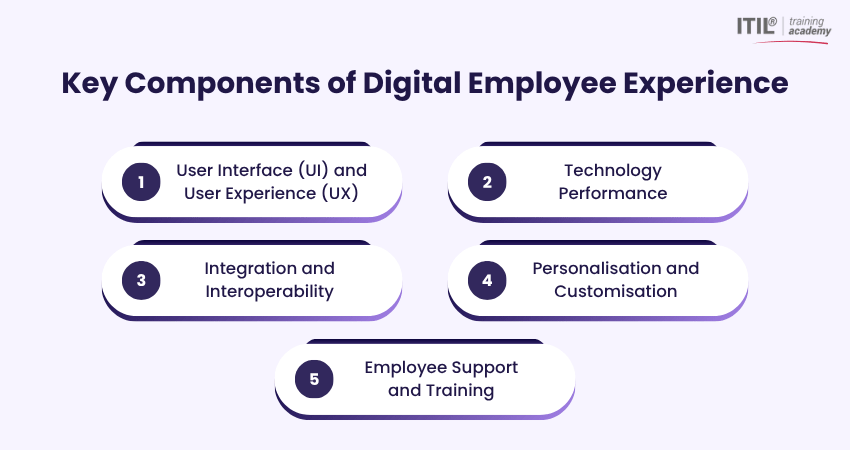
Simply having digital tools isn’t enough to create a great Digital Employee Experience. Those tools need to be easy to access and work smoothly so employees can actually enjoy using them. Here are the prime components that shape a strong DEX:
1) User Interface (UI) and User Experience (UX)
DEX starts with how easy and pleasant workplace tools are to use. Platforms must feel intuitive and visually appealing. It’s important to strike the right balance. A tool that looks great but crashes frequently, or one that’s organised but hard to navigate, can quickly create frustration.
2) Technology Performance
How well the tools and devices perform has a direct impact on productivity. Fast and responsive systems make it easier for employees to complete tasks and stay satisfied with their work experience.
3) Integration and Interoperability
Most employees rely on multiple tools to get their work done. When these tools integrate seamlessly, workflows become smoother and more efficient. Good integration also reduces manual Data Entry, thus minimising errors and saving time.
4) Personalisation and Customisation
Employees have a better experience when tools meet their needs. Features like personalised recommendations or customisable settings help reduce tedious effort and make tools more user-friendly. This flexibility allows employees to work in a way that suits them best.
5) Employee Support and Training
Even the best tools won’t help if employees don’t know how to use them properly. Providing the right training, guidance, and technical support ensures that employees can confidently use workplace technologies and maximise their value.
Upgrade your skills and expand your impact in IT excellence with ITIL® 5 Service Certification Training – Register today!
Key Benefits of Digital Employee Experience
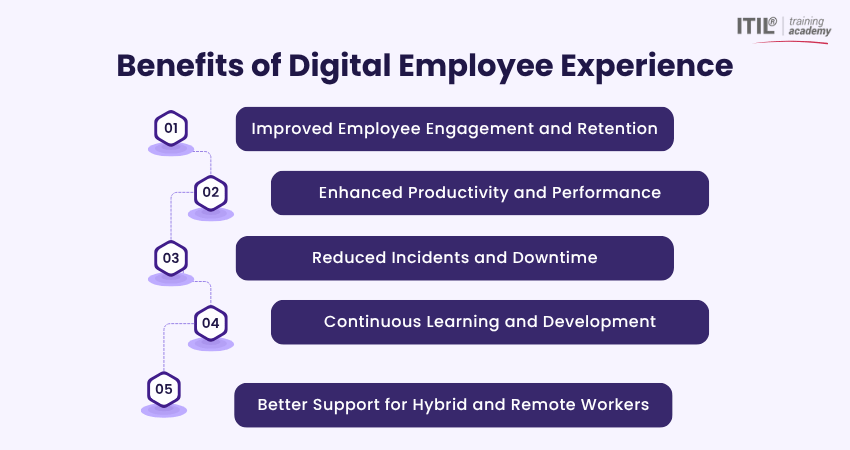
A strong Digital Employee Experience brings real value to both employees and organisations. It creates an environment where technology upholds collaboration and boosts productivity. Here are its key benefits:
1) Improved Employee Engagement and Retention
When employees have the right tools to do their jobs, it shows that the organisation values their work. This is the key to higher job satisfaction and stronger engagement. People who feel supported are more likely to stay longer, thus reducing turnover. Additionally, digital tools make it easier to share ideas and collaborate, helping employees feel connected regardless of their location.
2) Enhanced Productivity and Performance
When tools are intuitive, employees spend less time figuring things out and more time getting work done. The right technology streamlines tasks and keeps the workflows smooth. This empowers employees to produce higher-quality work with confidence. As a result, organisations benefit from improved efficiency, stronger performance, and increased productivity across teams.
3) Reduced Incidents and Downtime
Good DEX helps prevent technical problems before they disrupt work. Sometimes employees fix small issues themselves without reporting them, but these can point to larger underlying problems. DEX tools can detect such issues early, even if they go unreported, and alert IT teams. This proactive approach reduces downtime.
4) Continuous Learning and Development
A well-designed digital experience encourages continuous learning and professional development. With access to training programmes and online resources, employees can build new skills and grow in their roles. This keeps employees motivated and invested in their careers. It also helps organisations develop a more skilled and adaptable workforce.
5) Better Support for Hybrid and Remote Workers
As remote and hybrid work become the norm, DEX plays a big role in maintaining a strong work culture. For many employees, digital tools are their work environment. A good DEX ensures that everyone, despite their location, has equal access to collaboration and support, thus helping teams stay aligned.
Become a strategic product-driven IT professional with ITIL® 5 Product Certification Training – Sign up soon!
Common Challenges of Prioritising Digital Employee Experience
Building a strong Digital Employee Experience isn’t always straightforward. It comes with its own set of challenges and understanding them early can help you plan better. Here are the key challenges:
1) Cost
Creating a great DEX often requires a significant investment of time and money. To secure the needed budget, you’ll need to clearly show how these upfront costs will deliver value in both the short and long term.
2) Stakeholder Buy-in
One of the biggest hurdles is overcoming resistance to change. Leaders may hesitate to move away from familiar systems, so it’s important to demonstrate why digital transformation matters. At the same time, employees may need encouragement and time to adapt before they fully see the benefits.
3) Building the Right Tech Stack
Selecting the right tools is critical. The technology you choose should support both employee needs and business goals. Just as importantly, these systems must work well together. Otherwise, they can end up making things more complicated instead of simpler.
4) Change Management
Digital transformation brings a lot of change. Employees need training and existing workflows may need to be redesigned. Successfully managing this shift requires careful planning, clear communication and flexibility as the organisation adapts.
Tips for Creating Your Digital Employee Experience Strategy
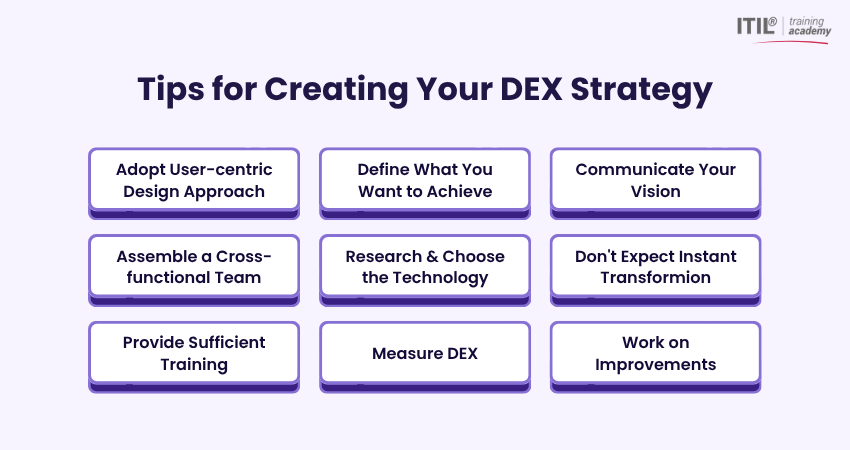
Every organisation’s path to building a great Digital Employee Experience will look a little different. But no matter where you start, there are a few tips that can guide your journey. Those tips include the following:
1) Adopt a User-centric Design Approach
Start by focusing on what your employees actually need. Digital tools should make their work easier, not more complicated. Gather feedback through focus groups, surveys, interviews, etc., to understand what’s working and what’s not. Involving employees early ensures the solutions truly help them.
2) Define What You Want to Achieve
Define what you want to achieve with DEX and how it supports your business. Think about the tools you need, the kind of experience you want to create and how you’ll measure success. A clear roadmap makes decision-making easier along the way.
3) Communicate Your Vision
For DEX to succeed, everyone needs to understand and support it. Get leadership buy-in early and communicate the benefits clearly across the organisation. A simple, clear message about your strategy can help build awareness and alignment.
4) Assemble a Cross-functional Team
DEX isn’t a one-team effort. Bring together people from HR, IT, communications, and other departments to drive the strategy. Different perspectives help create a more complete and effective solution.
5) Research and Choose the Technology
Pick tools that are easy to use, secure and aligned with your goals. Make sure they integrate well with each other to avoid unnecessary complexity. Testing options through demos or trials can help you make better decisions.
6) Don't Expect to Transform Everything at Once
When implementing DEX, try not to transform everything at once. Introduce changes step by step so employees have time to adapt. This approach helps reduce resistance and allows you to learn and adjust as you go.
7) Provide Sufficient Training
Make sure employees feel comfortable using new tools. Offer them training that fits different skill levels and cultivate an environment where asking questions is encouraged. The easier the adoption, the better the results.
8) Measure Digital Employee Experience
Regularly collect feedback to understand how employees feel about the tools they use and the overall digital workplace experience. Combine surveys with system data to identify what’s working and what needs improvement.
9) Work on Improvements
DEX is an ongoing process. Use insights from feedback and performance data to continuously refine and enhance the experience. Regularly reviewing outcomes and adapting to changing employee needs helps ensure that digital tools remain effective and relevant to organisational goals.
Bridge the gap to modern IT practices with ITIL® (Version 5) Managing Professional (MP) Transition Certification Course – Join now!
Digital Employee Experience Examples
Let’s check some real-world examples that show how improving DEX can transform the way organisations work and support their people:
1) Digital Internal Communication at Toolstation
Toolstation is a leading building supplies retailer that faced a major communication challenge across its distributed workforce. With teams spread across stores and warehouses, many employees didn’t have access to business email, making it hard to share important updates.
To create a more open and transparent culture, the company introduced a mobile-friendly communication app designed for deskless workers. This platform became a central space for updates, onboarding, chats, surveys, and company events. As a result, employees became more connected, better informed, and more engaged in day-to-day operations.
2) Embracing DEX at Accenture
Accenture focused on creating a seamless and personalised digital experience for its workforce. The goal was to make it easier for employees to embrace digital tools and feel confident using them.
They introduced a system to continuously measure and improve employee experience, used engaging formats like video to communicate updates, and offered a wide range of tools and support options to meet different needs.
They also placed strong emphasis on helping employees understand why new tools were important, encouraging smoother adoption. This approach helped employees make better use of digital tools, automate tasks, and find solutions more independently.
The Future of Digital Employee Experience
Looking ahead, Digital Employee Experience is set to evolve even further, especially with the rise of Artificial Intelligence (AI) and other emerging technologies. These advancements are expected to make workplace tools more personalised and engaging. That said, while AI holds a lot of promise, it’s still evolving. There’s plenty of excitement as well as uncertainty around what it can truly achieve. Here’s what the future holds for DEX:
1) More Personalised Experiences: AI can help tailor digital experiences by understanding how employees work and suggesting the right tools or training. This makes support more relevant and aligned with individual goals.
2) Smarter Virtual Assistants: AI-powered assistants can simplify everyday tasks such as answering questions, guiding users and helping solve problems quickly.
3) Better Collaboration Tools: AI is also improving how teams work together, especially in remote setups. From automating scheduling to summarising meetings and assigning tasks, it helps teams stay aligned and save time.
4) Data-driven Insights: With AI, organisations can better understand how employees interact with tools. These insights make it much easier to spot these issues early on and improve the overall experience in a more proactive way.
5) Continuous Learning and Development: AI-driven learning platforms can adapt to individual needs, offering personalised training based on progress and preferences. This encourages ongoing growth and keeps learning relevant.
6) Greater Accessibility and Inclusion: Advancements like real-time transcription and translation help make digital tools more accessible to everyone, supporting a more inclusive and diverse workplace.
Conclusion
Digital Employee Experience is the foundation of a modern workplace where people and technology work seamlessly together. When organisations invest in DEX, they unlock better engagement, smoother workflows and memorable outcomes. By continuously refining these experiences, businesses can create environments where employees thrive, adapt and grow with confidence.
Unlock the future of IT service excellence with ITIL® Managing Professional Courses - Register now!
Frequently Asked Questions?
Digital Employee Experience (DEX) improves retention by ensuring employees have seamless, efficient, and frustration-free digital interactions. When tools are reliable and user-friendly, productivity and satisfaction increase, stress decreases, and employees are more likely to stay engaged, loyal, and committed to their organisation.
DEX success can be measured using metrics such as employee satisfaction surveys, productivity levels, system performance, helpdesk ticket volumes, tool adoption rates and employee retention rates. Regular feedback and data analysis help organisations narrow down areas for improvement and track their progress over time.
DEX focuses specifically on employees' interactions with workplace technology, digital tools and systems. Employee Experience (EX) is broader and includes every aspect of an employee’s journey. It includes workplace culture, leadership, physical environment, well-being etc. DEX is an important component of the overall EX.
Most Recent
Date - Aug 1, 2026
Date - Jul 18, 2026
Date - Jul 11, 2026