


 Back to
Topics
Back to
Topics



Author-Maria Thompson

Last updated-Jun 24, 2026
In a world where digital services never stop, organisations cannot afford suppliers that operate like separate islands. From cloud providers and software vendors to cybersecurity specialists and support teams, modern businesses rely on multiple service providers to keep operations running smoothly. This is where Service Integration and Management (SIAM) comes in.
SIAM ensures all service providers work together towards shared business objectives. Want to know how this is achieved? Read on this blog to explore what is SIAM, how it works, its benefits and the key trends shaping its future. Let's dive in!
What is Service Integration and Management?
Service Integration and Management (SIAM) is a methodology designed to coordinate and govern services delivered by multiple internal and external providers. Its primary goal is to ensure that all service providers from both inside and outside your organisation work together to deliver a consistent and high-quality experience to end users.
SIAM acts as a layer between the organisation and its suppliers. Instead of managing every vendor separately, businesses use a central governance framework that integrates people, processes, technologies and suppliers into a single service ecosystem.
Why is Service Integration and Management (SIAM) Important?
SIAM is important because modern organisations often depend on multiple service providers to deliver critical business services. Without a structured approach, suppliers may work independently, leading to communication gaps, duplicated efforts, slower issue resolution, and inconsistent service quality.
To address this issue, SIAM helps bring all providers together under a common framework, ensuring they collaborate effectively and work towards shared business goals. It also improves governance, accountability and visibility across the entire service ecosystem. Moreover, by creating stronger coordination between suppliers, SIAM helps businesses increase operational efficiency, reduce risks, improve customer satisfaction, and adapt more easily to changing business needs.
Key Concepts of Service Integration
Understanding SIAM begins with understanding its core concepts. So, here are its concepts:
1) Governance: It establishes policies, standards, controls and accountability mechanisms that guide service providers. It ensures all suppliers follow agreed procedures and align with organisational objectives.
2) Service Integration: It focuses on coordinating activities across multiple providers. It creates seamless workflows and reduces operational fragmentation.
3) End-to-end Service Management: Instead of focusing on individual supplier performance, SIAM evaluates how services perform from the end user's perspective.
4) Collaboration: Collaboration is a central principle of SIAM. Suppliers must work together rather than operate in isolation.
5) Continuous Improvement: SIAM encourages organisations to monitor performance regularly and identify opportunities to improve service quality and efficiency.
6) Supplier Management:
Effective supplier management ensures providers meet contractual obligations, service levels and business expectations.
How Does Service Integration and Management (SIAM) Work?
SIAM works by creating a structured framework that brings together multiple service providers, business teams and governance functions. Let's check the steps involved in this process. This structured approach ensures smooth coordination, improved service quality, and better alignment with business objectives.
1) Coordinating Service Providers
In a SIAM environment, multiple suppliers may be responsible for different parts of a service. For example, one provider may manage cloud infrastructure, while another handles cybersecurity or application support. SIAM ensures these providers work together through shared objectives, clear communication channels and defined responsibilities.
This reduces operational silos, improves collaboration and helps deliver a seamless experience for end users. Effective coordination ensures that all service providers contribute to a unified and efficient service delivery model.
2) Using a Service Integrator
The service integrator acts as the central coordination function between the organisation and its service providers. It is responsible for managing supplier relationships, facilitating communication, monitoring service performance and resolving conflicts when they arise.
By providing a single point of oversight, the service integrator ensures all providers align with business goals and contribute to consistent service delivery. This central role improves accountability and strengthens overall service governance.
3) Standardising Processes
SIAM introduces common processes and procedures across all suppliers to create consistency in service delivery. Activities such as incident management, problem management, Itil Change Management, and service request handling follow agreed standards regardless of which provider is involved.
This helps reduce confusion, improve efficiency and ensure issues are managed in a structured and predictable manner. Standardisation enables smoother operations and improves service reliability across multiple providers.
4) Measuring Performance and Continuous Improvement
SIAM uses shared Key Performance Indicators (KPIs) and service targets to evaluate supplier performance. Regular monitoring and reporting provide visibility into service quality, operational efficiency and supplier effectiveness. In the same way, performance reviews help organisations identify areas for improvement and implement changes that enhance overall service delivery.
This focus on continuous improvement ensures the SIAM model remains effective as business needs evolve. Continuous evaluation helps organisations maintain high service standards and adapt to changing requirements.
Equip yourself with practical service management techniques with
ITIL® 5 Experience Certification Training
– Register today!
Understanding the SIAM Operating Model
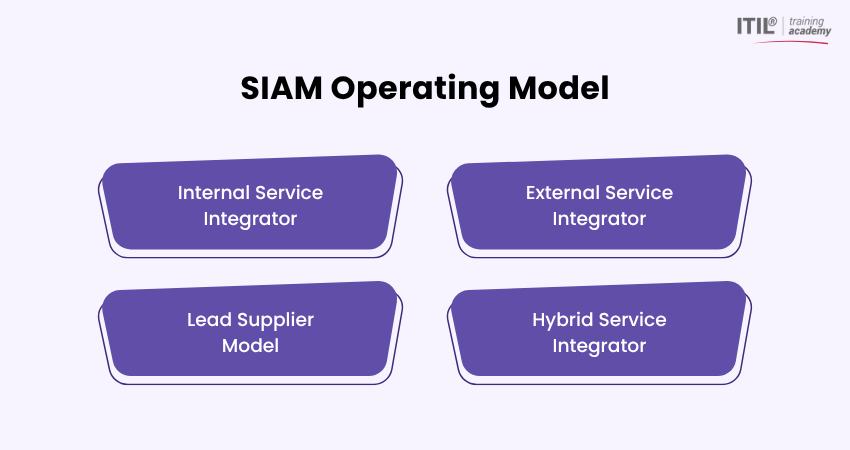
The SIAM operating model defines how service integration responsibilities are organised within an organisation. It determines who manages supplier relationships, governance, performance monitoring and service coordination across the multi-provider environment. Below are the most common operating models of SIAM:
1) Internal Service Integrator
In this model, the organisation manages the service integration function using its own employees and resources. This approach provides greater control over governance, supplier management and strategic decision-making. It is often preferred by organisations that want to retain ownership of critical service management activities.
2) External Service Integrator
Here, a third-party provider performs the service integration function. The external integrator coordinates suppliers, manages performance and oversees service delivery on behalf of the organisation. This model can be beneficial for organisations that lack internal SIAM expertise or resources.
3) Lead Supplier Model
In the lead supplier model, one of the existing service providers takes responsibility for coordinating other suppliers. This can simplify management and reduce operational overhead. However, organisations must ensure that the lead supplier acts fairly and does not prioritise its own services over others.
4) Hybrid Service Integrator
The hybrid model combines internal and external capabilities. Some integration responsibilities remain within the organisation, while others are handled by an external partner. This approach provides a balance between control, expertise, and operational flexibility. It is often adopted by organisations that want to retain strategic oversight while benefiting from SIAM resources.
What are the Benefits of SIAM?
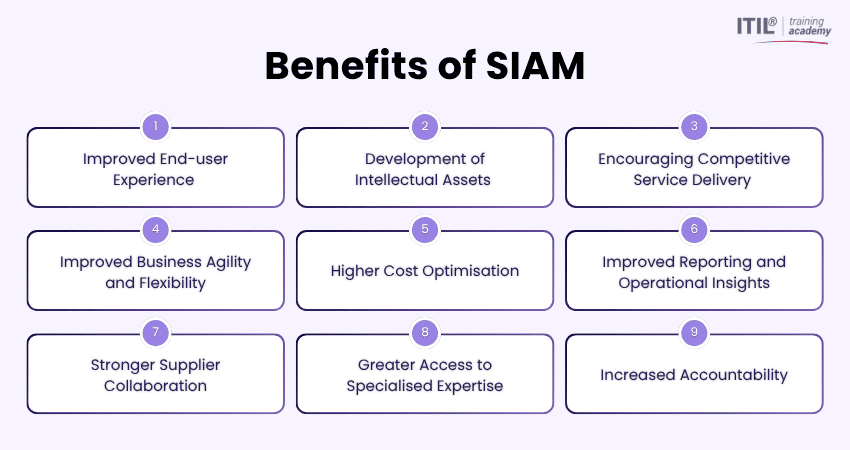
Implementing SIAM offers several benefits for businesses, highlighting how it enables organisations to deliver efficient, reliable and customer-focused services. The following are the benefits of SIAM:
1) Improved End-user Experience
One of the primary benefits of SIAM is its focus on delivering a seamless experience for end users. Customers and employees are generally concerned with the quality of the service they receive rather than which supplier is responsible for delivering it. SIAM helps ensure that all providers work together, reducing service disruptions and improving service consistency.
By establishing clear communication channels and coordinated processes, SIAM enables faster issue resolution and reliable service delivery. This results in improved user satisfaction, increased trust in IT services and a better customer experience.
2) Development of Intellectual Assets
SIAM encourages organisations to document processes, best practices, operational knowledge and service management procedures. This creates valuable intellectual assets that can be reused across projects, teams and suppliers. Over time, these assets contribute to greater organisational knowledge and maturity.
A strong knowledge base also reduces dependence on individual suppliers or employees. When information is properly documented and shared, organisations can maintain effective service continuity and support faster onboarding of new providers or team members.
3) Encouraging Competitive Service Delivery
In a SIAM environment, supplier performance is regularly monitored and measured against agreed service targets. This transparency encourages providers to maintain high standards and continuously improve their services. Suppliers understand that their performance is visible and contributes to overall service success.
Healthy competition between providers often drives innovation, efficiency and better service quality. As suppliers strive to meet or exceed expectations, organisations benefit from improved performance and greater value from their service contracts.
4) Improved Business Agility and Flexibility
Modern organisations should adapt quickly to changing market conditions, customer demands and technological developments. SIAM supports agility by providing a structured framework that makes it easier to introduce new suppliers, technologies or services without disrupting existing operations.
The flexibility offered by SIAM enables organisations to respond effectively to business opportunities and challenges. This adaptability helps businesses remain competitive while maintaining control over complex service environments.
5) Higher Cost Optimisation
Managing multiple service providers without coordination can result in duplicated efforts, inefficient resource usage and unnecessary costs. SIAM improves visibility across suppliers and services, helping organisations identify areas where resources can be used properly. It also helps detect service redundancies and eliminate activities that do not add value.
By streamlining processes and reducing operational overlaps, SIAM supports better cost management. Organisations can make more informed financial decisions and maximise the value they receive from their service providers.
6) Improved Reporting and Operational Insights
SIAM provides a consolidated view of service performance across all suppliers. Instead of reviewing separate reports from different providers, organisations gain access to unified reporting that offers a clearer picture of overall service health. This centralised visibility makes it easier to track service outcomes and identify areas that require attention.
Similarly, these operational insights help decision-makers predict trends, monitor performance, manage risks and address issues proactively. Better reporting also supports strategic planning and continuous service improvement initiatives.
7) Stronger Supplier Collaboration
SIAM promotes a culture of collaboration by encouraging suppliers to work towards shared objectives rather than focusing solely on their individual responsibilities. Clear governance structures and communication processes help build stronger relationships between providers. This creates an inclusive environment where information can be shared with everyone.
Improved collaboration reduces misunderstandings, speeds up issue resolution and supports effective service delivery. When suppliers work together as part of a coordinated ecosystem, organisations are better positioned to achieve their business goals.
8) Greater Access to Specialised Expertise
Different suppliers often bring unique skills, knowledge and industry experience. SIAM enables organisations to leverage specialised expertise from multiple providers while maintaining effective oversight and coordination. With this, businesses can access a wider range of capabilities than a single provider could typically offer.
This access to expert knowledge can improve service quality, support innovation and help organisations address complex technical challenges. Businesses can benefit from specialist capabilities without sacrificing governance or control.
9) Increased Accountability
SIAM establishes clear roles, responsibilities and performance expectations for all service providers involved in delivering services. This clarity helps eliminate confusion about ownership and ensures that suppliers understand their obligations. Clearly defined accountability also helps prevent tasks from being overlooked or duplicated.
When issues occur, accountability can be identified more quickly, leading to faster resolution and improved governance. Increased accountability also encourages suppliers to take greater responsibility for their performance and service outcomes.
Strengthen IT product delivery, innovation, and value creation with
ITIL® 5 Product Certification Training
– Sign up soon!
What are the Challenges of SIAM?
While SIAM offers many benefits, implementing and managing a multi-supplier environment can present several challenges. The following challenges are among the most common when adopting a SIAM model:
1) Aligning Processes Across Providers
Different service providers often use their own processes, tools and operational practices. Bringing these varying approaches together under a common framework can be difficult and may require significant planning and standardisation. Without proper alignment, inconsistencies can arise that affect service quality and overall operational efficiency.
2) Managing Disconnected Technologies
Many suppliers rely on different platforms, monitoring tools and Service Management Systems. Integrating these technologies to create a unified view of service performance can be complex, particularly when legacy systems are involved. Organisations must ensure that systems can exchange information effectively to support reporting and coordinated ITIL Service Delivery.
3) Collaboration Resistance
Not all suppliers may be willing to collaborate openly with other providers. Some may prioritise their own objectives, processes, or contractual responsibilities rather than focusing on shared outcomes. Overcoming this resistance requires strong governance, clear expectations and a culture that encourages cooperation across the supplier ecosystem.
4) Improving Data Transparency
SIAM depends on accurate and transparent information sharing between service providers. However, suppliers may use different reporting methods and data formats, making it difficult to gain a consistent view of service performance. Establishing common reporting standards and encouraging open communication are essential for improving transparency.
Future Trends in Service Integration and Management
As organisations continue to expand their digital ecosystems, SIAM is evolving to meet new business and technology demands. The following trends are expected to influence the future of SIAM:
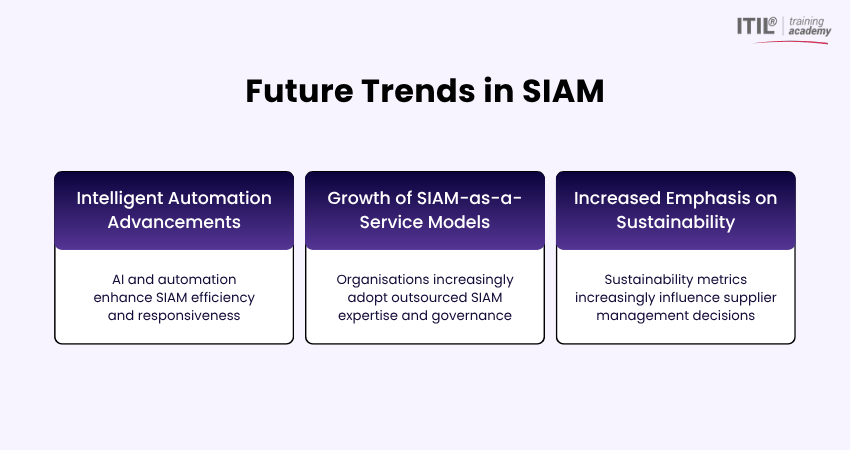
1) Intelligent Automation Advancements
Automation and Artificial Intelligence (AI) are becoming increasingly important in modern service management environments. Many routine tasks, such as incident routing, service request handling, performance monitoring and reporting, can now be automated. This helps reduce manual effort, improve accuracy and increase operational efficiency.
As automation technologies continue to mature, SIAM frameworks will become more proactive rather than reactive. AI-powered analytics can identify potential issues before they impact services, enabling organisations to respond faster and improve service reliability.
2) Growth of SIAM-as-a-Service Models
Many organisations are choosing SIAM-as-a-Service models instead of building and managing service integration capabilities internally. In this approach, a specialised provider delivers SIAM expertise, governance support and integration services on behalf of the organisation.
This model allows businesses to access experienced SIAM professionals without investing heavily in internal resources and infrastructure. As demand for flexible and cost-effective service management solutions grows, SIAM-as-a-Service is expected to become increasingly popular across industries.
3) Increased Emphasis on Sustainability
Sustainability is becoming an important consideration in supplier management and service delivery decisions. Organisations are increasingly evaluating service providers based not only on performance and cost but also on their environmental and social impact.
Future SIAM frameworks are likely to include sustainability-related metrics as part of supplier performance assessments. Factors such as energy efficiency, carbon reduction initiatives, ethical business practices and responsible sourcing will play a greater role in shaping supplier relationships and governance strategies.
Conclusion
Service Integration and Management has become a critical capability for organisations operating in today's digital environments. It enables businesses to manage complexity, improve service quality and enhance end-user experience. As multi-supplier environments continue to grow, SIAM will remain an essential approach for achieving effective and coordinated service delivery.
Build the knowledge needed to manage modern IT-enabled services with ITIL® Managing Professional Training – Join now!
Frequently Asked Questions?
ITIL is a framework that provides best practices for managing IT services, while SIAM focuses on coordinating multiple service providers within a shared service ecosystem. ITIL helps organisations improve service management processes, whereas SIAM ensures those processes work effectively across various suppliers and partners.
Most Recent
Date - Aug 1, 2026
Date - Jul 18, 2026
Date - Jul 11, 2026