


 Back to
Topics
Back to
Topics



Author-Maria Thompson

Last updated-Jan 5, 2026
ITIL® Problem Management is integral in helping organisations move beyond the temporary fixes and address the root cause of recurring IT issues. Focusing on why problems occur supports implementing effective solutions for building long-term growth, service stability, and improving IT service performance.
As organisations increasingly rely on complex IT services, addressing recurring issues has become critical for ensuring service quality and reliability. In this blog, you will learn about Problem Management, its importance, types, flow, and more. So, if you are ready to move from reactive fixes to sustained problem resolution, keep reading to learn more!
What is ITIL® Problem Management?
ITIL® Problem Management is an IT Service Management practice that manages the full lifecycle of underlying problems that cause recurring incidents. Its primary goal is to identify problems proactively, offer effective solutions, and prevent them from happening again. Addressing the root cause helps organisations to improve IT service stability.
Additionally, ITIL® Problem Management helps to identify faults within the IT infrastructure that contribute to repeated incidents. According to the IT Infrastructure Library, the key Problem Management terms include:
1) Problem:
The cause, or potential cause, of one or more incidents. The cause may not be known when the problem is first identified.
2) Error:
A defect or malfunction that causes, or may cause, failure in one or more IT services.
3) Known Error:
A problem with a documented root cause and an agreed workaround.
4) Root Cause:
The fundamental underlying reason for a problem that, if resolved, prevents recurrence.

Why is ITIL® Problem Management So Important?
ITIL® Problem Management is important because it helps organisations prevent recurring incidents by identifying and eliminating root causes. Addressing underlying reduces downtime and improves service availability. This leads to fewer disruptions, resulting in a stable IT environment.
Additionally, ITIL® Problem Management enhances service quality by highlighting areas that need improvement and supports efficient service delivery. It ensures IT services are aligned with business goals, enabling organisations to operate effectively and drive real business growth.
What are the Types of ITIL® Problem Management?
ITIL® Problem Management processes constitute two main types based on when the problems are identified and addressed. Let’s look at them.
1) Proactive Problem Management
Proactive Problem Management focuses on preventing issues before they occur. In this approach, IT teams analyse past incidents and system data to spot potential risks and prevent problems from happening again. In this type, the main tasks include:
1) Identifying risks and fixing them before incidents are caused
2) Using data from past incidents to prevent future problems
3) Reducing IT failures and downtime issues
4) Improving system stability and performance efficiency
2) Reactive Problem Management
Reactive Problem Management focuses on managing problems after incidents have occurred. In this approach, IT teams investigate the root cause of the incidents, log problems, and execute long-term solutions to ensure they do not repeat in the future. Here, the main tasks include:
1) Focusing on resolving problems after incidents happen.
2) Detects and finds a solution for the root cause of the incidents.
3) Preventing the recurrence of similar issues.
4) Improving IR service quality by reducing the same set of failures
Process Flow for Problem Management
ITIL® Problem Management moves beyond fixing individual incidents and focuses on managing the entire lifecycle of a problem. Let us look at the process flow of Problem Management in detail.
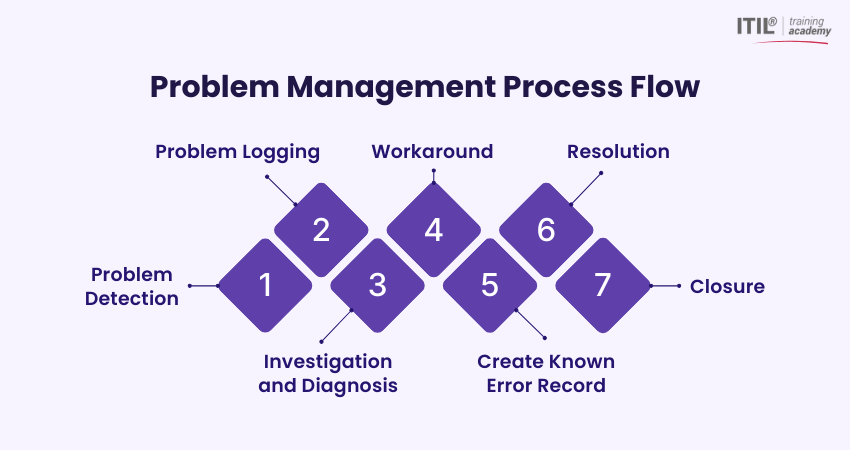
1) Problem Detection
Problem Detection is implemented through incident reports, trend analysis, or using automated event management tools. A problem arises when the cause of the incident is unknown or if a related problem already exists. Otherwise, a new problem will be recorded.
2) Problem Logging
Every problem must be logged to maintain the complete history, including data and time, user details, problem description, affected configuration systems, related incidents, resolution and closure details. Problems are categorised for accuracy and prioritised based on impact and urgency.
3) Investigation and Diagnosis
The problem is investigated to identify its root causes or underlying issues. This involves reviewing the Known Error Database (KEDB), analysing incident patterns, or recreating the issue to understand its recurrence.
4) Workaround
In some ITIL® Problem Management cases, a temporary workaround is provided to reduce the impact on users. However, the focus remains on finding a permanent solution to the underlying issue. This helps maintain service availability until the issue is fully resolved.
5) Create Known Error Record
Once the root causes and workarounds are identified, a “Known Error” record is created. This helps the service desk resolve future incidents proactively using documented solutions. It ensures consistent and faster incident handling.
6) Resolution
A permanent fix is executed and tested to ensure service recovery. If the fix requires a formal change, a Request for Change (RFC) is raised and approved before implementation. This reduces the risk of further service disruption.
7) Closure
After resolving the problem, the problem and any related incidents are closed. Records are reviewed for accuracy and used for reporting and future reference. This confirms that the problem has been fully addressed and resolved.
Learn controlled change practices to reduce risk and disruption with ITIL® 4 Specialist: Monitor, Support, and Fulfil Training – Join now!
What are the Roles and Responsibilities of Problem Management?
In the ITIL® 4 Framework, ITIL Problem Management involves several key roles that work together to identify, analyse, and resolve problems. Let’s look at the important roles and their responsibilities:
1) Problem Manager:
Oversees the Problem Management process, from identifying problems, assigning ownership, to managing investigations, and problem resolution
2) Problem Owner:
Analyses root causes, coordinates investigations, develops solutions, and works closely with stakeholders until resolution.
3) Technical Analyst:
Conducts thorough technical investigations to identify underlying causes and support the development of long-term solutions.
4) Service Desk:
Logs and categorises problem records, links problems to related incidents, assigns them to Problem Management teams and provides support when criteria are met.
5) Change Manager:
Assesses the impact of problem resolutions on IT services and infrastructure, ensuring changes are planned, tested, approved, and implemented.
6) IT Support Teams:
Teams for application, network, and database support contribute technical expertise based on the nature of the problem and affected services.
Benefits of Problem Management in ITIL®
ITIL® Problem Management offers various benefits to help organisations improve service stability and reduce the impact of recurring issues. Let’s explore them below.
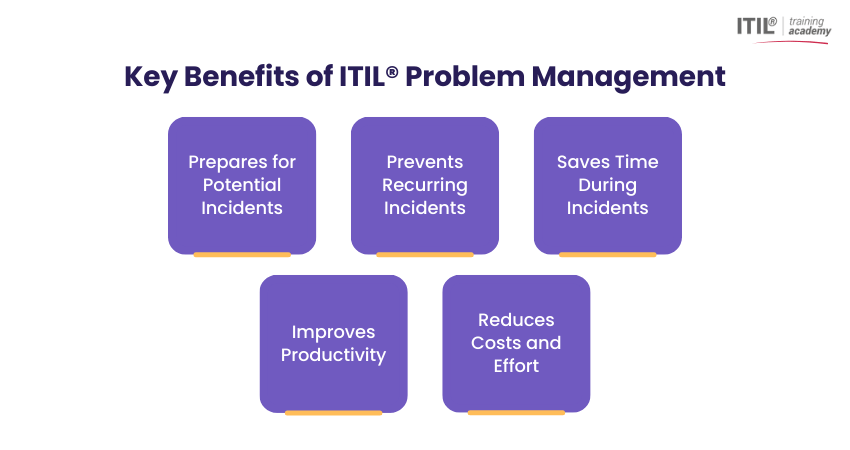
1) Prepares for Potential Incidents:
Helps organisations anticipate and address issues before they escalate into major incidents or service disruptions.
2) Prevents Recurring Incidents:
Supports continuous improvement by identifying the root causes and preventing problems from occurring again.
3) Saves Time During Incidents:
Allows teams to respond quickly using pre-identified workarounds and solutions.
4) Improves Productivity:
Eliminates repeated firefighting, enabling teams to focus on adding activities that foster value.
5) Reduces Costs and Effort:
Minimises unnecessary expenses by preventing repeated incidents and reducing downtime.
Strengthen information security practices with
ITIL® 4 Practitioner: Change Enablement Training
– Register today!
ITIL® Problem Management Best Practices
For effective ITIL® Problem Management, organisations need to follow best practices to improve efficiency, service stability, and collaboration. Let’s understand more below.
1) Collaborate Across Teams:
ITIL® Problem Management requires input from multiple Information Technology teams. Clear communication between teams ensures effective problem diagnosis and resolution.
2) Encourages Continuous Improvement:
Problem Management must be treated as an ongoing improvement process. Promote an encouraging culture where teams are encouraged to report problems, learn from past issues, and contribute long-term solutions.
3) Analyse Recurring Problems:
Track and review incidents to identify trends and root causes. Use Problem Management tools and trend analysis to prevent the occurrence recurrence of similar issues.
4) Balance Proactive and Reactive Approaches:
Combining proactive Problem Management with reactive Problem Management helps to resolve issues effectively. This ensures both prevention and recovery are addressed.
5) Automate Where Possible:
Automate daily tasks such as logging, categorising, and prioritising problems based on urgency and business impact to improve efficiency and consistency.
6) Establish Feedback Loops:
Collect regular feedback from stakeholders to ensure the Problem Management process meets business and service needs.
7) Align Change and Problem Management:
Aligning Problem Management with Change Management helps organisations gain better visibility into how services are affected.
Conclusion
ITIL® Problem Management plays a significant role in helping organisations in the Information Technology sphere to maintain stability in their services. Focusing on root cause analysis, prevention, and continuous improvements reduces issues, improves service quality, and supports continuity. When it is executed properly, it strengthens IT operations and ensures services are delivering real value to the organisation.
Build expertise in root cause analysis and prevent recurring
IT service issues with ITIL® 4 Practice Manager (PM) Courses
now!
Frequently Asked Questions?
Proven ITIL® techniques to manage problems:
1) Root Cause Analysis: Identifies incident causes
2) Five Whys: Repeatedly asks “why” to find root causes
3) Ishikawa Diagram: Visually maps problem causes
4) Trend Analysis: Detects recurring issues
5) Kepner–Tregoe Analysis: Used structured approach for problem resolution
The five stages of ITIL ® are:
1) Service Strategy: Defines services and their value
2) Service Design: Plans service delivery
3) Service Transition: Moves changes into operation
4) Service Operation: Runs services daily
5) Continual Service Improvement: Improves services continuously a
Most Recent
Date - Aug 1, 2026
Date - Jul 18, 2026
Date - Jul 11, 2026