


 Back to
Topics
Back to
Topics



Author-James Smith

Last updated-Jun 24, 2026
Every organisation must implement changes to improve services, adopt new technologies, and meet evolving business needs. However, even well-planned changes can create risks if they are not carefully planned and reviewed. A Change Advisory Board helps organisations evaluate the proposed changes and make informed decisions before implementation.
By bringing together key stakeholders, a CAB ensures that risks, impacts, and business requirements are thoroughly assessed. In this blog, you will learn what a Change Advisory Board is, who its members are, its importance, key roles and responsibilities, and more. So, let’s begin!
What is a Change Advisory Board (CAB)?
A Change Advisory Board (CAB) is a group of stakeholders and experts in IT Service Management (ITSM) that reviews proposed changes to IT infrastructure and services. It is a part of the ITIL® Framework, helping organisations assess risks, understand impacts, and ensure changes are implemented in a controlled and effective way.
The primary purpose of a CAB is to support informed decision-making while reducing disruptions to business operations. By reviewing changes before implementation, it helps maintain service reliability, improve change success rates, and ensure changes align with organisational objectives.

Why is a Change Advisory Board Important?
A Change Advisory Board plays an important role in helping organisations manage IT changes effectively. As businesses continuously update systems, services, and processes, changes must be carefully reviewed to avoid unnecessary risks. A CAB provides the oversight needed to ensure changes are planned, assessed and implemented in a controlled manner.
By evaluating the potential impact of proposed changes, a CAB helps reduce risks, prevent service disruptions and support smoother service transitions. Also, it ensures that changes align with business objectives, improving service reliability, operational stability and organisational performance.
Roles and Responsibilities of the Change Advisory Board
A Change Advisory Board (CAB) plays a crucial role in ensuring that changes are planned, reviewed, and implemented effectively. Let’s look at the key roles and responsibilities of a CAB below:
1) Reviewing Proposed Changes
The CAB carefully reviews all change requests before they are approved. This includes understanding the purpose of the change, technical details, implementation plans, required resources, and how it may affect other systems. The board also checks whether sufficient documentation, testing results, and supporting information have been provided.
2) Assessing Risks and Impact
Every change carries potential risks. The CAB evaluates these risks from both technical and business perspectives. It considers factors such as system failures, security concerns, performance issues, user impact, and the best timing for implementation. This helps reduce disruptions and ensures informed decision-making.
3) Ensuring Business Alignment and Compliance
The CAB makes sure that proposed changes support business objectives and deliver real value. It also verifies that changes comply with company policies, industry standards, security requirements, and regulatory guidelines. This ensures that improvements benefit the organisation without creating compliance issues.
4) Providing Recommendations to the Change Manager
After reviewing and assessing a change request, the CAB provides recommendations to the Change Manager. These recommendations may include approval conditions, risk-reduction measures, preferred implementation schedules, additional testing requirements, phased rollouts, or communication strategies to support a successful change process.
Build resilient service management skills and elevate service performance with the ITIL® 5 Service Certification Course – Join now!
Benefits of Having a Change Advisory Board
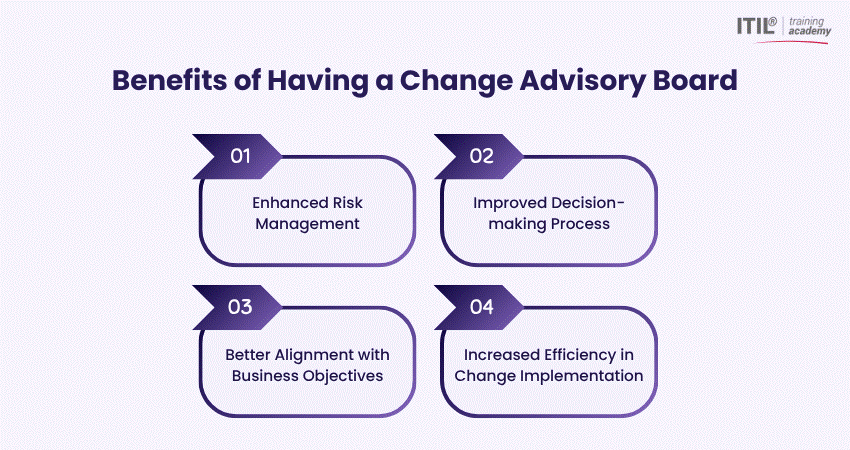
A Change Advisory Board (CAB) adds value by ensuring that changes are properly reviewed, carefully planned, and aligned with organisational goals. Let’s look at some of the key benefits of having a CAB below:
1) Enhanced Risk Management
A CAB carefully evaluates proposed changes to narrow down the potential risks before implementation. This approach helps prevent service disruptions, security issues and costly operational failures while maintaining system stability.
2) Improved Decision-making Process
By bringing together stakeholders with different areas of expertise, a CAB ensures that proposed changes are assessed from technical and business perspectives. This leads to more informed and balanced decisions.
3) Better Alignment with Business Objectives
A CAB ensures that every proposed change supports organisational goals and delivers business value. This helps organisations focus resources on initiatives that contribute to growth, performance, and long-term success.
4) Increased Efficiency in Change Implementation
A CAB helps prioritise important changes and streamlines the review and approval process. By identifying issues early, it reduces delays and enables organisations to implement changes more smoothly and efficiently. Efficient processes help organisations implement changes faster without compromising on the quality.
How to Build a High-performing CAB?
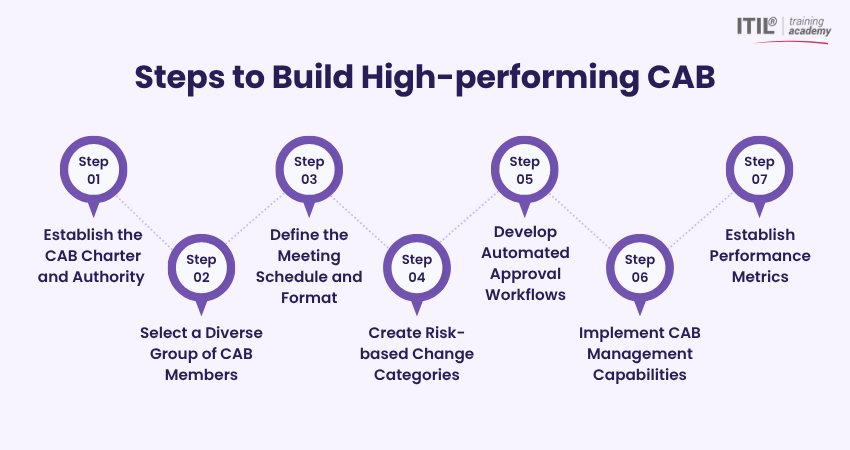
Creating an effective Change Advisory Board requires clear processes and the right people. Here are the steps to create a high-performing CAB:
Step 1: Establish the CAB Charter and Authority
Start off by creating a clear CAB charter that outlines its decision-making authority and the types of changes it will review. The charter must also explain how disagreements are handled and how the CAB reports to leadership. Without clear executive support, teams may see the CAB as optional and bypass important change review processes.
Step 2: Select a Diverse Group of CAB Members
The success of a CAB depends on having the right mix of expertise. Include representatives from areas such as development, operations, security and business teams. A group of seven to 12 members is usually ideal, providing diverse perspectives while keeping discussions efficient. It's also important to assign backup members who can step in when regular members are unavailable.
Build in-demand Skills That Shape Better IT Experiences with our ITIL® 5 Experience Certification Training - Sign up now!
Step 3: Define the Meeting Schedule and Format
CAB meetings must be scheduled according to the organisation's pace of change. Fast-moving environments may need weekly meetings, while strategic reviews can occur on a monthly basis. Emergency changes can be handled through special emergency CAB (ECAB) meetings. To keep meetings productive, share the agenda in advance and set time limits for discussions. Also, focus on decision-making rather than detailed technical troubleshooting.
Step 4: Create Risk-based Change Categories
Not all changes carry the same level of risk. Create clear categories such as standard changes (Low-risk, routine changes), normal changes (moderate-risk changes) and major changes (high-risk changes requiring extensive approval). Establish approval requirements, documentation standards and review timelines for each category.
Step 5: Develop Automated Approval Workflows
Manual approval processes often create delays and bottlenecks. Automation helps move change requests through the correct approval path automatically.
For example:
a) Standard changes can be pre-approved
b) Normal changes can be sent directly to the CAB
c) Major changes can be escalated to senior leadership
Automated workflows improve efficiency, reduce delays, and ensure stakeholders are notified promptly.
Step 6: Implement CAB Management Capabilities
An effective CAB needs a centralised platform to manage all change-related activities. The system should support change request submissions, documentation storage, change calendars, approval tracking, workflow automation and reporting and analytics.
Step 7: Establish Performance Metrics
High-performing CABs regularly monitor their effectiveness using key metrics such as:
a) Average approval time
b) Meeting efficiency
c) Change success rate
d) Number of change-related incidents
Who are the Members of a Change Advisory Board (CAB)?
A Change Advisory Board includes individuals with the knowledge and expertise needed to assess proposed changes from different perspectives. While the exact composition may vary, the following members are commonly involved:
a) Change Manager: Leads CAB meetings, coordinates change reviews and oversees the decision-making process.
b) Service Desk Analysts: They provide insights into incidents, user issues, and the potential impact of changes on service operations.
c) Operations Manager: They evaluate how proposed changes affect daily business and IT operations.
d) Application Manager or Engineer: They assess the impact of changes on applications, systems and technical performance.
e) Information Security Officer: They review security risks and identify potential vulnerabilities associated with proposed changes.
f) Senior Network Engineers: They evaluate the impact of changes on network infrastructure, connectivity and system availability.
g) Business Relationship Manager: They represent customer and business interests, thus ensuring changes align with organisational and user needs.
Common Challenges of CAB and Ways to Address Them
While a Change Advisory Board (CAB) helps organisations manage changes effectively, it can also face challenges that affect efficiency and decision-making. Let’s look at some of the challenges below and how to mitigate them:
1) Scheduling and Availability of Members
CAB members have multiple responsibilities, making it difficult to ensure consistent participation in meetings. Also, delays in attendance can slow down the review and approval of important changes.
Ways to Address This Challenge:
a) Designate primary and backup members for key roles.
b) Enable virtual attendance for remote or travelling members.
c) Record meetings for asynchronous review.
d) Create role-based sub-committees for specialised changes.
2) Decision-making Bottlenecks
When every proposed change requires full CAB review, the approval process can become slow and inefficient. This can delay implementation and reduce the organisation's ability to respond quickly to business needs. A good way to address this challenge is to categorise the changes like this:
a) Standard Changes: Pre-approved changes that do not require CAB review.
b) Normal Changes: Changes reviewed through the regular CAB process.
c) Major Changes: Changes requiring extended review and additional stakeholders.
d) Emergency Changes: Changes handled through a fast-tracked Emergency Change Advisory Board (ECAB) process.
3) Lack of Engagement
CAB members may lose interest if meetings are too frequent, unfocused, or provide little value. Low engagement can affect participation, collaboration, and the quality of decision-making.
Ways to Address This Challenge:
a) Rotate meeting leadership among members.
b) Share performance metrics that highlight CAB contributions.
c) Recognise successful changes and lessons learned.
d) Keep meetings focused, structured, and time-bound.
4) Strategies for Improvement
A CAB must continuously evolve to remain effective as business needs, technologies, and risks change. Regular reviews help ensure that CAB processes continue to deliver value.
Ways to Address This Challenge:
a) Track key metrics such as change success rates, cycle times, and incident trends.
b) Conduct periodic reviews to identify process improvements.
c) Automate routine assessments using change management tools.
d) Regularly review and update risk assessment criteria and approval workflows.
Future-proof your IT Service Management skills by joining the ITIL® (Version 5) Managing Professional (MP) Transition Certification Course now!
Best Practices for an Effective Change Advisory Board (CAB)
Adopting the right practices helps the CAB improve decision-making, increase participation, and ensure that proposed changes are reviewed with the right level of oversight. Let’s look at some of the best practices for CAB below:
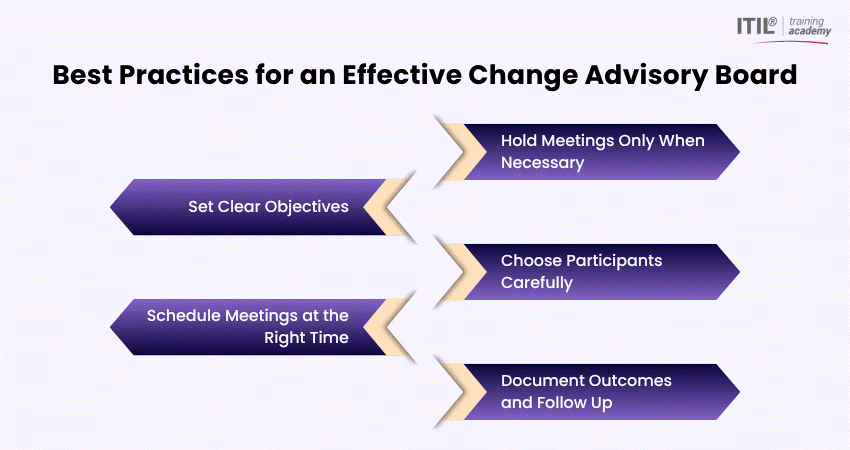
a) Hold Meetings Only When Necessary: CAB meetings should be organised based on the needs of the change process. Meetings are most valuable when there are significant changes that require review, discussion, or recommendations.
b) Set Clear Objectives: Every CAB meeting should have a defined purpose and agenda. Discussions should focus on key areas such as potential risks, business impact, alignment with organisational goals, and the effect of changes on end users.
c) Choose Participants Carefully: The effectiveness of a CAB depends on having the right people involved. Invite participants who can provide relevant expertise and insights for the specific change being reviewed.
d) Schedule Meetings at the Right Time: CAB meetings should take place when sufficient information is available to support informed decisions. Holding meetings before major deployments, releases, or emergency changes allows the board to provide meaningful guidance.
e) Document Outcomes and Follow Up: Meeting outcomes should be clearly documented and translated into actionable steps. Maintaining records of decisions, recommendations, and action plans helps ensure accountability, supports implementation, and improves future change management activities.
Conclusion
A Change Advisory Board helps organisations implement changes in a structured and controlled manner. By improving decision-making, reducing risks, and supporting business objectives, a CAB enhances service reliability and operational stability. Following effective CAB practices enables organisations to manage change more successfully and achieve better long-term outcomes.
Learn to drive high-impact IT service leadership with the ITIL® Managing Professional Courses – Join now!
Frequently Asked Questions?
A Change Control Board (CCB) is a project management group that approves or rejects changes to a project's scope, schedule or budget. In contrast, a Change Advisory Board is part of the ITIL framework and evaluates changes to IT services and infrastructure by assessing their risks and impacts before implementation.
Most Recent
Date - Aug 1, 2026
Date - Jul 18, 2026
Date - Jul 11, 2026