


 Back to
Topics
Back to
Topics



Author-Maria Thompson

Last updated-Jun 27, 2026
Have you ever wondered why some workplace changes succeed while others quickly lose momentum? A new system is introduced, processes are updated, and expectations are set, yet employees continue working the old way. Change can be exciting in theory, but in practice, it often brings uncertainty, resistance, and a reluctance to step outside familiar routines.
This is where Kotter's 8 Step Change Model comes in. It provides a structured framework for gaining support, overcoming resistance, and driving successful change. In this blog, we will explore how the model works, its eight key steps, and the key benefits and challenges of using it. Read on to learn more!
What is the Kotter Change Management Model?
The Kotter Change Management Model is a structured framework developed by leadership expert John P. Kotter in 1995 to help organisations successfully implement and sustain change. The model consists of eight steps and provides a clear approach for managing transformation while addressing the challenges that often arise during periods of organisational change.
Building on earlier Change Management concepts, including the work of Kurt Lewin, the model focuses on the people side of change, emphasising leadership, communication, and employee engagement. It helps organisations reduce resistance, encourage adoption of new ways of working, and embed lasting changes into the organisational culture to achieve long-term success.

How Does Kotter's 8 Step Change Model Work?
Kotter's 8-Step Change Model guides organisations through a structured process for planning, implementing, and sustaining change. The model follows eight sequential steps, from establishing the need for change to embedding new behaviours into the organisational culture. Each step builds momentum, promotes collaboration, and supports successful transformation.
The framework places a strong emphasis on leadership, communication, and active participation throughout the change journey. By creating urgency, building support, removing barriers, celebrating early successes, and reinforcing new ways of working, organisations can reduce resistance and increase the likelihood of achieving long-term, sustainable change.
Kotter's 8 Steps for Leading Change
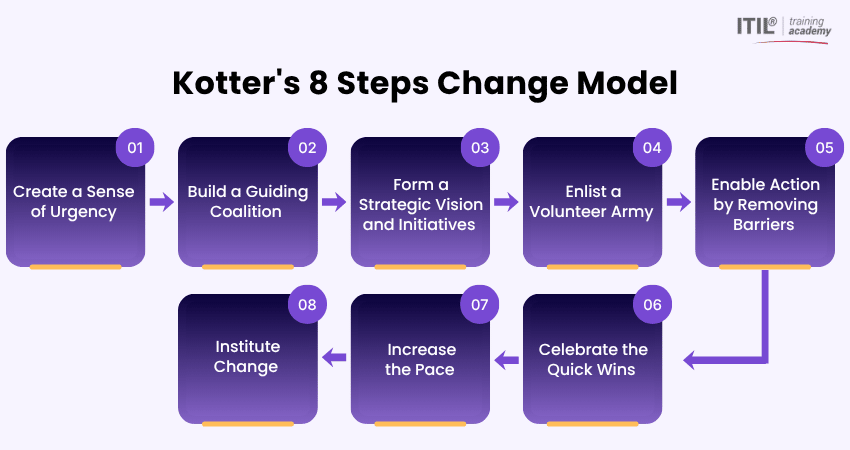
Kotter's framework consists of eight interconnected steps that help organisations manage transformation effectively. Each step has a specific objective that drives the change initiative forward. The eight steps are outlined below:
1) Create a Sense of Urgency
The first step focuses on helping employees and stakeholders understand why change is necessary. Leaders should communicate the risks of maintaining the status quo and the consequences of inaction. When people recognise the urgency of change, they are more likely to support and engage in the transformation process.
2) Build a Guiding Coalition
Successful change requires strong leadership and collaboration. This step involves forming a coalition of influential leaders and key employees from different parts of the organisation who can champion the change effort. A diverse and committed coalition helps build credibility, gain wider acceptance, and drive the initiative forward.
3) Form a Strategic Vision and Initiatives
A clear vision helps employees understand the goals and direction of the change. Leaders should develop a clear and compelling vision of the desired future state and develop initiatives that support its achievement. A well-defined strategy ensures everyone understands the goals of the transformation and how they contribute to its success.
4) Enlist a Volunteer Army
Once the vision is established, organisations need widespread employee support. This step focuses on communicating the vision consistently and encouraging employees to actively contribute to the transformation. Building a network of enthusiastic supporters helps foster collaboration and strengthens commitment across the organisation.
5) Enable Action by Removing Barriers
To implement change effectively, organisations must identify and remove obstacles that may hinder progress. These barriers can include outdated systems, ineffective processes, limited resources, or resistance to change. Removing these challenges empowers employees to adopt new approaches and support the successful implementation of the change.
6) Celebrate the Quick Wins
Achieving and recognising short-term successes helps maintain motivation throughout the change process. Quick wins demonstrate that the initiative is delivering positive results and provide employees with a sense of accomplishment. They also help build confidence in the change effort and encourage continued support.
7) Increase the Pace
After securing early successes, organisations should continue building momentum rather than losing focus. Leaders can use the credibility gained from quick wins to drive further improvements, involve more employees, and implement larger changes that support the overall vision.
8) Institute Change
The final step focuses on making the change a permanent part of the organisation. New behaviours, processes, and values should be integrated into everyday operations and organisational culture. By reinforcing these changes over time, organisations can prevent a return to old habits and ensure long-term success.
Learn modern Service Management practices that improve business outcomes with the ITIL® 5 Service Certification Training – Sign up now!
The Pros of Kotter's 8 Step Change Model
Kotter's 8 Step Change Model is widely used for its structured approach to organisational change. By focusing on leadership, communication, and employee engagement, it helps organisations implement and sustain change effectively. Some of its key advantages include:
1) Structured Approach
The model provides a clear, step-by-step framework for managing change. Each stage builds on the previous one, helping organisations implement transformation in a logical and organised manner while reducing uncertainty.
2) Strong Leadership Focus
Kotter's model emphasises the role of leadership throughout the change process. By establishing a guiding coalition and maintaining leadership involvement, organisations can create stronger commitment and support for change at all levels.
3) Vision-driven Framework
A key strength of the model is its focus on developing a clear vision for change. This helps employees understand the purpose of the transformation, align their efforts with organisational goals, and remain focused on the desired outcomes.
4) Effective Barrier Removal
The model encourages organisations to identify and address obstacles early in the process. Removing barriers such as outdated systems, inefficient processes, or organisational resistance helps employees adopt change more smoothly and effectively.
5) Momentum Through Early Wins
By recognising and celebrating short-term wins, the model helps maintain enthusiasm and engagement throughout the transformation journey. These early achievements demonstrate progress, boost morale, and encourage continued commitment to the change initiative.
Develop Product Management skills that drive value and innovation through the ITIL® 5 Product Certification Training – Join now!
The Cons of Kotter's 8 Step Change Model
While Kotter's 8-Step Change Model provides a clear framework for managing change, it also has certain limitations. In some situations, organisations may require a more flexible or detailed approach. Some of the key challenges associated with the model include:
1) Limited Actionable Guidance
Although the model clearly outlines the stages of change, it provides limited detail on how to implement each step. Organisations may understand what needs to be done but still require additional tools, frameworks, or expertise to execute the change successfully.
2) Sequential Approach
The model follows a structured, step-by-step process, which may not always suit organisations operating in dynamic environments. Businesses managing multiple or overlapping change initiatives may find the sequential approach less flexible and harder to adapt to changing circumstances.
3) Can be Time-intensive
Implementing all eight steps thoroughly can require considerable time, effort, and resources. For organisations seeking rapid transformation, the model's comprehensive approach may slow the pace of change and delay results.
4) Heavy Reliance on Leadership
Kotter's model places significant emphasis on leadership to drive and sustain change. While strong leadership is important, a highly top-down approach can sometimes reduce employee involvement and make lower-level staff feel less connected to the transformation process.
5) Limited Attention to Individual Resistance
The model primarily focuses on organisational change rather than individual employee experiences. It offers limited guidance on addressing personal concerns, emotions, and varying levels of readiness for change. As a result, some employees may require additional support to fully embrace and adopt new ways of working.
Conclusion
Kotter's 8 Step Change Model provides a structured approach to managing organisational transformation by combining strong leadership, clear communication, and employee engagement. By following its eight stages, organisations can reduce resistance, build momentum, and embed lasting change, helping them achieve successful and sustainable outcomes in an evolving business environment.
Transform your decision-making and create lasting organisational impact through the ITIL® Strategic Leader (SL) Training – Join today!
Frequently Asked Questions?
The most popular Change Management models are Kotter's 8-Step Change Model, the ADKAR Model, and Lewin's Change Management Model. Kotter's model is known for its structured approach to organisational change, ADKAR focuses on individual adoption, while Lewin’s model offers a practical framework for managing organisational transitions.
Most Recent
Date - Aug 1, 2026
Date - Jul 18, 2026
Date - Jul 11, 2026