


 Back to
Topics
Back to
Topics



Author-Veronica Davis

Last updated-Jul 11, 2026
Technology has evolved from being just a support function to becoming the heart of every business decision. As a result, understanding where technology budgets are spent and what value they create has become increasingly important. This is where Technology Business Management (TBM) comes in to improve financial transparency and business alignment.
TBM brings structure, clarity and strategy to IT, helping business and technology leaders speak the same language, make smarter investments and drive real outcomes. This blog explores what is TBM in detail, shedding light on its benefits, framework, key components and more. So read on!
What is Technology Business Management (TBM)?
Technology Business Management (TBM) is a strategic discipline that helps organisations manage the value of technology across the enterprise. It provides a structured framework for connecting technology resources, costs, and investments with measurable business outcomes.
By creating a common language and shared model, TBM brings technology, finance, and business leaders together to make informed decisions. It improves spending transparency, supports real-time optimisation, and aligns technology investments with priorities such as innovation, efficiency, resilience, and customer experience. This enables organisations to manage technology as a valuable business asset rather than simply a cost centre.

Core Components of the TBM Framework
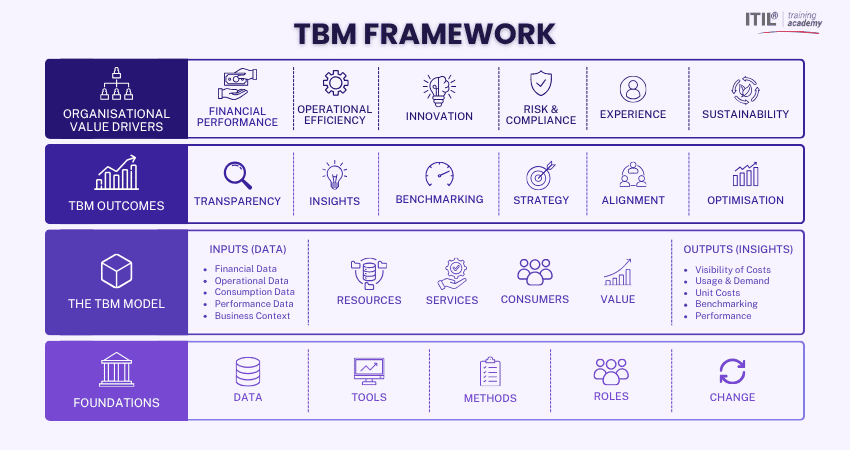
The TBM Framework helps organisations connect technology spending and operations with wider business priorities. It is organised into four connected areas: Foundations, the TBM Model, TBM Outcomes, and Organisational Value Drivers. The following sections explain each component and its role within the TBM Framework.
Foundations
Foundations cover the essential capabilities required to introduce, maintain and strengthen a TBM practice. They ensure that the organisation has reliable information, suitable systems, clear responsibilities, and consistent working methods.
The five foundations are:
1) Data: Financial, operational, and business information used to analyse technology costs, usage, and performance.
2) Tools: Systems and platforms that support data collection, modelling, analysis, and reporting.
3) Methods: Defined approaches for applying TBM principles to technology and business decisions.
4) Roles: The individuals, teams, and governance groups responsible for managing TBM activities.
5) Change: The actions required to integrate TBM into organisational processes, behaviours, and decision-making.
These foundations provide the capabilities required to establish and maintain a TBM practice.
The TBM Model
The TBM Model converts financial, operational, consumption, and performance data into useful information for decision-makers. It connects technology resources and costs with the services, products, and business areas they support.
The model helps organisations analyse investments across areas such as:
1) Cloud platforms and on-premises infrastructure
2) Applications and software
3) Internal employees and technology teams
4) Vendors and external service providers
5) Technology products and business services
The TBM Model is supported by three main elements:
1) TBM Taxonomy: A consistent structure for classifying technology, financial, and business information.
2) Taxonomy Extensions: Adaptations designed for the specific needs of industries such as banking, manufacturing, and the public sector.
3) Connected Standards: Links with related practices and frameworks, including FinOps, Agile, IT Financial Management (ITFM) and sustainability standards.
By applying the model, organisations can understand technology costs, compare investment options, and direct spending towards business priorities.
TBM Outcomes
TBM Outcomes describe the practical results organisations can achieve through an effective TBM practice. They show how improved technology management can contribute to informed decisions, stronger collaboration, and better business performance.
The main outcomes include:
1) Transparency: Greater visibility into technology spending, consumption, and performance.
2) Insights: A clearer understanding of how technology contributes to business value.
3) Benchmarking: Comparison of costs and performance with peers, standards, or recognised practices.
4) Strategy: Stronger links between technology initiatives and organisational objectives.
5) Alignment: Better coordination among technology, finance, and business leaders.
6) Optimisation: Continuous improvement of technology investments, resources, and operations.
These outcomes help leaders evaluate technology decisions and identify opportunities to increase efficiency and value.
Organisational Value Drivers
Organisational Value Drivers represent the wider business priorities that TBM is intended to support. They demonstrate that TBM is not limited to controlling IT costs but can also contribute to long-term organisational performance.
The primary value drivers are:
1) Financial Performance: Using technology investments to support profitability and stronger business results.
2) Operational Efficiency: Improving the use of resources, simplifying processes, and reducing unnecessary expenditure.
3) Innovation: Funding new technologies and capabilities that support growth and competitive advantage.
4) Risk and Compliance: Managing technology-related risks and meeting security, regulatory, and governance expectations.
5) Experience: Improving technology services for customers, employees, and business partners.
6) Sustainability: Supporting environmental, social, and governance objectives through responsible technology decisions.
By connecting technology activities with these value drivers, organisations can assess technology based on its broader contribution to enterprise success.
Build resilient service strategies for a fast-changing digital landscape with ITIL® (Version 5) Transformation Certification Training - Sign up now!
Key Benefits of TBM
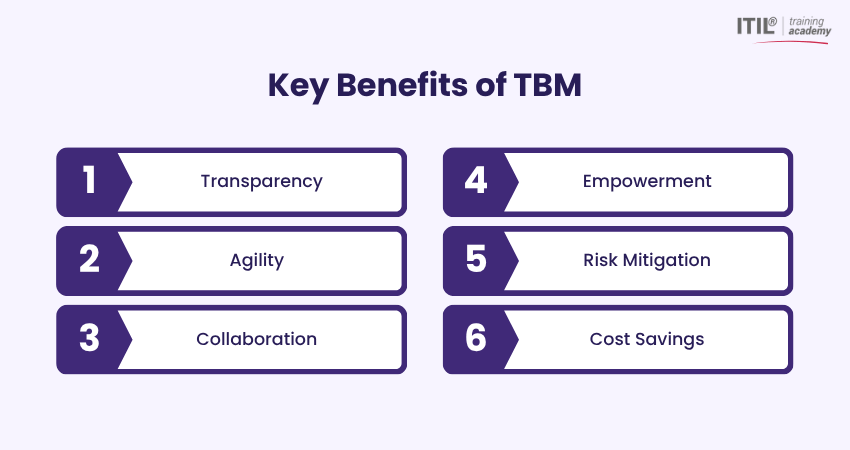
TBM helps organisations make sure their IT spending and operations are aligned with business goals. When done right, it delivers a range of meaningful benefits:
1) Transparency
TBM provides a clear view of technology costs, services, and resource consumption. By standardising financial and operational data, it helps organisations understand where technology spending is allocated and how investments support business objectives.
2) Agility
TBM enables organisations to respond quickly to changing business priorities by providing accurate cost and performance insights. This allows leaders to reallocate resources, optimise investments, and make faster, data-driven decisions.
3) Collaboration
TBM establishes a common language across IT, finance, and business teams. Through consistent cost models and shared metrics, stakeholders can collaborate more effectively, improve communication, and align decisions with organisational goals.
4) Empowerment
TBM equips technology and business leaders with reliable financial and operational insights. This enables them to make informed investment decisions, prioritise initiatives, justify technology spending and clearly demonstrate business value.
5) Risk Mitigation
By improving visibility into technology costs, dependencies, and performance, TBM helps organisations identify financial and operational risks early. This supports stronger governance, regulatory compliance and more effective resource planning.
6) Cost Savings
TBM helps organisations identify inefficient spending, optimise resource allocation, and eliminate waste. Improving cost transparency and accountability enables smarter technology investments while maintaining or enhancing business outcomes.
TBM Implementation Phases
Now, let’s explore the three implementation phases of Technology Business Management in detail:
Phase 1: Establish Financial Transparency
The first phase focuses on establishing financial transparency across technology spending. This involves implementing automated data collection, mapping technology costs using the TBM Taxonomy, and creating dashboards that provide stakeholders with clear financial insights.
Phase 2: Align with Business Outcomes
The second phase aligns technology services with business outcomes by identifying critical business services and mapping the resources that support them. It also involves defining Service-level Agreements (SLAs) and monitoring relevant performance indicators.
Phase 3: Benchmark and Optimise
The final phase focuses on benchmarking technology costs and performance against industry standards. It also involves continuously optimising investments, resources, and operational efficiency through ongoing improvement initiatives.
Drive strategic IT success through effective planning and continuous improvement. Join the ITIL® 4 Strategist: Direct, Plan and Improve Course today!
Challenges of Implementing TBM
Although TBM offers significant benefits, its implementation can involve organisational, technical, and data-related challenges. The following are some common barriers organisations may encounter:
1) Initial Complexity: Setting up TBM takes effort. You need to choose the right tools, organise and map your data, and establish processes. The time and resources needed upfront can feel overwhelming.
2) Resistance to Change: TBM often requires shifts in how decisions are made, along with new levels of accountability and governance. Getting teams across IT, finance and the business to align can be tough.
3) Data Quality and Availability: TBM depends heavily on having detailed and up-to-date data from different systems. If the data is incomplete or inconsistent, the insights you get won’t be very reliable.
4) Tooling and Integration: TBM tools need to connect with financial systems, IT Asset Management platforms and other data sources. Making all of these systems work together can be both technically and organisationally challenging.
5) Skills and Expertise: TBM isn’t just about finance or technology; it’s a mix of both, plus operational understanding. Many organisations struggle to find people with the right combination of skills to lead the effort.
TBM Best Practices for Sustainable Adoption
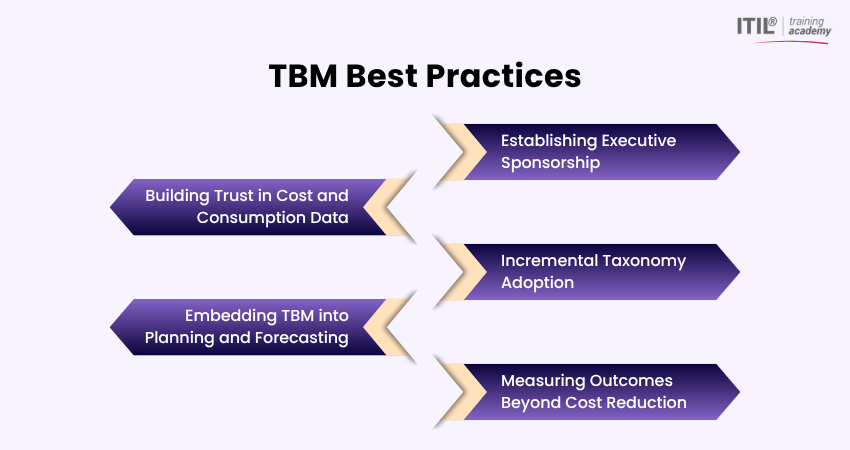
The following best practices can help organisations establish, scale, and sustain an effective Technology Business Management practice:
1) Establishing Executive Sponsorship
Sustained TBM adoption requires visible support from senior leadership. Executive sponsors can set clear expectations, communicate the strategic value of TBM, remove organisational barriers, and hold teams accountable for agreed outcomes.
To maintain leadership engagement, teams should regularly report progress, challenges, measurable improvements, and the business impact of TBM initiatives.
2) Building Trust in Cost and Consumption Data
Reliable data is essential for producing credible TBM insights. Organisations should establish clear data ownership and governance, validate information regularly, and explain how technology costs and consumption are classified, allocated, and reported.
When stakeholders understand and trust the underlying information, they are more likely to use TBM insights when planning investments and making operational decisions.
3) Incremental Taxonomy Adoption
Implementing every element of the TBM Taxonomy at once may create unnecessary complexity. Organisations can begin with priority services, cost areas, or use cases and gradually expand the model as data quality, capabilities, and business needs develop.
This incremental approach allows teams to learn, refine their methods, and improve data stability without placing excessive pressure on existing operations.
4) Embedding TBM into Planning and Forecasting
To deliver sustained value, TBM should extend beyond reporting and become part of budgeting, forecasting, prioritisation, and investment planning. Technology, finance, and business teams should use TBM insights collaboratively to evaluate options and align spending with organisational priorities.
Embedding TBM into established planning cycles helps turn financial and operational information into practical business decisions.
5) Measuring Outcomes Beyond Cost Reduction
Although cost optimisation is an important TBM objective, its value extends beyond financial savings. TBM can also support service performance, organisational agility, risk management, innovation, customer experience, and strategic alignment.
Organisations should therefore monitor measures linked to business outcomes, such as customer satisfaction, time to market, service performance, investment value, and risk exposure.
Bridge business goals and IT success with ITIL® 4 Leader: Digital and IT Strategy Certification Course - Register now!
The Future of Technology Business Management
As organisations become increasingly dependent on technology, TBM is evolving to address new investment models, data requirements, and business expectations. The following trends are likely to shape its future development:
1) Cloud Economics
With more organisations moving to the Cloud, IT spending is no longer just about fixed infrastructure costs. It’s becoming variable and consumption-driven. With the global cloud computing market projected to reach approximately £2.5 trillion by 2033, organisations need better ways to manage increasingly complex and consumption-based technology spending.
In practice, this means applying TBM principles to track Cloud usage, allocate costs accurately, and optimise spending across services like compute, storage, and SaaS platforms.
2) AI and Automation
Artificial Intelligence and automation have begun playing a bigger role in TBM, especially when it comes to handling complex data and repetitive tasks. AI can help automate cost allocation, detect anomalies and identify optimisation opportunities across large datasets. For example, it can flag unused resources, recommend cost-saving actions or predict future spending patterns.
3) Real-time Analytics
Traditionally, TBM has relied on monthly or periodic reporting cycles. But with faster-moving business environments, that’s no longer enough. Organisations are now moving toward real-time analytics, where leaders can monitor costs, usage and performance as they happen.
4) Value Realisation
One of the biggest shifts in TBM is the growing emphasis on value rather than just cost. Organisations want to clearly understand not only how much they’re spending, but what they’re getting in return. This means linking IT investments directly to business outcomes such as revenue growth, customer experience, innovation, or operational efficiency.
Conclusion
Technology Business Management represents a mindset shift in how organisations manage and evaluate technology. By improving cost transparency and aligning technology investments with business goals, TBM helps organisations turn complexity into clearer insights and better decisions. As digital transformation continues, adopting TBM can support greater agility, stronger alignment, and more strategic technology investment.
Shape the future of IT with a comprehensive range of ITIL® Strategic Leader (SL) Courses - Sign up now!
Frequently Asked Questions?
A Technology Business Manager helps organisations manage technology spending and align IT investments with business goals. They analyse costs, track technology value and improve financial transparency to make sure that the technology resources deliver maximum business benefits.
The seven core technologies commonly refer to key areas that support modern IT operations:
a) Computing
b) Networking
c) Data storage
d) Cybersecurity
e) Cloud Computing
f) Software Development
g) Artificial Intelligence (AI)
Together, these technologies enable organisations to deliver, manage and optimise digital services effectively.
TBM focuses on managing technology costs, investments and business value. Information Technology Infrastructure Library (ITIL) focuses on IT Service Management, thus providing best practices for delivering and improving IT services. In simple terms, TBM focuses on financial transparency, while ITIL focuses on service quality.
Most Recent
Date - Aug 1, 2026
Date - Jul 18, 2026
Date - Jul 11, 2026