


 Back to
Topics
Back to
Topics



Author-David Walter

Last updated-Mar 28, 2026
When your system suddenly stops working, or you cannot access an important file, the first person you rely on is the one providing technical support. This is where understanding What is a Service Desk Analyst becomes important, as this role ensures that everyday IT issues are resolved smoothly without compromising productivity.
Organisations depend on skilled professionals to keep systems running efficiently. Learning What is a Service Desk Analyst helps you understand the skills and career opportunities that make this role a strong entry point into the IT industry. In this blog, you will learn about Service Desk Analysts, their job role and responsibilities, key skills, and more. Let’s begin!
What is a Service Desk Analyst?
A Service Desk Analyst is the first point of contact for customers seeking technical support. They handle incoming queries and help requests through channels, such as email or phone. They ensure that issues are addressed quickly and efficiently. By providing immediate assistance, they maintain smooth operations and minimise disruptions for users.
They follow structured processes like request fulfilment and Incident Management to respond to customer needs. This involves assessing each situation, identifying the problem, and deciding on the best course of action. Additionally, they may also provide information about services or products and arrange appointments with specialists when more complex support is needed.

What Does a Service Desk Analyst Do?
Service Desk Analyst handles user queries and technical issues by capturing and validating problems, then triaging them for the appropriate action. Also, it includes communicating with users through suitable channels to provide support and updates.
Their support is organised into three tiers, allowing more complex issues to be passed to higher-level support when needed. They require strong problem-solving skills and attention to detail to assess issues and determine the best course of action efficiently.
Key Roles and Responsibilities of Service Desk Analyst
Service Desk Analysts play an integral role in keeping IT services running smoothly by managing user issues, maintaining systems, and ensuring consistent support. Let’s look at their key roles and responsibilities below:
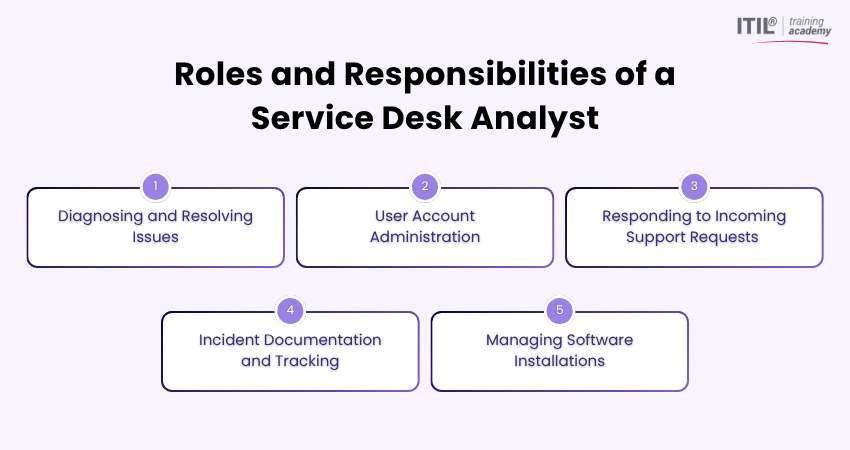
1) Diagnosing and Resolving Issues
A Service Desk Analyst uses structured troubleshooting methods to identify the underlying cause of technical problems. Whether it is a minor issue or a recurring fault, they apply suitable fixes or escalate when needed to ensure quick resolution.
2) User Account Administration
A Service Desk Analyst manage the full lifecycle of user accounts, including creation, access control, password resets, and deactivation. This helps maintain security while ensuring users have the correct level of access to systems and data.
3) Responding to Incoming Support Requests
A Service Desk Analyst handle incoming queries through tickets, calls, and emails, ensuring each request is acknowledged promptly. They prioritise issues based on urgency and impact to maintain productivity and reduce downtime.
4) Incident Documentation and Tracking
A Service Desk Analyst records all incidents, actions taken, and outcomes in a ticketing system. This documentation helps track recurring issues, supports knowledge sharing, and improves future response times and overall service quality.
5) Managing Software Installations
A Service Desk Analyst install, configures and updates software across systems, ensuring compatibility and compliance with organisational policies. Also, they support users in using applications and resolving software-related issues.
Bridge your skills to modern ITSM practices by joining the
ITIL® Version 5 Foundation Bridge Training
now!
Requirements for Becoming a Service Desk Analyst
To become a Service Desk Analyst, you require a strong understanding of IT systems along with the ability to resolve both common and complex technical issues. Generally, employers assess a candidate’s education, experience, and professional development to ensure they can handle the demands of the role. Let’s look at it below:
1) Education
There are no mandatory educational requirements for this role, and many positions are open to candidates without a degree. However, having a qualification in Information Technology, computer science, or any related field can improve your chances. Generally, these programmes take two to four years and help build core technical and problem-solving skills.
2) Experience
Employers prioritise candidates with practical experience in IT support and customer service. Even entry-level roles may expect some exposure to troubleshooting or user support. Also, experience in customer-facing roles, such as retail or helpdesk support, is valuable for developing communication and issue-handling skills.
3) Qualifications
Certifications and training can greatly improve your employability and career growth. Taking courses in IT support, Service Management, or customer service is beneficial. Also, recognised certifications, such as those from the Service Desk Institute (SDI) or frameworks like ITIL, are valued by employers and can open more career opportunities.
Key Skills of a Service Desk Analyst
A Service Desk Analyst relies on a combination of communication, teamwork, and organisational skills, along with practical technical abilities. These skills help in resolving user issues efficiently while maintaining a high level of service quality. Let’s look at the key required skills below:
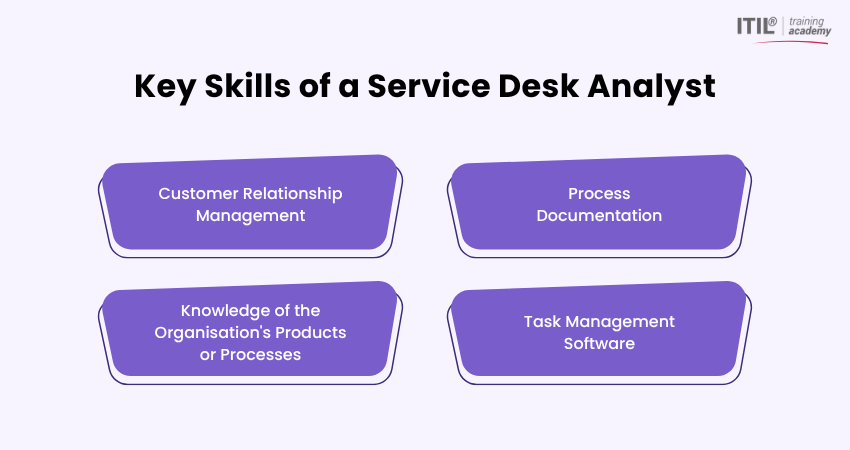
1) Customer Relationship Management
Customer Relationship Management (CRM) involves maintaining positive and consistent interactions with users. Service Desk Analysts follow structured approaches, such as scripts or guidelines, to provide accurate information and ensure no key details are missed. Also, they use CRM tools to access customer history, track interactions and deliver personalised support.
2) Process Documentation
Process documentation refers to creating and maintaining clear records of procedures, solutions, and recurring issues. Service Desk Analysts contribute to building a knowledge base that helps teams resolve problems faster and ensures consistency in how tasks are handled across the organisation.
3) Knowledge of the Organisation's Products or Processes
A strong understanding of the organisation’s products, services, or internal processes is essential. This enables Service Desk Analysts to diagnose issues quickly, provide accurate solutions and guide users effectively. It is especially valuable when dealing with technical systems or software platforms.
4) Task Management Software
Task Management software helps Service Desk Analysts organise, prioritise, and track support requests efficiently. These tools support workflow automation, provide visibility into ongoing tasks, and ensure that issues are resolved within expected timelines while keeping users informed.
Learn IT Service Management that drives results with
ITIL® 4 Foundation Training
today!
What are the Challenges of a Service Desk Analyst?
Working in a Service Desk Analyst role can be demanding, as it involves handling multiple technical issues while maintaining clear communication with users. Let’s look at the common challenges faced by a Service Desk Analyst below:
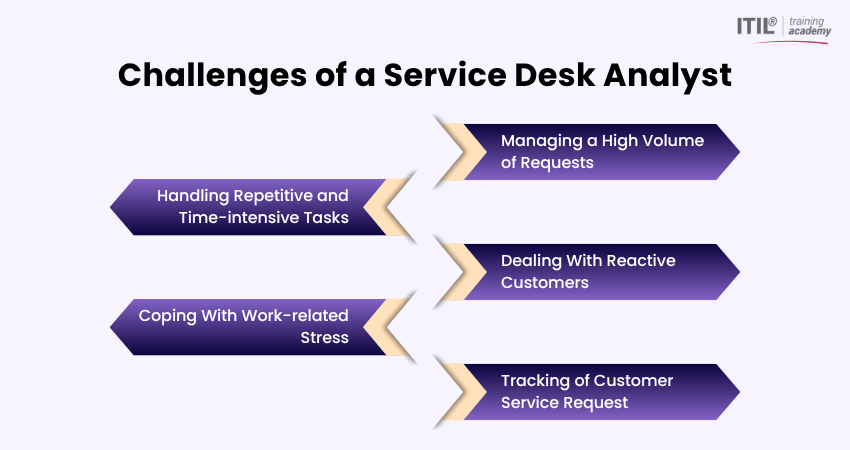
1) Managing a High Volume of Requests
It can be overwhelming to manage a high volume of support requests, especially during peak times or system outages. Service Desk Analyst must prioritise tasks based on urgency and impact while ensuring no request is overlooked. Also, constant interruptions can reduce focus and make it harder to complete ongoing tasks efficiently.
2) Handling Repetitive and Time-intensive Tasks
A large portion of requests involve routine issues, such as password resets or basic troubleshooting. While these tasks are simple, they can consume a lot of time if not managed efficiently. Also, maintaining an updated knowledge base and using automation tools can help reduce the workload and improve response times.
3) Dealing With Reactive Customers
Users may become frustrated when technical issues disrupt their work, leading to challenging interactions. Service Desk Analysts need to remain calm, listen actively, and manage expectations while working towards a solution. Also, handling such situations professionally is important to maintain trust and ensure a positive support experience.
4) Coping With Work-related Stress
For a Service Desk Analyst, the pressure to resolve issues quickly, combined with a high workload, can lead to stress. Over time, this may affect performance and well-being if not addressed. So, recognising early signs of stress and using coping strategies, such as taking short breaks or seeking support from colleagues, is important for maintaining balance.
5) Tracking of Customer Service Request
Service Desk Analysts must keep a detailed record of incidents, solutions, and changes, which can be a time-consuming process but is essential for effective ITIL Service Management. Also, accurate documentation helps to identify recurring issues, supports knowledge sharing, and ensures consistency in handling future requests.
Deliver exceptional IT services confidently with
ITIL® 5 Service Certification
– Join now!
Measuring the Performance of a Service Desk Analyst
Measuring the performance of a Service Desk Analyst helps organisations understand how effectively support is delivered and where improvements are needed. It focuses on both efficiency and quality, ensuring that users receive timely and high-quality service standards. Let’s look at the ways to measure their performance below:
1) Key Performance Indicators (KPIs)
Key Performance Indicators (KPIs) are used to evaluate how efficiently and effectively issues are handled. These metrics provide clear insights into workload, resolution speed, and the ability to manage tasks independently.
Key Metrics Include:
a) First Contact Resolution (FCR):
Measures the percentage of issues resolved during the first interaction with the user.
b) Average Handle Time (AHT):
Tracks the average time taken to resolve each user support request.
c) Ticket Volume:
Indicates the number of tickets handled over a specific period.
d) Escalation Rate:
Shows how often issues are passed or escalated to higher-level support.
e) Response Time:
Measures how quickly new user requests are acknowledged and addressed.
2) Customer Satisfaction Metrics
Customer satisfaction metrics help assess the quality of support from the user’s perspective. These indicators give you clarity on how users feel about the service they receive and how easy it is for them to get help.
Key Metrics Include:
a) Customer Satisfaction Score (CSAT):
Captures user feedback after an issue is resolved.
b) Net Promoter Score (NPS):
Measures how likely users are to recommend the support service.
c) Customer Effort Score (CES):
Evaluates how easy it was for users to resolve their issue.
d) Post-resolution Surveys: Provide detailed feedback on the overall support experience.
3) Continuous Improvement Feedback Loops
Continuous improvement focuses on using performance insights to enhance service quality. It involves regular evaluation, knowledge sharing, and ongoing learning to address gaps and improve efficiency.
Key Metrics Include:
a) Participate in regular performance reviews to assess strengths and areas for improvement.
b) Engage in peer discussions to share knowledge and best practices.
c) Analyse ticket trends to identify recurring issues and improve processes.
d) Apply lessons learned from past cases to handle future issues more effectively.
e) Attend training sessions to address skill gaps and stay updated with new practices.
Learn service desk skills for real-world support with
ITIL® 4 Practitioner: Service Desk Training
today!
Best Practices for Service Desk Analysts
Delivering consistent and efficient support requires more than just technical knowledge. Service Desk Analysts need to work in a more structured and adaptable way. Following best practices helps improve response times, maintain service quality, and ensure users receive consistent support. Let’s look at some of them below:
1) Prioritise and Categorise Requests:
Assess the urgency and impact of requests to handle critical issues first. A clear categorisation system ensures queries are routed to the right team quickly. This helps reduce delays and ensures important issues are not overlooked.
2) Maintain Accurate Documentation:
Record incidents, solutions, and user interactions clearly. Up-to-date documentation supports faster resolution and consistent service. Also, it helps teams refer to past cases when handling similar issues in the future.
3) Improve the Knowledge Base:
Regularly update the knowledge base with solutions and Frequently Asked Questions (FAQs). Keep content simple, relevant, and easy to navigate. A well-maintained knowledge base allows users and Analysts to find answers quickly.
4) Prioritise Self-care:
Manage workload effectively and take breaks to avoid burnout. Also, continuous learning helps to maintain performance. This supports long-term productivity and job satisfaction.
5) Follow a Problem-solving Approach:
Collect complete information, avoid assumptions, and follow a structured troubleshooting process. This ensures accurate resolutions and improves efficiency when similar issues occur again.
Tools Used by Service Desk Analysts
Service Desk Analysts rely on a variety of tools to manage support requests, resolve technical issues, and maintain system performance. Let’s look at the prominent tools below:
1) Ticketing Systems:
Ticketing systems are used to log, track, and prioritise user requests and incidents. They help manage workloads, monitor progress, and ensure issues are resolved within expected timeframes.
2) Remote Support Tools:
Remote support tools allow Analysts to access user devices and troubleshoot issues without being physically present. This helps resolve problems quickly and reduces downtime for users.
3) Collaboration Tools:
Collaboration tools support real-time communication between team members. They make it easier to share information, discuss issues, and seek assistance during complex problems.
4) Knowledge Management Platforms:
These platforms help store and organise troubleshooting guides, solutions and FAQs. They support faster issue resolution and allow users to find answers independently.
5) ITSM Software:
IT Service Management (ITSM) tools provide a broader system for managing IT services. They support processes, such as Asset Management, Change Management and service requests.
6) Monitoring and Alerting Tools: Monitoring tools track system and network performance in real time. They generate alerts for potential issues. This allows Analysts to act early and prevent disruptions.
Conclusion
A Service Desk Analyst plays a massive role in keeping IT services running smoothly by resolving issues, supporting users, and maintaining system efficiency. Understanding What is a Service Desk Analyst highlight the skills, responsibilities and career opportunities within this role. This makes it a strong starting point for anyone seeking a successful career in IT support.
Build strong IT Service Management foundations by joining the ITIL® Foundation Level Courses today!
Frequently Asked Questions?
A Service Desk Analyst can earn between £21K and £27K per year in the UK, depending on experience, location and organisation.
Yes, a Service Desk Analyst role can be stressful due to high ticket volumes, tight deadlines, and constant user interaction. Also, handling technical issues while managing demanding users can lead to pressure.
A good Service Desk Analyst combines strong communication, empathy, and listening skills with a willingness to help. Also, taking ownership of issues and staying accountable builds trust with users. Overall, a positive attitude, adaptability, organisation, and teamwork are key traits that ensure effective and reliable support.
Most Recent
Date - Aug 1, 2026
Date - Jul 18, 2026
Date - Jul 11, 2026