


 Back to
Topics
Back to
Topics



Author-David Walter

Last updated-Apr 18, 2026
Ever felt stuck between the need to release updates quickly and the fear of something breaking? This is a common challenge for many organisations today, where speed and stability must go hand in hand. That is exactly why approaches like DevOps and ITIL have become so important in modern IT environments.
When understanding ITIL vs DevOps, it is not about choosing one over the other but finding the right balance between control and agility. This blog explores their key differences, use cases, and best practices, showing how both can improve service delivery. Let’s explore how it all comes together!
What is ITIL?
ITIL, or Information Technology Infrastructure Library, is a widely accepted framework of best practices used in IT Service Management. It helps organisations align their IT services with business needs and deliver value in a consistent way.
It provides a structured approach for designing, delivering, managing, and improving IT services. By following standard processes, ITIL helps improve efficiency, reduce risks, and ensure that services meet customer expectations while supporting overall business goals.
What is DevOps?
DevOps is a set of methodologies and tools that help automate and streamline Software Development processes such as deployment, testing, and monitoring. It focuses on improving how development and IT operations teams work together.
The main goal of DevOps is to enhance communication and collaboration while using automation to speed up workflows. This helps organisations release software faster, improve quality, and deliver more reliable products.
Key Differences Between ITIL and DevOps
The key differences between ITIL and DevOps lie in team structure, delivery, and implementation. ITIL focuses on defined roles and structured processes, while DevOps emphasises collaboration, automation, and speed. Understanding ITIL vs DevOps becomes clearer below:
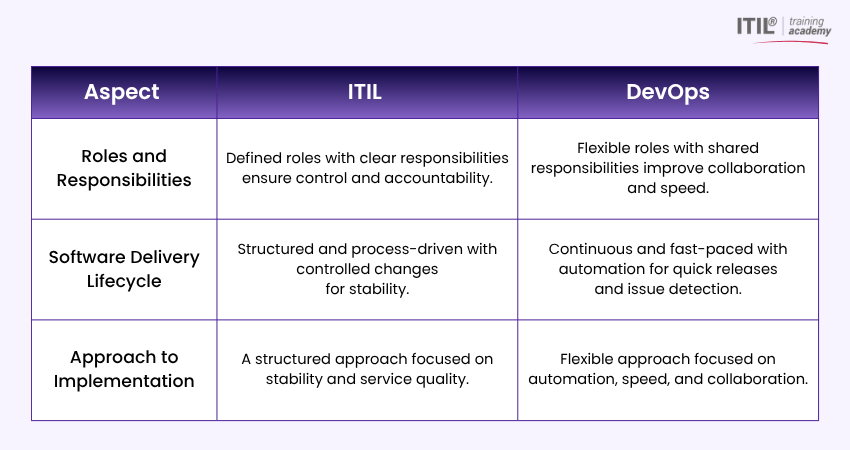
1) Roles and Responsibilities
In ITIL, roles are clearly defined and structured. Responsibilities are assigned to specific positions such as Service Strategy Managers, Demand Managers, and Business Relationship Managers. This ensures accountability, better control, and alignment with business objectives.
In DevOps, roles are more flexible and collaborative. Teams such as developers, DevOps Engineers, Release Managers, and Security Specialists work together. This shared responsibility improves communication and helps deliver software faster.
2) Software Delivery Lifecycle
In ITIL, the software delivery lifecycle is structured and process-driven. It focuses on service quality, defined workflows, and controlled changes to reduce risks and ensure reliable outcomes.
In DevOps, the lifecycle is continuous and fast-paced. It uses automation, continuous integration, and monitoring to release updates quickly and detect issues early, improving efficiency and speed.
3) Approach to Implementation
In ITIL, the approach is structured and focuses on stability. It reduces workloads through efficient IT Service Management and improves customer satisfaction with clear service agreements and defined processes.
In DevOps, the approach is flexible and methodical. It supports frequent deployments, uses automation to resolve issues, and promotes collaboration to improve workflows and delivery speed.
Develop ITIL skills to create, deliver, and manage digital products through the
ITIL® 5 Product Certification
– Join now!
Relationship Between ITIL and DevOps
Understanding ITIL vs DevOps and how they work together is important for modern organisations. Rather than choosing one, many combine both to improve performance and service delivery. This creates a balanced approach that supports control and flexibility, as shown below:
1) Complementary Approaches:
DevOps and ITIL work together rather than oppose each other, combining structure with agility.
2) ITIL for Stability:
ITIL provides a structured framework for IT Service Management, ensuring consistency, control, and alignment with business needs.
3) DevOps for Speed:
DevOps focuses on collaboration, automation, and faster delivery to improve efficiency and responsiveness.
4) Balanced IT Environment:
Together, they create a balance between stability and rapid innovation.
5) Improved Service Delivery:
Combining both helps organisations deliver reliable, high-quality services while adapting quickly to change.

Use Cases for ITIL and DevOps
ITIL and DevOps can solve a wide range of IT challenges. When comparing ITIL vs DevOps, each has its own strengths, but combining both often gives better results. Below are some practical use cases that show how they work individually and together:
1) Prevent Incidents Using ITIL and DevOps
ITIL helps prevent incidents through structured practices such as incident and problem management. These processes ensure risks are identified early and handled properly. This approach improves service stability and reduces the chances of recurring issues affecting users.
DevOps supports this by using automation, monitoring tools, and shared responsibility across teams. It helps detect issues early and respond quickly. This reduces downtime and limits the overall impact of incidents on systems and services.
2) Accelerate Releases with DevOps
ITIL focuses on controlled changes through defined approval processes. This helps reduce risks and maintain service stability. However, this structured approach can sometimes slow down the speed of releasing updates or new features in dynamic environments.
DevOps enables faster releases through small and frequent updates. It uses automation and continuous integration to speed up delivery. This approach allows teams to release updates quickly and fix issues easily without affecting overall system performance.
3) Enhance Processes with DevOps and ITIL
ITIL provides well-defined processes that guide IT operations and Service Management. These structured workflows ensure consistency and reliability. It helps organisations follow proven practices and avoid unnecessary errors when managing services and processes.
DevOps enhances these processes by adding automation, collaboration, and continuous feedback. It helps teams improve workflows and remove delays. This makes processes more efficient, flexible, and better suited to changing business and technical requirements.
4) Minimise Service Desk Requests with ITSM
ITIL uses ITIL knowledge management to document solutions while resolving issues. This helps create self-service options for users. As a result, common problems can be solved quickly without raising tickets, reducing the workload on service desk teams.
DevOps supports this by improving system reliability and fixing issues faster. It reduces repeated problems through better monitoring and automation. This leads to fewer support requests and improves the overall efficiency of IT support services.
5) Improve Customer Clarity with ITIL
ITIL improves customer clarity by using Service Level Agreements (SLA) to define services clearly. These agreements help set expectations and reduce confusion. Customers understand what they will receive, which improves trust and overall service satisfaction.
DevOps supports this by delivering updates quickly and improving service performance. Faster releases and reliable systems enhance user experience. This ensures customers receive better services and remain satisfied with ongoing improvements.
6) Perform Root Cause Analysis with DevOps
ITIL helps identify root causes through structured problem management practices. It ensures issues are analysed carefully, and solutions are documented. This helps prevent similar problems from occurring again and improves long-term service stability.
DevOps strengthens this with a blameless culture and open communication. Teams analyse failures without blame and focus on real causes. This helps resolve issues faster and encourages continuous improvement across systems and processes.
Build skills to design and manage impactful IT service experiences with the
ITIL® 5 Experience Certification
– Register now!
Best Practices for Integrating ITIL and DevOps
Bringing ITIL and DevOps together helps organisations balance control and speed. When exploring ITIL vs DevOps, the real value lies in combining both. This approach improves services while enabling faster delivery, as outlined below:
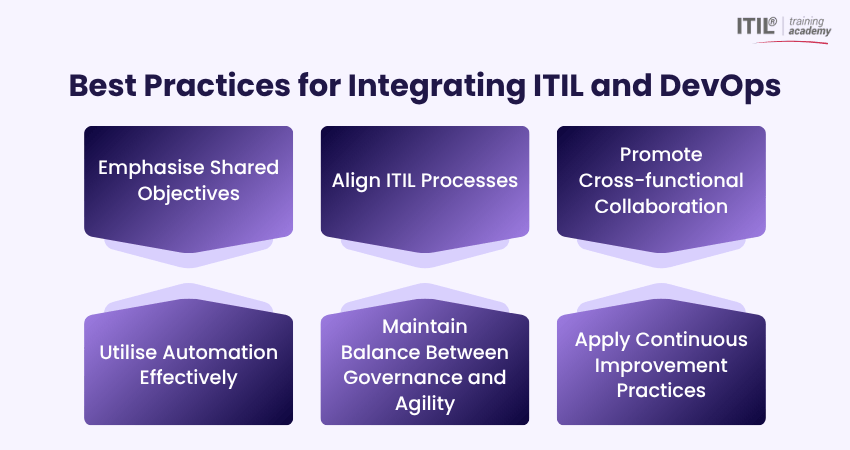
1) Emphasise Shared Objectives
Both DevOps and ITIL aim to deliver good services to customers. Teams should focus on common goals like improving service quality and reducing downtime. When everyone works towards the same outcome, it becomes easier to collaborate and achieve better results.
2) Align ITIL Processes
ITIL processes can feel strict, but they can be adjusted to support faster work. For example, small and low-risk changes can be approved quickly, while bigger changes follow proper checks. This helps teams move faster without losing control.
3) Promote Cross-functional Collaboration
Teams should include people from both development and operations. Working together helps share ideas and solve problems quickly. This improves communication and ensures that both stability and speed are maintained in projects.
4) Utilise Automation Effectively
Automation helps reduce manual work and saves time. Tasks like testing, monitoring, and incident handling can be automated. This improves accuracy, speeds up responses, and ensures work is done in a consistent way.
5) Maintain Balance Between Governance and Agility
It is important to balance control and flexibility. Clear rules should be set so teams know what they can do. This allows them to work quickly while still following important standards and avoiding risks.
6) Apply Continuous Improvement Practices
Teams should regularly review their work and look for ways to improve. Small and frequent changes help fix issues early. This ensures processes stay effective and continue to improve over time.
Advance your IT career with expert IT Service Management knowledge with the
ITIL® 5 Service Certification
– Join today!
How to Select the Right Approach for Your Specific Challenges?
Choosing the right approach depends on your organisation’s needs, goals, and working style. There is no one solution for all situations. The following factors will help you decide what works best, as outlined below:
1) Organisational Culture
Organisational culture plays a key role in choosing the right approach. If teams prefer structured work with clear roles, ITIL fits well. If the culture supports collaboration and flexibility, DevOps is more suitable for improving teamwork and speed.
2) Business Objectives
Business goals help decide the right approach. If the focus is on stability, risk control, and consistent service delivery, ITIL is a better choice. If the goal is faster releases, innovation, and quick response to change, DevOps works more effectively.
3) Team Structure
Team structure affects how work is managed. ITIL suits organisations with defined roles and separate teams. DevOps works best with close collaboration and shared responsibilities, improving communication, reducing delays, and delivering results more efficiently.
4) Resource Availability
Resources influence implementation. ITIL requires effort in documentation and process management, while DevOps needs tools, automation, and skilled teams. Organisations should choose an approach that fits their resources and supports long-term efficiency.
5) Existing Processes
Existing processes should be reviewed before choosing an approach. ITIL strengthens structured systems with clear workflows, while DevOps improves slow processes through automation and flexibility, helping organisations work faster and adapt easily.
6) Technology Ecosystem
Technology plays an important role in selection. Modern systems and cloud platforms support DevOps practices well. Traditional systems often align better with ITIL, as it focuses on stability, control, and structured Service Management practices.
7) Customer Expectations
Customer needs should guide the decision. DevOps suits environments needing quick updates and fast service, while ITIL fits where reliability and consistency matter. This helps ensure services align closely with customer expectations.
8) Compliance and Regulatory Requirements
Compliance is important in many industries. ITIL supports this through clear processes and documentation. DevOps can also be used but must follow strict rules to maintain compliance while ensuring speed and efficiency.
Conclusion
Choosing between ITIL vs DevOps depends on your organisation’s needs, but the real strength lies in using both together. ITIL brings stability and control, while DevOps adds speed and flexibility. By combining them wisely, organisations can deliver better services, adapt quickly, and stay competitive in a changing digital world.
Learn ITIL fundamentals to improve service delivery and business performance with the ITIL® Version 5 Foundation Certification – Join now!
Frequently Asked Questions?
The Five Pillars of DevOps, known as CALMS, include Culture, Automation, Lean, Measurement, and Sharing. They improve teamwork, reduce manual work, enhance efficiency, track performance, and promote knowledge sharing, helping teams deliver faster, reliable, and high-quality software.
DevOps Engineers need skills in automation, cloud platforms, and infrastructure management, along with strong collaboration. Key skills include Linux, scripting in Python or Bash, CI/CD tools like Jenkins, containers such as Docker and Kubernetes, and Infrastructure as Code tools like Terraform.
There is no single most important tool in DevOps. The focus is on processes, automation, and collaboration rather than on one tool. However, tools like Jenkins, Docker, Kubernetes, and Git are widely used to support development, deployment, and system management.
Most Recent
Date - Aug 1, 2026
Date - Jul 18, 2026
Date - Jul 11, 2026