


 Back to
Topics
Back to
Topics



Author-Maria Thompson

Last updated-May 1, 2026
Have you ever dealt with repeated IT issues that seem to be fixed but return tomorrow, slowing teams down and frustrating users? This happens when processes lack structure and consistency. Learning How to Implement ITIL can help bring clarity to your IT services, ensuring tasks are handled efficiently and consistently every time.
The real challenge is implementing ITIL in a way that fits your organisation. Many teams struggle with where to begin and how to make changes that last. In this blog, you will learn How to Implement ITIL, how it improves efficiency, its challenges, and best practices. Let’s begin!
How to Implement ITIL Successfully?
ITIL Implementation requires a structured and practical approach that aligns IT services with business requirements. Let’s look at the steps below to better understand How to Implement ITIL effectively and successfully:
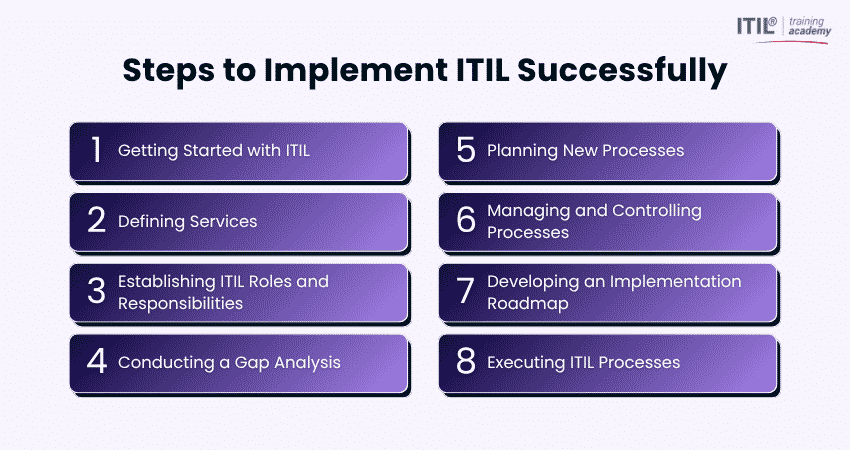
1) Getting Started with ITIL
Before starting ITIL Implementation, secure strong support from senior management to ensure the availability of funding, training, and resources. Also, appoint a dedicated ITIL process owner to oversee process integration, maintain documentation, and coordinate tools so all processes work together effectively.
2) Defining Services
Now, begin by identifying and defining both business services and supporting IT services. Business services deliver direct value to customers, while supporting services enable them to function. Document key commitments like availability and performance, as these will guide the Service Level Agreement (SLA) and technical design.
3) Establishing ITIL Roles and Responsibilities
Then, clearly define roles and responsibilities to ensure accountability and avoid confusion. Not every role may be required, but key roles must be assigned. Using a RACI matrix helps clarify ownership, and involving the same people in design and operations improves process adoption.
4) Conducting a Gap Analysis
After assigning roles, evaluate current processes to understand their maturity and identify gaps between the current and desired state. This step highlights which processes need improvement, replacement, or introduction, along with the required time, cost, and resources.
5) Planning New Processes
When planning new processes, follow ITIL best practices and align related processes, such as Incident and Problem Management. Clearly define inputs and outputs to ensure efficient workflows and reduce issues caused by incomplete or unclear data.
6) Managing and Controlling Processes
Establish measurable performance metrics to track process performance and ensure they meet expectations. These metrics should be practical and automated using tools like Service Desk software. Also, define clear reporting methods to maintain visibility and control.
7) Developing an Implementation Roadmap
Then, create a structured roadmap outlining key steps and timelines for implementation. Break the process into phases, focusing on high-priority areas and quick wins first to show early results and maintain stakeholder support.
8) Reviewing and Improving ITIL Processes
Once processes are live, assess whether they are delivering expected results. If gaps exist, use continual improvement, a core practice within ITIL Version 5's Collaborate, Assure and Improve (CAI) module to refine and enhance performance. It is important to note that ITIL is a long-term, iterative framework centred on sustained value delivery.
Bridge your knowledge to modern ITIL and effectively transition to
ITIL 5 by joining the ITIL® Version 5 Foundation Bridge Training
now!
How Do ITIL Processes Enhance the Efficiency and Effectiveness of IT Service Management?
ITIL processes improve efficiency by providing a standardised set of best practices that streamline workflows, reduce duplication, and ensure consistent service delivery. By clearly defining roles and responsibilities, ITIL eliminates confusion, ensures tasks are properly assigned, and improves coordination across teams.
They further enhance effectiveness by strengthening communication, accountability, and risk management. Processes like Change Management and IT Service Continuity Management help minimise disruptions and maintain service stability. Additionally, ITIL promotes continuous monitoring and improvement, using performance data and feedback to refine services over time. This leads to a more effective and high-quality IT Service Management environment.
What Common Challenges Arise During ITIL Implementation?
Implementing ITIL can bring significant improvements to IT Service Management, but organisations face practical challenges along the way. Let's look at some of the common challenges below:
1) Superficial Adoption
Some organisations adopt ITIL only at a surface level without fully integrating it into operations, resulting in limited effectiveness. This approach often fails to deliver meaningful improvements in service quality or performance.
2) Limited Business Support
If the business teams are not involved from the beginning, ITIL may not align with business goals. This can lead to poor integration and misunderstandings, reducing the value IT services deliver to the organisation.
3) Complexity in Phased Implementation
ITIL involves multiple processes and phases, which can become complex and disrupt operations if not implemented in a structured way. Poor planning can lead to confusion, delays, and inefficiencies.
4) Resistance to Change
Employees may resist adopting new ITIL processes, making it difficult to gain cooperation and ensure smooth implementation across teams. This happens when teams are used to existing workflows and are unsure about the benefits of change, slowing down adoption.
5) Insufficient Management Commitment
Without strong support from senior management, ITIL Implementation may lack the resources, direction, and priority needed for success. This can lead to delays, limited adoption, and reduced overall impact.
6) Ongoing Improvement and Monitoring Challenges
ITIL requires ongoing monitoring and improvement, which can be challenging for organisations without clear long-term planning and commitment. Without consistent tracking and review, processes may become outdated and fail to deliver expected results.
Take the next step with
ITIL® 5 Product Certification
and transform services.
What are the Best Practices for Successfully Implementing ITIL Processes?
Learning how to implement an ITIL process requires a focused and practical approach that aligns with business goals and delivers measurable value. Let’s look at some of the best practices below:
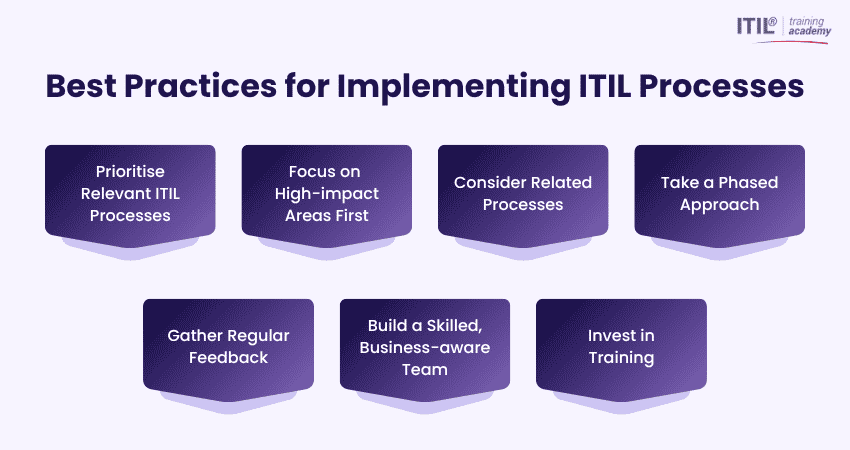
1) Prioritise Relevant ITIL Processes:
Start with the ITIL practices that address your organisation’s key challenges and align with business goals, ensuring a focused and practical implementation.
2) Focus on High-impact Areas First:
Begin with areas that deliver quick and visible results, such as recurring incidents or service issues, to demonstrate value early and build momentum.
3) Consider Related Processes:
Even when prioritising, consider how processes connect. ITIL works as an integrated system, so skipping related practices can reduce effectiveness.
4) Take a Phased Approach:
Implement ITIL step by step instead of all at once. This allows teams to adapt, reduces disruption, and improves results.
5) Gather Regular Feedback:
Collect feedback from employees, users, and stakeholders to identify gaps early and support continual improvement.
6) Build a Skilled, Business-aware Team:
Ensure your team has both ITIL knowledge and a clear understanding of business goals to deliver better service outcomes.
7) Invest in Training:
Provide training so team members understand ITIL concepts and can apply them consistently, supporting long-term success.
Conclusion
Successfully Implementing ITIL is about creating a structured, value-driven approach to managing IT services. By applying the right processes and best practices, organisations can build reliable, efficient, and scalable IT operations. Knowing how to implement ITIL helps teams deliver consistent results. At the same time, Service Integration and Management can strengthen coordination across complex service environments and support long-term success in a competitive environment.
Lay the groundwork for IT Service Excellence with the ITIL® Foundation Level Training – Sign up now!
Frequently Asked Questions?
ITIL can begin with basic tools like spreadsheets or email, but specialised IT Service Management tools are recommended for long-term success. These tools act as a central system, enabling automation, standardised workflows, and better control, making ITIL Implementation more efficient and scalable.
Yes, ITIL is compatible with Agile and DevOps. ITIL provides structured practices for managing IT services, while Agile focuses on flexibility and iterative delivery, and DevOps promotes collaboration and automation. Together, they help organisations balance governance, speed, and continuous improvement in service delivery.
IT Service Management is the broad discipline focused on managing IT services to meet business needs. In contrast, ITIL is a specific framework within ITSM that provides structured guidance and practices for how to design, deliver, and improve those services.
Most Recent
Date - Aug 1, 2026
Date - Jul 18, 2026
Date - Jul 11, 2026