


 Back to
Topics
Back to
Topics



Author-Hailey Davis

Last updated-Apr 18, 2026
Change today doesn’t wait for anyone. Markets shift overnight, technology evolves faster than ever, and what worked yesterday may not work tomorrow. This constant disruption can feel overwhelming, leaving many businesses unsure of their next move. That’s where VUCA comes in.
It gives you a simple way to understand why things feel so uncertain and complex, and how to deal with them. Instead of seeing change as a threat, it helps businesses recognise patterns and respond in a smart way. In this blog, we’ll explore What is VUCA, how each element affects your organisation, and practical ways to navigate uncertainty. Let's get started!
What is VUCA?
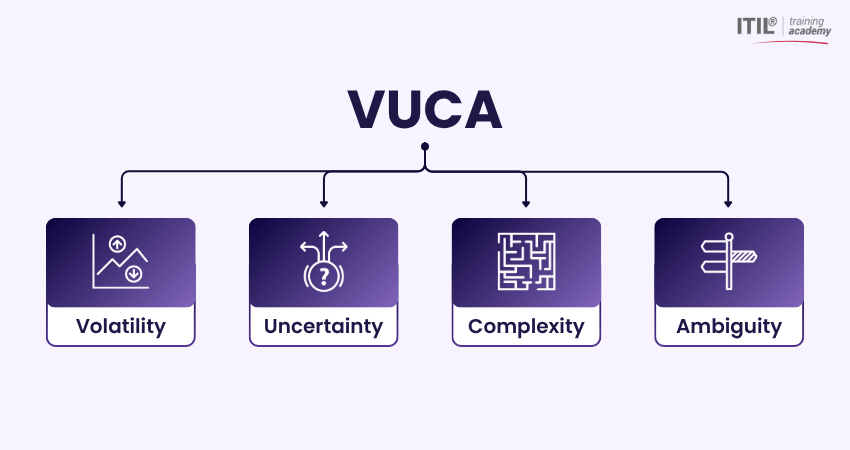
VUCA is a term used to describe the unpredictable and fast-changing conditions that organisations face today. It stands for Volatility, Uncertainty, Complexity, and Ambiguity, four factors that explain why decision-making has become more challenging in modern environments.
Originally introduced by the US army after the Cold War, the VUCA term has since become widely used in leadership, management, and strategic planning. It helps organisations understand the nature of change and how it affects planning, strategy, and performance. Instead of relying on fixed approaches, businesses must learn to adapt quickly, think strategically, and respond to unexpected situations.

What Does VUCA Mean?
To truly understand What is VUCA, it is important to look at each part individually. Each element represents a different type of challenge that organisations face in a rapidly changing world. Let's check each part of VUCA:
1) Volatility
Volatility refers to the speed and magnitude of change. In a volatile environment, situations can shift rapidly and unexpectedly, often without warning. Markets fluctuate, customer preferences evolve overnight, and external factors like political changes or pandemics can disrupt operations instantly.
Strategies for Managing Volatility
To handle volatility, organisations must focus on flexibility and preparedness. Some effective approaches include:
1) Building Agile processes that allow quick adaptation
2) Keep extra resources or savings for emergencies
3) Avoid depending on a single supplier or market
4) Investing in real-time data and monitoring systems
2) Uncertainty
Uncertainty happens when the future is unclear. Even if you know something is going to change, you may not know when it will happen or what the exact result will be. For example, a company may know that new technology will affect its industry, but it may not know how or when. This makes decision-making difficult because there is not enough information.
Strategies for Managing Uncertainty
Handling uncertainty requires strong awareness and forward thinking. Key strategies include:
1) Using Data Analytics and forecasting tools to understand possible outcomes
2) Encouraging scenario planning and risk assessment
3) Investing in continuous learning and skill development
4) Build strong decision-making processes
3) Complexity
Complexity refers to the number of interconnected factors influencing a situation. In complex environments, multiple variables interact in ways that are difficult to predict or control. For example, a global company needs to handle different laws, cultures, currencies, and customer needs. All these factors are connected, making decisions more complicated.
Strategies for Managing Complexity
Organisations can manage complexity better by simplifying how they operate. You can follow these strategies for that:
1) Break large problems into smaller, simpler tasks
2) Improve teamwork across departments
3) Use advanced tools like Artificial Intelligence (AI) and automation for analysis
4) Creating clear processes and governance frameworks
4) Ambiguity
Ambiguity occurs when situations lack clarity or have multiple interpretations. Unlike uncertainty, where outcomes are unclear, ambiguity involves unclear meaning itself. This often happens in new or unfamiliar scenarios where there is no precedent to follow. For example, entering a new market or launching a new product can involve ambiguity.
Strategies for Managing Ambiguity
To manage ambiguity, you need creativity, experimentation, and an open mind. Some of the common strategies to follow include:
1) Gather as much information as possible before making decisions
2) Try new ideas and learn from experiments
3) Accept and adopt a test-and-learn approach
4) Stay flexible and be ready to change your approach
Build confidence in managing IT services with
ITIL® Version 5 Foundation Certification
– Register today!
Strategies for Dealing With VUCA World
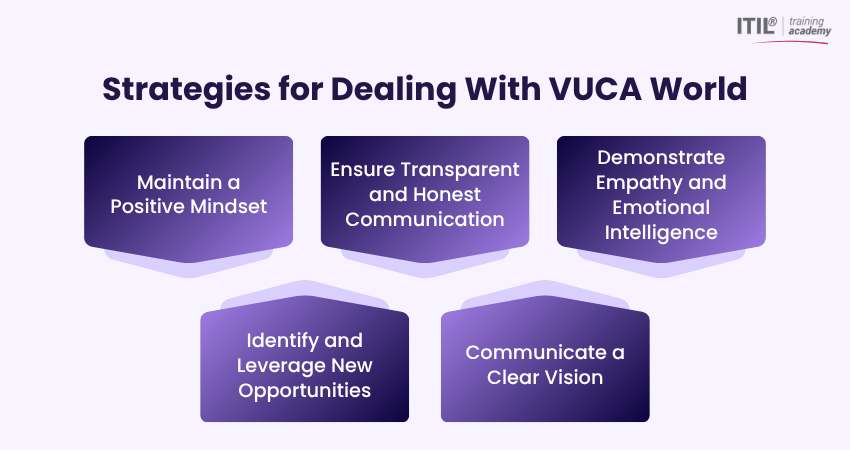
Being in a VUCA world can feel challenging, but the right strategies can make a big difference. Below are some strategies to help manage it more successfully:
1) Maintain a Positive Mindset
A positive mindset is very important in a VUCA world. When things are uncertain or changing quickly, people can feel stressed or confused. Staying positive helps individuals and teams remain calm and focused. This improves confidence and helps teams identify effective solutions.
2) Ensure Transparent and Honest Communication
Clear and honest communication is important when dealing with change. If people do not understand what is happening, they may feel confused or worried. Sharing information openly helps build trust and keeps everyone aligned.
3) Demonstrate Empathy and Emotional Intelligence
In times of uncertainty, people need support and understanding. Emotional Intelligence (EQ) helps leaders understand how others feel and respond in a helpful way. Also, showing empathy builds strong relationships and improves teamwork.
4) Identify and Leverage New Opportunities
Even though a VUCA world is challenging, it also creates new opportunities. Changes in the market can open doors for new ideas, products, or services. Organisations that stay alert and are willing to adapt can take advantage of these opportunities and drive long-term success.
5) Communicate a Clear Vision
A clear vision helps guide an organisation during uncertain times. Even if the future is unclear, having a strong direction keeps everyone focused. Leaders should clearly explain their goals and make sure all employees understand them. This gives teams a sense of purpose and stability.
Stay relevant in today’s evolving IT landscape with
ITIL® Version 5 Foundation Bridge Training
– Join now!
Leadership Approaches to Overcome VUCA Challenges
Leadership plays a significant role in guiding teams through uncertainty and change. Below are some effective leadership approaches that can help overcome VUCA challenges:
1) Agile Leadership
Agile leadership focuses on flexibility, collaboration, and rapid decision-making. Agile leaders embrace change rather than resist it. They encourage continuous improvement and empower teams to respond quickly to new challenges. This makes it easier to handle sudden changes effectively.
2) Transformational Leadership
Transformational leaders inspire their teams to think differently and aim for long-term success. They focus on change, innovation, and growth. By motivating employees and encouraging new ideas, they help organisations adapt effectively to evolving environments.
3) Servant Leadership
Servant leadership focuses on the needs of employees and stakeholders. Leaders prioritise supporting their teams, enabling them to perform at their best. This creates trust, strong relationships, and a positive work culture. In a VUCA world, this support helps teams stay resilient and confident.
What Industries are Most Susceptible to VUCA?
Some industries are more affected by VUCA than others because they face rapid changes and uncertain situations. Below are some of the industries that are susceptible to VUCA:
1) Finance and Economic Sectors
The finance industry is highly sensitive to volatility and uncertainty. Market fluctuations, regulatory changes, and global economic conditions can significantly impact operations. Financial institutions must constantly adapt to changing environments and manage risks effectively.
2) Technology and IT Industry
The Information Technology (IT) sector experiences rapid innovation and disruption. New technologies emerge frequently, making existing systems obsolete. This creates both opportunities and challenges for organisations.
3) Healthcare Sector
Healthcare faces complexity and uncertainty due to evolving regulations, technological advancements, and unpredictable health crises. These changes can affect how services are delivered and how organisations plan their resources, with a strong focus on quality and patient safety.
4) Government and Public Administration
Governments operate in highly complex environments. They address diverse challenges such as economic stability, public health, and social issues. Decision-making in this sector often involves multiple stakeholders and competing priorities, making it highly susceptible to VUCA conditions.
Conclusion
VUCA reflects the reality of the world we live in today, one that is constantly changing and often unpredictable. Instead of seeing them as obstacles, businesses can view them as chances to grow, adapt, and innovate. By building the right mindset of What is VUCA, improving communication, and adopting flexible leadership styles, you can stay strong even during constant change.
Develop practical strategies to handle IT change with ITIL® Strategic Leader (SL) Training – Sign up soon!
Frequently Asked Questions?
To cope with VUCA, organisations can focus on staying flexible and prepared with strong teams and skills. It is also important to accept change, communicate clearly, and stay open to new ideas. These steps help organisations handle challenges with confidence.
Yes, VUCA is still very relevant today. The world continues to change quickly due to technology, global events, and shifting markets. Therefore, it remains a useful concept for understanding modern challenges and improving decision-making.
VUCA has been replaced by frameworks like BANI (Brittle, Anxious, Nonlinear, and Incomprehensible). BANI reflects today’s highly connected world and helps leaders understand fragile systems and complex cause-and-effect patterns. It also helps explain modern challenges beyond traditional VUCA environments.
Most Recent
Date - Aug 1, 2026
Date - Jul 18, 2026
Date - Jul 11, 2026