


 Back to
Topics
Back to
Topics



Author-Maria Thompson

Last updated-Mar 21, 2026
Have you ever sat in a meeting where everyone discusses an IT issue, yet no one is clearly responsible for fixing it? Deadlines pass, updates are vague, and accountability feels blurred. In fast-paced IT environments, even small confusion about ownership can turn minor issues into major disruptions. This is where the ITIL RACI Matrix becomes a game-changer in structured Service Management.
By defining who is Responsible, Accountable, Consulted, and Informed, the ITIL RACI Matrix turns scattered efforts into clear, coordinated action. It removes guesswork and strengthens governance. Let’s explore how this clarity strengthens IT Service Management in practice.
A RACI Matrix in ITIL is a responsibility assignment tool that defines who does what within IT Service Management processes. The ITIL RACI model clarifies which activities each person, team, or group is expected to perform, helping prevent confusion, duplication, and delays across practices such as Incident, Problem, and Change Management.
The RACI model includes four roles: Responsible, Accountable, Consulted, and Informed. Responsible performs the task, Accountable owns the final outcome, consulted provides input, and informed receives updates. Only one role is accountable for each activity, ensuring clear ownership and stronger governance.

How RACI is Used in the ITIL Framework?
In the ITIL framework, a RACI Matrix defines and documents roles and responsibilities across Service Management processes. While ITIL outlines what activities should be performed, RACI clarifies who is Responsible, Accountable, Consulted, and Informed. This structured approach strengthens governance, improves coordination, and reduces operational confusion.
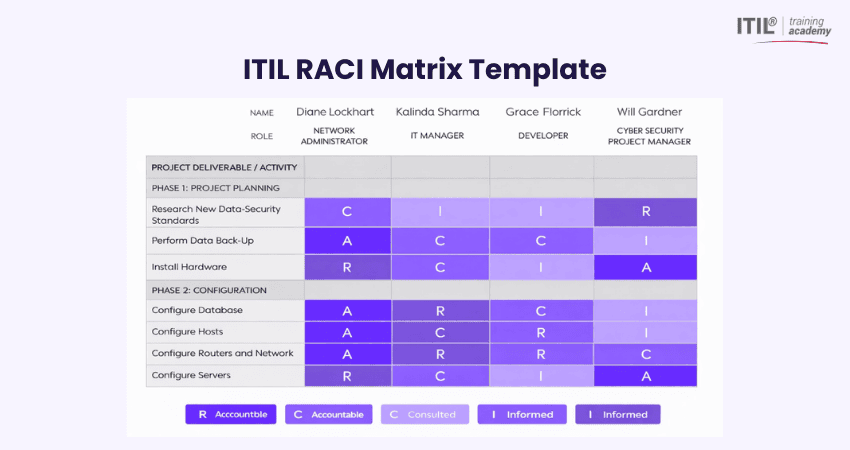
In ITIL practices, RACI is used to:
1) Define Accountability:
Ensure only one role is ultimately answerable for each activity
2) Clarify Execution Roles:
Identify who performs the task and who supports it
3) Improve Process Flow:
Specify who must be consulted or informed to reduce delays
4) Reduce Confusion:
Prevent overlapping duties and duplicate efforts
5) Assign Job Roles:
Allocate responsibilities to roles, not individuals, to maintain continuity
6) Strengthen Maturity:
Promote clear role definitions and documented processes
RACI for Problem Management
A RACI Matrix for Problem Management defines clear roles for identifying, analysing, and resolving the root causes of incidents. It ensures structured accountability, improves root cause analysis, and reduces recurring issues by clearly assigning ownership across teams.
RACI roles in Problem Management typically include:
1) Problem Manager:
Accountable for the entire process, including completion of Root Cause Analysis and driving resolution.
2) Specialist or Technical Teams:
Responsible for investigating root causes and implementing technical fixes.
3) Problem Analyst:
Responsible for trend analysis and identifying recurring incidents.
4) Service Desk or Incident Management:
Informed about known errors and workarounds and may be Responsible for providing initial input.
5) Change Management:
Consulted when permanent fixes require formal approval and controlled implementation.
Refresh your ITIL knowledge and step confidently into the latest framework with the
ITIL® Version 5 Foundation Bridge Training
– Register now!
RACI for Change Management
It assigns clear ownership, approval authority, and communication roles to reduce risk and prevent poorly controlled changes. ITIL Change Management helps establish a structured approach to managing these changes. The key change management roles are outlined below:
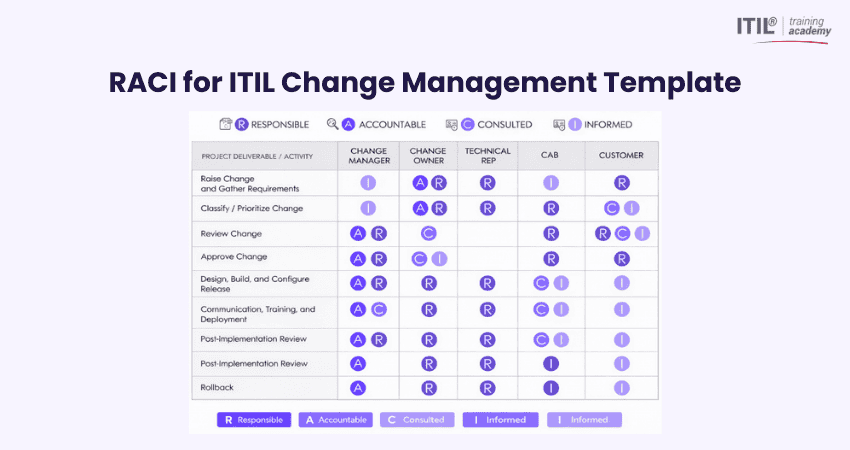
1) Change Owner
The Change Owner is typically responsible for managing the change from initiation to closure. This role ensures proper documentation, risk and impact assessments, and a rollback plan if required. The Change Owner may also be accountable for securing approvals and aligning the change with business objectives.
2) Change Manager
The Change Manager oversees the overall Change Management process and governance. This role is usually accountable for approving or rejecting changes based on risk, impact, and compliance requirements. The Change Manager coordinates assessments, chairs approval meetings if required, and ensures that changes follow organisational policies and standards.
3) Change Initiator
The Change Initiator is responsible for raising the change request. This role, often a developer, analyst, or service owner, provides justification, outlines expected benefits, and submits supporting details. The Change Initiator is usually consulted during evaluation and Informed of the final decision.
RACI for Incident Management
The Change Initiator is responsible for raising the change request. This role, often a developer, analyst, or service owner, provides justification, outlines expected benefits, and submits supporting details. The Change Initiator is usually consulted during evaluation and informed of the final decision.
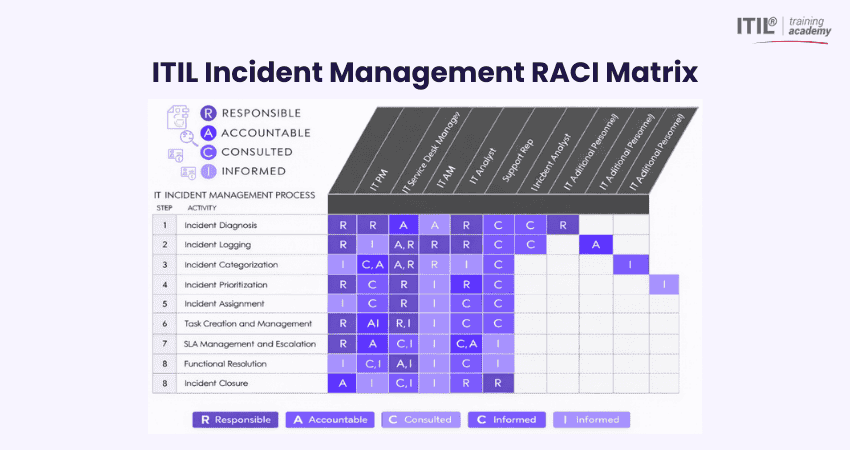
1) Service Desk:
Responsible for logging, categorising, and prioritising incidents, and keeping users informed of updates.
2) Incident Manager:
Accountable for overseeing the entire incident lifecycle, coordinating response efforts, and ensuring timely resolution.
3) Technical or Support Teams:
Responsible for investigating the issue, diagnosing root causes, and implementing fixes.
4) Service Owner or Business Stakeholders:
Informed about major incidents and consulted when business impact decisions are required.
Conclusion
The ITIL RACI Matrix brings clarity, control, and confidence to Service Management processes. Defining clear accountability and structured collaboration reduces confusion, speeds up decisions, and strengthens governance. When roles are transparent and ownership is clear, organisations deliver more reliable services and drive lasting operational improvement.
Gain practical ITIL knowledge and excel in IT service delivery excellence through the
ITIL® Foundation Level Training
– Join now!
Frequently Asked Questions?
The RACI Matrix includes four role types:
1. Responsible (R): Completes the task
2. Accountable (A): Owns the final outcome. Only one person holds this role
3. Consulted (C): Provides input before action
4. Informed (I): Receives updates on progress
The five levels of ITIL are:
1) ITIL Foundation: Introduces core ITIL concepts
2) ITIL Practice Manager: Applies ITIL practices in operations
3) ITIL Managing Professional: Builds advanced Service Management skills
4) ITIL Strategic Leader: Connects IT strategy to business goals
5)ITIL Master: Demonstrates expert-level ITIL application
A RACI Matrix for IT Services maps roles such as Service Desk or System Administrator to ITIL processes like Incident and Change Management. It defines who is Responsible, Accountable, Consulted, and Informed, ensuring clear ownership and accountability in IT operations.
Most Recent
Date - Aug 1, 2026
Date - Jul 18, 2026
Date - Jul 11, 2026