


 Back to
Topics
Back to
Topics



Author-Debra Jones

Last updated-Mar 14, 2026
Have you ever faced slow IT support, unresolved system issues, or unclear service processes at work? These challenges often arise when organisations lack a structured approach to managing IT services. As businesses rely more on technology, having an effective system for delivering and managing IT services has become essential. This is where frameworks such as ISO 20000 and ITIL play an important role.
When comparing ISO 20000 vs ITIL, organisations often ask which approach better improves service quality and efficiency. ITIL offers best-practice guidance, while ISO 20000 provides a formal international Service Management standard. This blog explores their key differences and how they support IT Service Management. Let’s get started!
Overview of ISO 20000
ISO 20000 is an international standard for IT Service Management (ITSM) developed by the International Organization for Standardization (ISO). It provides global guidelines that help organisations maintain quality, consistency, and efficiency in delivering IT services.
The standard can be adopted by both IT and non-IT organisations that rely on technology to deliver services. Organisations seeking ISO 20000 Certification must undergo an external assessment to confirm their Service Management processes meet the required standards.
Key Characteristics of ISO 20000:
1) Comprehensive and Systematic Approach:
Provides a structured framework with clear processes for effective IT Service Management.
2) Widely Adopted Across Industries:
Used across sectors such as finance, healthcare, telecommunications, and government.
3) Alignment with Other ISO Standards:
Compatible with standards like ISO 9001 (Quality Management) and ISO 27001 (Information Security).
4) Organisational Certification:
Organisations can obtain certification through an accredited assessment process.
History of ISO 20000
The development of ISO 20000 has evolved over several stages as IT Service Management practices matured. The key milestones in its roadmap are as follows:
1) 1980s (Early Service Management Practices):
The concept of structured IT Service Management began gaining importance, leading to the development of formal standards for managing IT services effectively.
2) BS 15000 by the British Standards Institution (BSI):
The first formal standard for IT Service Management was introduced by the British Standards Institution as BS 15000, providing guidelines for managing IT services.
3) 2005 (Introduction of ISO/IEC 20000):
BS 15000 was adopted internationally and published as ISO/IEC 20000, becoming the first globally recognised IT Service Management standard.
4) 2011 (Revision of the Standard):
The ISO 20000 standard was reviewed and updated to improve its structure and align with evolving Service Management practices.
5) 2018 (Latest Version ISO/IEC 20000-1:2018):
The most recent version of the standard introduced improved requirements for Service Management systems, supporting better integration and continuous service improvement.

Overview of ITIL
Information Technology Infrastructure Library (ITIL) is an internationally recognised IT Service Management (ITSM) framework that defines best practices for delivering high-quality IT services. It helps organisations manage IT services while aligning them with business goals.
ITIL also supports continuous improvement and can integrate with approaches such as Agile, DevOps, and Lean, helping organisations improve service delivery and support digital transformation.
Key Characteristics of ITIL:
1) Improves Quality of IT Services
: Helps organisations deliver reliable, efficient, and high-quality IT services.
2) Supports Integration with Agile, DevOps, and Lean:
Allows organisations to incorporate modern development and operational practices.
3) Provides a Holistic View of Operations:
Offers a broader perspective of Service Management and organisational processes.
4) Supports Digital Transformation:
Helps organisations modernise IT services and adapt to evolving technologies.
History of ITIL
The development of ITIL has evolved over several stages as IT Service Management practices advanced. The key milestones in its roadmap are as follows:
1) 1980s (ITIL v1):
ITIL was developed by the UK government to establish standardised best practices for managing IT services across government agencies and improving ITIL Service Delivery.
2) 2000–2001 (ITIL v2):
ITIL v2 simplified the framework by consolidating more than 30 volumes into nine core books, making it easier to adopt across private-sector organisations.
3) 2007–2011 (ITIL v3):
ITIL v3 introduced the Service Lifecycle model, organising IT Service Management into stages such as Strategy, Design, Transition, Operation, and Continual Improvement.
4) 2019 (ITIL 4):
ITIL 4 modernised the framework by introducing value co-creation and integrating approaches such as Agile, DevOps, and Lean to support digital transformation.
5) 2026 (ITIL Version 5):
The latest version expands the framework beyond traditional IT Service Management, focusing on a unified Digital Product and Service Management model for modern digital ecosystems.
Kickstart your ITSM journey with our
ITIL® 4 Foundation Training
- Register now!
Key Differences Between ISO 20000 and ITIL
ISO 20000 and ITIL are widely used in IT Service Management (ITSM) but serve different purposes. ISO 20000 focuses on formal standards, while ITIL provides best practice guidance. The key difference between ITIL and ISO 20000 is explained below:

1) Nature
ISO 20000 is an internationally respected standard that defines specific requirements for establishing and maintaining an IT Service Management system. Organisations must meet these requirements to demonstrate compliance with globally recognised Service Management practices.
ITIL, in contrast, is a framework of best practices that provides guidance on how organisations can manage IT services effectively. It offers recommendations rather than mandatory rules, allowing organisations to adopt the practices that best suit their operations.
2) Certification
ISO 20000 Certification is awarded to organisations after they successfully pass an external audit conducted by an accredited certification body. This certification confirms that the organisation’s IT Service Management processes meet the requirements of the standard.
ITIL Certification is primarily designed for individual professionals. IT professionals can obtain ITIL Certifications to demonstrate their knowledge and skills in applying IT Service Management best practices.
3) Focus
ISO 20000 focuses on structured Service Management processes and ensuring consistent service delivery. It emphasises process control, governance, and compliance with defined requirements.
ITIL focuses more on guidance and continuous improvement. It helps organisations design, deliver, manage, and improve IT services by providing practical recommendations for Service Management activities.
4) Rigidity vs Flexibility
ISO 20000 is more structured and prescriptive because organisations must follow clearly defined requirements to achieve certification. This ensures consistency and compliance with international IT Service Management standards.
ITIL is more flexible and adaptable. It allows organisations to tailor the framework according to their business needs, organisational structure and overall ITIL Service Management maturity level across different operational environments.
Transition from previous ITIL versions to modern digital Service Management through the
ITIL® Version 5 Foundation Bridge Training
– Join now!
ITIL vs ISO 20000: Key Comparison
ISO 20000 and ITIL both support IT Service Management (ITSM) but serve different roles. ITIL provides best-practice guidance, while ISO 20000 defines formal requirements. The key comparison between ISO 20000 and ITIL them is shown below:
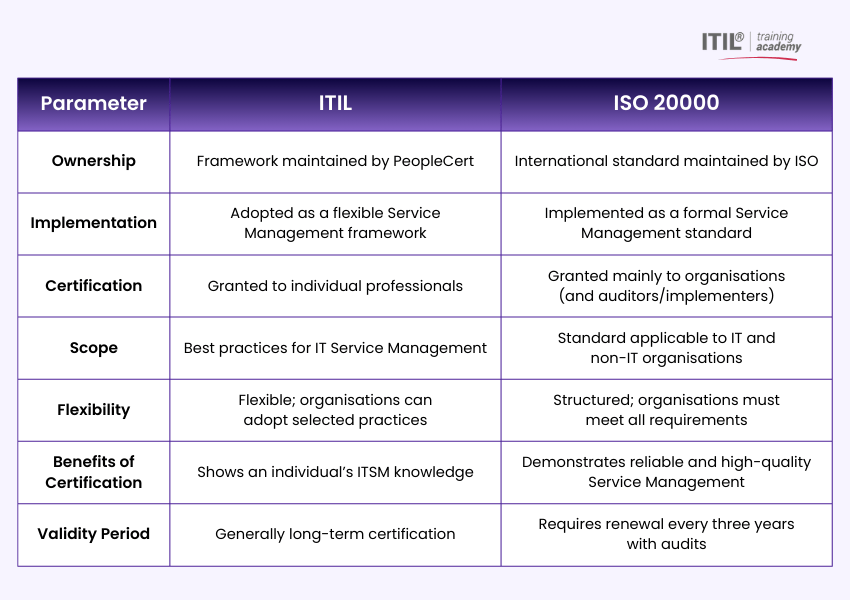
How do ITIL and ISO 20000 Fit Together?
ISO 20000 and ITIL complement each other in IT Service Management (ITSM). ITIL provides best-practice guidance on how to manage and improve IT services, while ISO 20000 defines the formal requirements for certification. Organisations often use ITIL practices to build processes that meet ISO 20000 standards.
Conclusion
Making the right pick between ISO 20000 vs ITIL depends on an organisation’s Service Management goals. While ITIL guides teams with practical best practices, ISO 20000 provides a structured standard for certification and compliance. Understanding ISO 20000 vs ITIL helps organisations build stronger processes, improve service quality, and deliver reliable IT services.
Gain essential ITIL knowledge to improve service delivery and operational efficiency through the
ITIL® Foundation Level Certification
– Join now!
Frequently Asked Questions?
The five stages of ITIL are Service Strategy, Service Design, Service Transition, Service Operation and Continual Service Improvement. These stages form the IT service lifecycle and help organisations manage services from planning to continuous improvement.
ISO 20000 Certification demonstrates that an organisation follows internationally recognised IT Service Management standards. It improves service quality, strengthens governance, increases customer confidence and helps organisations deliver consistent and high-quality IT services.
Both ISO 20000 and ITIL focus on improving IT Service Management and ensuring reliable service delivery. They emphasise structured processes, continuous improvement and aligning IT services with business objectives. Many organisations use ITIL practices to support ISO 20000 implementation.
Most Recent
Date - Oct 23, 2026
Date - Aug 1, 2026
Date - Jul 18, 2026