


 Back to
Topics
Back to
Topics



Author-Maria Thompson

Last updated-May 23, 2026
Have you ever dealt with slow IT support, unclear processes, constant service issues, or teams blaming each other when something goes wrong? These are common problems in many organisations, and in most cases, the issue is not just the technology but how people, processes, suppliers, and systems work together. This is where the Four Dimensions of ITIL Service Management make a real difference.
The Four Dimensions help organisations build practical, efficient, and customer-focused IT services. By balancing people, technology, partners, and workflows, businesses can improve teamwork, reduce disruptions, and deliver better customer experiences. In this blog, you will explore the 4 Dimensions of ITIL, their importance, and benefits. Let’s begin!
What are the Four Dimensions of Service Management?
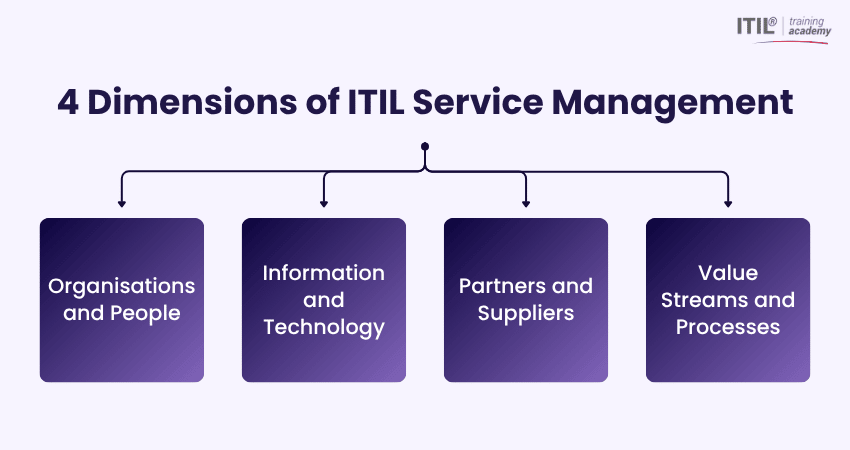
The 4 Dimensions of ITIL Service Management provide a balanced approach to delivering effective IT services. They focus on Organisations and People, Information and Technology, Partners and Suppliers, and Value Streams and Processes to improve collaboration, service quality, efficiency, and business value. Let’s explore each dimension in detail:
Dimension 1: Organisations and People
The Organisations and People dimension focuses on the workforce, organisational structure, culture, and skills required to deliver effective IT services. It highlights how people and organisational dynamics directly influence service quality and performance. Let’s explore its key elements:
1) Organisational Structure
Organisational structure defines how authority, responsibilities, and communication are managed within an organisation. Clear structures help teams coordinate effectively, improve decision-making, and create smooth escalation paths for IT Service Management activities. Well-defined roles and responsibilities also ensure accountability and efficient service delivery.
2) Organisational Culture
Organisational culture refers to the values, behaviours, and working practices followed within a company. A service-oriented culture encourages customer satisfaction, teamwork, innovation, and continuous improvement. It also helps organisations remain adaptable to changing technologies, business demands, and customer expectations.
3) People
People play a central role in IT Service Management because they design, manage, support, and improve IT services. Organisations must invest in employee training, development, motivation, and leadership to build skilled teams capable of delivering reliable, value-driven services. Strong leadership also helps guide teams towards achieving Service Management goals effectively.
4) Impact on IT Service Management
This dimension strengthens IT Service Management by aligning IT services with organisational goals, improving collaboration across teams, and enabling organisations to adapt to change more effectively. By focusing on people, structure, and culture together, organisations can improve service quality, operational efficiency, and customer satisfaction.
Dimension 2: Information and Technology
The Information and Technology dimension focuses on the data, systems, tools, and technologies needed to support effective IT services. It highlights the importance of reliable information management and modern technology in improving service quality, efficiency, and decision-making. Let’s explore its key elements:
1) Information Management
Information management involves collecting, storing, processing, and sharing data effectively within an organisation. Proper information management improves decision-making, strengthens communication, and ensures reliable service delivery. Information systems also support operations and help organisations maintain accurate, accessible data.
2) Technology Infrastructure
Technology infrastructure includes the hardware, software, networks, cloud services, and tools needed to support IT operations. Strong infrastructure enables smooth service delivery, secure data handling, efficient communication, and reliable business operations while helping organisations remain scalable and adaptable to changing technological demands.
3) Integration of Information and Technology in ITIL Processes
Information and technology play an important role across ITIL processes. In service design, technology supports innovative services, while in service transition, information systems help manage changes smoothly. During service operation, automation and tools improve incident and problem management, while data helps identify areas for continual improvement.
4) Challenges and Considerations
Organisations may face challenges such as cybersecurity threats, outdated technologies, and data privacy concerns. Rapid technological changes require continuous updates and investments, while compliance with data protection regulations is essential for maintaining security and customer trust.
Advance your ITIL expertise for better service performance and operational success with the ITIL® 5 Service Certification Training – Sign up now!
Dimension 3: Partners and Suppliers
The Partners and Suppliers dimension focuses on external organisations, vendors, and service providers that support IT services. It emphasises the importance of building strong relationships, effective communication, and strategic collaboration to ensure consistent service delivery and business value. Let’s explore its key elements:
1) Understanding the Role of Partners and Suppliers
Partners and suppliers help organisations achieve business and Service Management goals by providing technologies, specialised services, or operational support. Some act as strategic partners supporting long-term objectives, while others provide daily operational services or niche expertise that organisations may not have internally.
2) Collaboration and Integration
Effective collaboration with partners and suppliers ensures smooth service delivery and better alignment with organisational objectives. Clear communication, shared goals, and proper technology integration help organisations build strong relationships and maintain efficient service operations.
3) Challenges and Solutions
Organisations may face challenges such as quality inconsistencies, integration difficulties, or misaligned objectives with suppliers. These challenges can be managed through regular performance reviews, risk management practices, standardised integration methods, and continuous communication with partners.
Dimension 4: Value Streams and Processes
The Value Streams and Processes dimension focuses on the activities, workflows, and processes used to deliver IT services effectively. It highlights the importance of structured processes and efficient value streams in improving service quality, operational efficiency, and customer value. Let’s explore its key elements:
1) Value Streams
A value stream is a sequence of activities used to design, deliver, support, and improve improve services for customers. Value Stream Mapping helps visualise these activities, identify bottlenecks, reduce waste, improve workflow coordination, and ensuring organisations can quickly adapt to customer and business requirements.
2) Key ITIL Processes
ITIL processes are structured activities that help manage IT services effectively. Common examples include Incident Management, which resolves service disruptions quickly; ITIL Problem Management, which identifies root causes of issues; and Change Management, which controls service changes with minimal disruption.
3) Importance of Processes in ITIL
Processes in ITIL improve consistency, efficiency, and service quality by creating standardised ways of working. They also support accountability, transparency, better collaboration, and continual improvement, helping organisations adapt to changing business and technology needs more effectively.
Build confidence in managing digital products and customer-focused IT services with the ITIL® 5 Product Certification Training – Register soon!
Applying the Four Dimensions in Practice
The Four Dimensions can be applied to both individual services and entire service portfolios to ensure balanced and effective IT Service Management. For example:
1) People and Teams: Ensure employees have the right skills and structure to support services
2) Processes: Define clear workflows aligned with business outcomes
3) Technology and Information: Use reliable systems, tools, and data
4) Partners and Suppliers: Integrate external providers effectively for smooth service delivery
This structured approach helps reduce risks, improve collaboration, and ensure all important factors are considered from the start.
Benefits of Applying the Four Dimensions of ITIL Service Management
Applying the 4 Dimensions of ITIL Service Management helps organisations deliver balanced and efficient IT services. By focusing on people, technology, partners, and processes together, organisations can improve service performance and business value. Key benefits include:
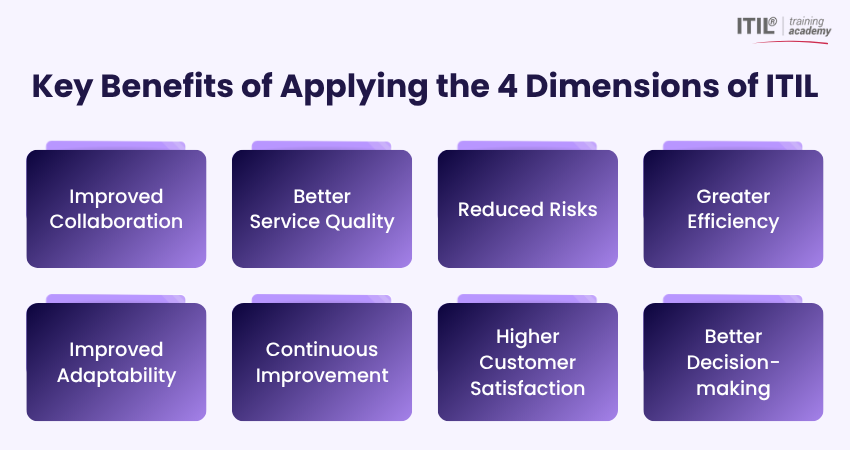
1) Improved Collaboration: Encourages better communication and teamwork across departments and suppliers
2) Better Service Quality: Helps deliver reliable, customer-focused, and value-driven IT services
3) Reduced Risks: Ensures all important areas are considered before implementing services or changes
4) Greater Efficiency: Streamlines processes, technology use, and service delivery operations
5) Improved Adaptability: Helps organisations respond effectively to changing business and customer needs
6) Continuous Improvement: Supports ongoing service enhancement and operational growth
7) Higher Customer Satisfaction: Improves user experience through efficient and consistent ITIL Service Delivery
8) Better Decision-making: Supports informed decisions through effective information and process management
Conclusion
The Four Dimensions of ITIL Service Management provide a balanced framework for delivering efficient, reliable, and value-driven IT services. By focusing on people, technology, partners, and processes together, organisations can improve collaboration, reduce risks, and adapt more effectively to changing business and customer requirements while maintaining consistent service quality.
Build strong foundations for modern IT Service Management success through the ITIL® Foundation Level Training– Join today!
Frequently Asked Questions?
The 5 pillars of ITIL are:
1) Service Strategy: Aligns IT services with business goals
2) Service Design: Plans effective IT services
3) Service Transition: Introduces services smoothly
4) Service Operation: Manages daily IT activities
5) Continual Service Improvement: Enhances services continuously
Yes, small businesses can apply the 4 Dimensions of ITIL to improve service quality, efficiency, and teamwork. By focusing on people, technology, processes, and partners, they can manage services more effectively and adapt to changing business needs.
Organisations and People focus on the internal workforce, structure, and culture that support IT services. In contrast, Suppliers provide external products or services for specific needs, while Partners build long-term relationships that support shared goals and business growth.
Most Recent
Date - Aug 1, 2026
Date - Jul 18, 2026
Date - Jul 11, 2026