


 Back to
Topics
Back to
Topics



Author-Maria Thompson

Last updated-Jun 6, 2026
As organisations grow, internal service delivery becomes more complex. Employee requests often involve multiple departments, systems, and approval processes. Without a structured approach, delays, inefficiencies, and inconsistent service experiences can affect productivity.
Enterprise Service Management (ESM) addresses these challenges by extending service management practices beyond IT. It uses standardised workflows, automation, and shared service platforms to improve coordination across departments. In this blog, we explore what ESM is, how it works, its benefits, and best practices for successful implementation.
What is Enterprise Service Management (ESM)?
Enterprise Service Management (ESM) is the practice of applying service management principles across an entire organisation. It extends proven service delivery approaches beyond IT to departments such as HR, Finance, Facilities, and Legal. ESM helps teams manage requests through structured workflows and standardised processes. This creates a more consistent and efficient service experience.
ESM brings services, processes, and teams onto a unified platform. It replaces disconnected emails, spreadsheets, and manual tracking methods. Employees can access support more easily through self-service tools and automated workflows. As a result, organisations improve collaboration, increase visibility, and deliver services more effectively.

Why is ESM Important?
Modern organisations rely on multiple departments to deliver internal services that support day-to-day operations. As service volumes increase, managing requests through disconnected systems can create process inefficiencies, limited visibility, and inconsistent service standards. ESM introduces a structured operating model that standardises how services are requested, delivered, monitored, and improved across the enterprise.
By centralising service management on a common platform, ESM enables workflow automation, service-level tracking, performance reporting, and cross-functional coordination. This helps organisations improve governance, optimise resource utilisation, reduce operational complexity, and create more scalable service delivery processes. As a result, departments can operate with greater efficiency while maintaining consistent service quality across the organisation.
How Does ESM Work?
Enterprise Service Management (ESM) works by applying structured service management processes across multiple business functions through a single platform. Here the following are the key points of how does ESM work:
1) Workflow Automation: ESM automates routine activities such as request routing, approvals, notifications, and status updates. This reduces manual effort, improves efficiency, and ensures service requests are handled consistently.
2) Standardised Departmental Workflows: It enables departments to create workflows that match their specific processes while maintaining organisation-wide consistency. For example, HR can manage onboarding requests while facilities handle maintenance requests through tailored workflows.
3) Self-Service Portals: ESM provides employees with a central platform to submit requests, access information, and track service progress. This improves accessibility, reduces response times, and enhances the overall employee experience.
What Does Enterprise Service Management Include?
Enterprise Service Management covers a wide range of organisational functions and service delivery activities.
1) Service Request Management: Employees can submit requests for equipment, software access, leave approvals, procurement support, or administrative assistance through a central platform.
2) Workflow Automation: Automated workflows streamline approvals, notifications, escalations, and task assignments to reduce manual effort and processing delays.
3) Knowledge Management: Centralised knowledge repositories provide employees with access to policies, procedures, FAQs, and troubleshooting guidance.
4) Incident and Issue Management: Departments can manage and resolve operational issues using structured processes that ensure accountability and visibility.
5) Service Catalogues: Service catalogues define available services, expected delivery timelines, and request procedures.
6) Reporting and Analytics: Dashboards and reporting tools help organisations monitor performance, identify bottlenecks, and measure service effectiveness.
7) Employee Self-Service: Self-service portals empower employees to find information and resolve common issues independently, reducing service desk workloads.
8) Cross-Department Collaboration: Integrated workflows allow multiple departments to work together efficiently on shared processes and business initiatives.
Benefits of Enterprise Service Management
Organisations adopting Enterprise Service Management often experience improvements in operational efficiency, service quality, and employee satisfaction. These benefits help organisations create more streamlined, responsive, and scalable service environments.
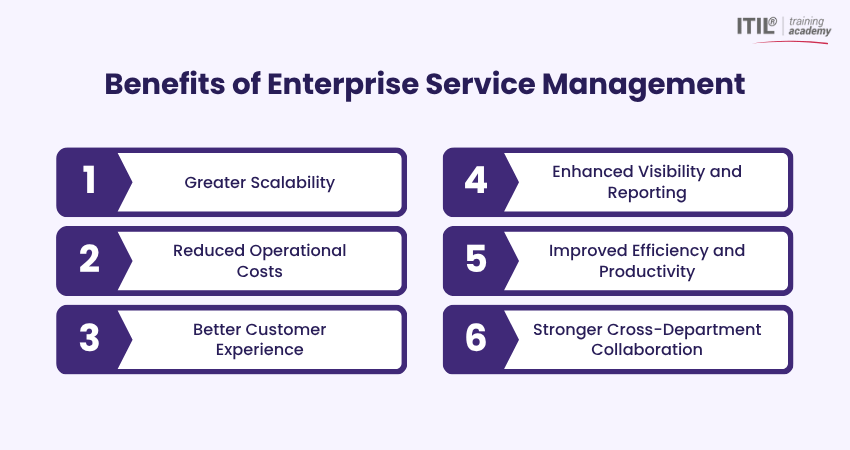
1) Greater Scalability
As organisations grow, service requests increase in volume and complexity. ESM provides standardised processes and automated workflows that allow departments to handle growing workloads without significantly increasing administrative effort. This enables organisations to scale operations while maintaining service quality and consistency. This scalability ensures businesses can expand without compromising efficiency or performance.
2) Reduced Operational Costs
Manual processes, duplicated work, and inefficient communication can increase operational expenses. ESM reduces costs by automating repetitive tasks, streamlining approvals, and minimising reliance on email-based processes. This allows teams to focus on higher-value activities while improving resource utilisation. Lower operational costs also contribute to better financial performance and resource optimisation.
3) Better Customer Experience
When internal services operate efficiently, employees can perform their roles more effectively and respond to customer needs faster. ESM improves service quality, reduces delays, and creates more consistent service experiences, ultimately contributing to better outcomes for both employees and customers.
4) Enhanced Visibility and Reporting
ESM platforms provide centralised dashboards and reporting capabilities that give organisations greater visibility into service performance, request volumes, and operational bottlenecks. This enables data-driven decision-making and helps leaders identify opportunities for continuous improvement.
5) Improved Efficiency and Productivity
By automating workflows, reducing manual handoffs, and providing self-service capabilities, ESM helps employees access support and information more quickly. This reduces delays, improves response times, and enables teams to work more productively across the organisation.
6) Stronger Cross-Department Collaboration
Many business processes require multiple departments to work together. ESM breaks down organisational silos by connecting teams through shared workflows, automated task assignments, and centralised service platforms. This improves coordination, accountability, and communication across departments.
Common ESM Use Cases
Enterprise Service Management can be applied across various organisational functions.
1) Human Resources
HR teams use ESM to manage:
a) Employee onboarding and offboarding
b) Leave requests
c) Benefits administration
d) Policy inquiries
e) Employee document management
2) Finance
Finance departments apply ESM for:
a) Expense approvals
b) Budget requests
c) Invoice processing
d) Procurement support
e) Financial service requests
4) Facilities Management
Facilities teams use ESM to handle:
a) Maintenance requests
b) Workspace allocation
c) Equipment repairs
d) Building access requests
e) Facility inspections
5) Procurement
Procurement departments manage:
a) Purchase requests
b) Vendor approvals
c) Contract management
d) Supplier onboarding
e) Asset acquisition workflows
6) Legal Services
Legal teams utilise ESM for:
a) Contract reviews
b) Compliance requests
c) Policy approvals
d) Regulatory support
e) Legal consultations
7) Information Technology
IT departments continue to use service management practices for:
a) Incident management
b) Service requests
c) Change enablement
d) Asset management
e) Access management
An Example of Enterprise Service Management
Consider the onboarding of a new employee. Without ESM, HR, IT, and facilities teams often communicate through separate emails, spreadsheets, and manual requests. This can lead to delays, duplicated work, and tasks being overlooked during the onboarding process.
With ESM, the onboarding process begins with a single service request submitted through a central platform. The system automatically assigns tasks to HR, IT, and facilities teams, ensuring each department completes its responsibilities on time. Managers can monitor progress through a shared dashboard, while the new employee arrives with the required equipment, access, and support already in place.
How Do You Implement ESM Successfully?
Implementing Enterprise Service Management (ESM) requires a structured approach that aligns people, processes, and technology. A well-planned implementation ensures smoother adoption and maximises business value. The following steps can help organisations implement ESM effectively and achieve long-term success.
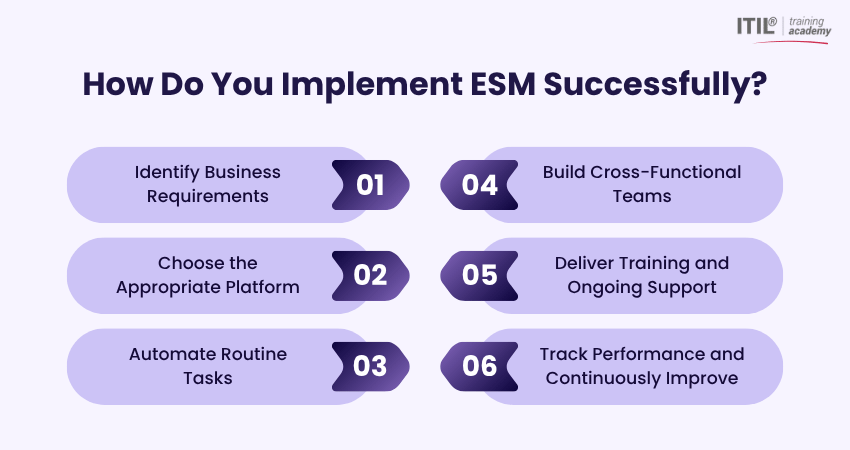
1) Identify Business Requirements
Start by assessing current service delivery processes and identifying areas for improvement. Understand the needs of different departments and the challenges they face. Gather input from key stakeholders to define service expectations and business objectives. Clear requirements help ensure the ESM initiative supports organisational goals.
2) Choose the Appropriate Platform
Select a platform that supports service delivery across multiple departments. Look for features such as workflow automation, self-service capabilities, reporting tools, and system integrations. The platform should be easy to use and flexible enough to support future growth. A suitable solution helps improve adoption and long-term value. Choosing the right platform ensures scalability and supports long-term operational efficiency.
3) Automate Routine Tasks
Identify repetitive activities that can be streamlined through automation. Common examples include request routing, approvals, notifications, and status updates. Automation reduces manual effort and improves process consistency. It also helps teams deliver services faster and more efficiently. Automation plays a key role in improving productivity and reducing operational delays.
4) Build Cross-Functional Teams
Involve representatives from different departments throughout the implementation process. Cross-functional teams encourage collaboration and help align service delivery practices. They also provide valuable insights into departmental requirements and challenges. This approach helps create processes that work across the organisation.
5) Deliver Training and Ongoing Support
Provide training to help employees understand new processes and tools. Ensure guidance materials and support resources are readily available. Regular communication can help address concerns and encourage adoption. Ongoing support helps employees use the platform effectively and consistently. Continuous support ensures long-term adoption and effective use of the system.
6) Track Performance and Continuously Improve
Monitor service performance using relevant metrics and feedback. Review response times, request volumes, and user satisfaction levels regularly. Use these insights to identify bottlenecks and improvement opportunities. Continuous refinement helps ensure ESM continues to deliver value as business needs evolve.
Prepare for the Future of Service Delivery with ITIL® Version 5 Foundation Bridge Training - Register now!
Choosing the Right ESM Software for Your Organisation
Selecting the right Enterprise Service Management (ESM) software is a strategic decision that can influence ITIL Service Delivery, employee experience, and operational efficiency across the organisation. Making an informed choice ensures long-term success and scalability. When evaluating ESM solutions, consider the following factors:
1) Scalability for Future Growth
Choose software that can support increasing service volumes, additional departments, and more complex workflows without compromising performance. A scalable platform enables organisations to expand their ESM initiatives gradually while maintaining a consistent service experience across teams.
2) Seamless Integration Capabilities
The most effective ESM platforms integrate with existing business applications, collaboration tools, HR systems, communication platforms, and other enterprise technologies. Strong integrations help eliminate information silos, improve data sharing, and create connected workflows across departments.
3) User-Friendly Experience
Adoption is often the deciding factor in ESM success. Look for software that offers intuitive employee portals, simple request submission processes, and easy-to-use administration tools. Platforms that allow non-technical users to configure workflows, forms, and service requests can accelerate implementation and reduce dependency on IT teams.
4) Workflow Automation and Self-Service
Automation capabilities help reduce repetitive manual work, improve response times, and ensure service consistency. Features such as automated approvals, intelligent routing, self-service portals, and knowledge bases enable departments to handle requests more efficiently while improving the employee experience.
5) Flexibility and Customisation
Every organisation has unique processes and requirements. The ideal ESM solution should provide configurable workflows, templates, forms, and reporting capabilities without requiring extensive development effort. This flexibility allows departments to tailor services while maintaining governance and standardisation.
6) Analytics and Reporting
Robust reporting tools provide visibility into service performance, request volumes, bottlenecks, and service level achievement. These insights help organisations measure success, identify areas for improvement, and make informed decisions about future service enhancements. Data-driven insights support continuous improvement and better decision-making.
7) Vendor Support and Implementation Resources
Successful ESM adoption relies on strong vendor support, including implementation guidance, training, and ongoing assistance. By choosing a scalable, user-friendly platform with robust integrations, automation, and reliable support, organisations can improve service delivery, strengthen collaboration, and drive long-term operational success.
The Future of Enterprise Service Management (ESM)
As organisations continue to embrace digital transformation, Enterprise Service Management (ESM) is becoming more intelligent, connected, and employee focused. Emerging technologies help organisations automate services, improve efficiency, and deliver better experiences across departments.
1) Artificial Intelligence and Predictive Service Management
AI and Machine Learning will help organisations automate routine tasks, identify service trends, and predict potential issues before they occur. This enables faster decision-making, improved efficiency, and more proactive service delivery.
2) Expanded Self-Service Capabilities
Advanced self-service portals, virtual assistants, and AI-powered chatbots will allow employees to resolve common requests independently. This reduces service desk workloads while improving accessibility and response times.
3) Intelligent Automation Across Departments
Automation will streamline approvals, request management, onboarding, and other repetitive processes. This helps departments improve consistency, reduce manual effort, and increase operational efficiency. Intelligent automation also enables faster service delivery and reduces the risk of human error.
4) Smarter Integrations and Connected Services
Future ESM platforms will offer deeper integrations with business applications and collaboration tools. Connected services will improve information sharing, eliminate silos, and create seamless employee experiences. These integrations support a more unified and efficient organisational workflow.
5) Real-Time Monitoring and Proactive Service Delivery
Real-time dashboards and monitoring tools will provide greater visibility into service performance. Organisations can identify issues earlier, respond more quickly, and minimise service disruptions.Proactive monitoring ensures Continual Service Improvement and better operational control.
6) Greater Focus on Employee Experience
Employee experience will remain a key priority for ESM initiatives. Organisations will focus on delivering personalised, user-friendly, and efficient services that improve productivity and satisfaction. A strong focus on employee experience helps drive engagement, retention, and overall organisational performance.
Conclusion
Enterprise Service Management helps organisations deliver services more efficiently by applying consistent service management practices across departments. By streamlining workflows, improving collaboration, and introducing automation, ESM enables teams to respond faster and work more effectively. As organisations continue to embrace digital transformation, it provides a scalable framework for improving employee experiences, increasing operational efficiency, and supporting business growth.
Learn Service Management Essentials with the ITIL® Foundation Level Course - Join now!
Frequently Asked Questions?
Companies implement ESM to standardise service delivery across departments, improve operational efficiency, and enhance employee experiences. It helps reduce manual work, automate routine processes, improve collaboration, increase visibility into service performance, and ensure faster, more consistent support across the organisation.
ITSM focuses on managing and delivering IT services, while ESM extends the same service management principles across the entire organisation. ESM supports departments such as HR, Finance, Facilities, and Legal, helping standardise processes, improve collaboration, and deliver consistent services beyond the IT function.
Most Recent
Date - Aug 1, 2026
Date - Jul 18, 2026
Date - Jul 11, 2026