


 Back to
Topics
Back to
Topics



Author-Hailey Davis

Last updated-Jun 6, 2026
Have you ever noticed how some organisations resolve employee or customer issues quickly while others struggle with delays and confusion? As businesses grow, managing services efficiently becomes more important across departments like IT, HR, finance, and customer support. This is where understanding ITSM vs ESM becomes essential for improving workflows, communication, and service quality.
While both approaches focus on delivering better services, they differ in scope, purpose, and business impact. Understanding ITSM vs ESM helps organisations decide whether they need service management only for IT operations or across the entire enterprise. In this blog, you will explore the differences between ITSM and ESM, their similarities, components and how to choose the right solution. Let’s begin!
What is IT Service Management (ITSM)?
IT Service Management (ITSM) is the process of designing, delivering, managing, and improving IT services within an organisation. It provides IT teams with structured processes and best practices to ensure services are reliable, efficient, and aligned with business needs.
A common example of ITSM is incident management. For instance, if an employee reports a malfunctioning laptop, the IT team follows a predefined process to identify the issue and resolve it quickly. This structured approach helps organisations minimise downtime, improve productivity, and maintain smooth IT operations.
Key Components of ITSM
ITSM consists of several important components that help organisations deliver reliable, efficient, and well-managed IT services. Let’s look at them below:
1) Service Desk: A central point where users report issues, request services, and receive IT support.
2) Incident Management: Focuses on restoring normal service operations quickly when IT issues occur to reduce business disruption.
3) Problem Management: Identifies the root causes of recurring incidents to prevent the same issues from happening again.
4) Change Management: Manages and approves IT changes in a controlled way to minimise risks and service interruptions.
5) Service Level Management: Defines and monitors service quality standards agreed between IT teams and users.
6) Configuration Management: Tracks IT assets, systems, and their relationships in a central database for better visibility and control.
7) Release Management:ITIL Release Management plans and manages software updates and releases to ensure smooth implementation with minimal impact.
8) Capacity Management: Ensures IT resources can handle current and future business demands while maintaining performance and cost efficiency.
9) IT Service Continuity Management: Creates recovery plans to maintain critical IT services during major disruptions or unexpected events.

What is Enterprise Service Management (ESM)?
Enterprise Service Management (ESM) extends service management practices beyond IT and applies them across the entire organisation. It helps departments like HR, finance, legal, and facilities manage requests through a single, organised system.
With ESM, employees can submit requests through one central platform. For example, during new employee onboarding, a single request can automatically notify HR for documentation, IT for equipment setup, and facilities for workspace preparation. This streamlined approach saves time, reduces confusion, and improves the overall employee experience.
Key Components of ESM
ESM includes several components that help organisations manage services across multiple departments through a unified and streamlined approach. Let’s look at them below:
1) Unified Portal: A single platform where employees can request services from any department without contacting separate teams.
2) Cross-department Workflow Automation: Automatically routes requests and coordinates tasks between departments for faster and smoother ITIL Service Delivery.
3) Universal Knowledge Management: A central knowledge base containing policies, guides, and self-service resources for all business functions.
4) Enterprise-wide Incident Management: Manages and resolves business disruptions across departments, including system, facility, or operational issues.
5) Integrated Service Catalogue: Provides a complete list of available business services with clear details, timelines, and request options.
6) Business Service Analytics: Tracks service performance, employee satisfaction, and operational efficiency across the organisation.
7) Multi-department Change Management: Ensures changes affecting multiple departments follow a standard approval and coordination process.
8) Service Level Agreements (SLAs): Defines service quality and response standards for all business services, not just IT-related services.
Learn how to lead high-quality and efficient service operations with the ITIL® 5 Service Certification Training now!
Key Differences Between ITSM and ESM
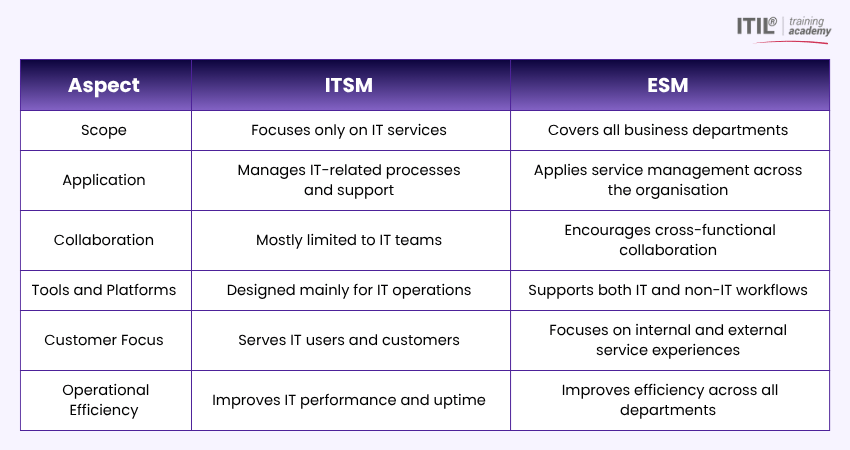
ITSM vs ESM differ in their scope, purpose, and business impact. Understanding these differences helps organisations select the right approach for improving service management across functions. Let’s look at the key differences between ITSM and ESM below:
1) Scope and Use Cases
ITSM is mainly focused on managing IT-related services within an organisation. It helps IT departments improve processes like incident handling, service requests, and system maintenance to ensure reliable technology services for users and customers.
In contrast, ESM extends these ITIL Service Management practices beyond IT and applies them across all business functions. Departments like HR, finance, legal, and facilities use the same structured approach to improve efficiency, consistency, and service delivery throughout the organisation.
2) Organisational Silos vs Integrated Collaboration
ITSM is usually limited to IT operations, which can sometimes create departmental silos. Since the framework is designed specifically for IT services, communication and coordination with other departments may remain separate. This limitation can reduce visibility and slow down cross-department collaboration.
In contrast, ESM promotes cross-functional collaboration by connecting multiple departments through shared workflows and service processes. This integrated approach improves communication, reduces delays, and ensures a more consistent service experience across the organisation. It enables teams to work together more efficiently and improves overall organisational alignment.
3) Service Management Platforms and Tools
ITSM tools are designed for IT-specific activities like incident management, Itil problem management, change management, and service desk operations. These tools focus on supporting technical service delivery and maintaining IT performance. They are optimised for handling complex IT environments and service operations.
In contrast, ESM platforms expand these capabilities to support non-IT processes as well. Many ESM solutions include workflow automation, enterprise reporting, self-service portals, and knowledge management features that help departments manage requests efficiently. This flexibility allows organisations to use a single platform for multiple service functions.
4) Customer Focus
ITSM mainly focuses on delivering reliable services to IT users and customers. Its primary goal is to ensure systems, applications, and technical services operate smoothly with minimal disruption. The emphasis is on maintaining system availability and service continuity.
In contrast, ESM takes a broader customer-centric approach by improving service experiences for both employees and external customers across all departments. This helps organisations deliver consistent and efficient support regardless of which department provides the service. It enhances overall user experience by creating a unified service delivery model.
5) Improving Business Operations and Productivity
ITSM improves operational efficiency within IT by reducing downtime, resolving incidents faster, and helping teams meet Service Level Agreements (SLAs). It ensures IT operations remain stable, responsive, and reliable. This results in better system performance and reduced service disruptions.
In contrast, ESM applies these efficiency principles across the entire organisation. By streamlining workflows, automating repetitive tasks, and improving coordination, it increases productivity, reduce operational costs, and respond quickly to changing business needs. This organisation-wide efficiency supports faster decision-making and improved business agility.
Upgrade your service management skills the right way by joining the ITIL® Version 5 Foundation Bridge Training today!
Key Similarities Between ITSM and ESM
Although ESM and ITSM differ in scope, they share several core service management principles that help organisations improve efficiency, consistency, and service quality. Here are the key similarities between them:
1) Process-driven Approach: Both use standardised workflows, ticketing systems, and SLAs to deliver consistent and organised services.
2) Employee Self-service Capabilities: Both provide self-service portals where employees can submit requests, access knowledge resources, and track issue resolution.
3) Performance Measurement: Both monitor service performance through metrics like response times, resolution speed, and service availability to improve service quality continuously.
4) Automation Focus: Both use automation, AI-powered tools, and intelligent routing systems to streamline workflows, reduce manual tasks, and improve user experience.
Choosing the Right Solution: ITSM or ESM
Selecting between ESM vs ITSM depends on your organisation’s goals, service management maturity, and operational requirements. Making the right choice ensures better alignment with business needs and improves overall service efficiency. Let’s look at how to select the right approach below:
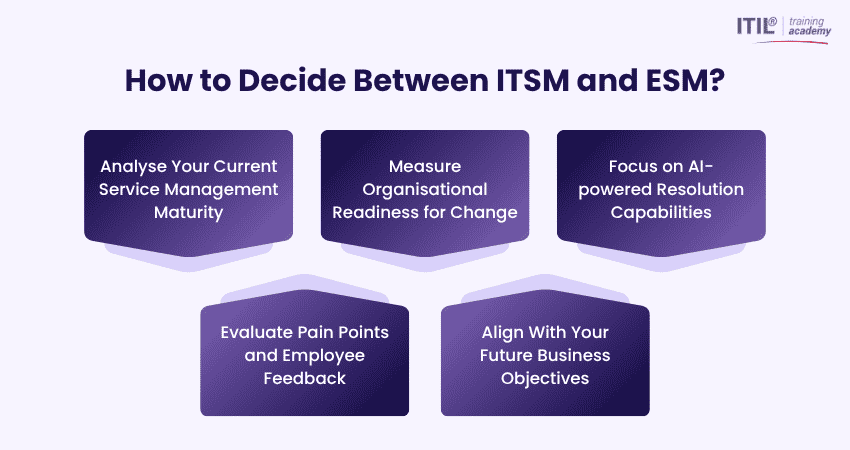
Organisations with mature ITSM practices can expand into ESM more easily because they already follow structured service management processes. Businesses still developing IT operations may benefit from starting with ITSM first.
2) Measure Organisational Readiness for Change
ITSM solutions are generally easier and quicker to implement because they focus on IT operations. In contrast, ESM requires broader organisational changes, employee training, and collaboration between departments, making change readiness an important factor before implementation.
3) Focus on AI-powered Resolution Capabilities
Modern ITSM and ESM platforms use AI and automation to improve efficiency, reduce manual tasks, and enhance user experience. Features such as intelligent routing and automated workflows help improve response times and productivity.
4) Evaluate Pain Points and Employee Feedback
If most service issues are IT-related, ITSM can improve technical support and service quality effectively. However, if employees experience delays across multiple departments, ESM can provide a more connected and consistent service experience.
5) Align With Your Future Business Objectives
Organisations focused on improving IT performance may benefit more from ITSM. Businesses aiming for enterprise-wide service improvement and stronger cross-department collaboration may find ESM more suitable.
Conclusion
Understanding ITSM vs ESM helps organisations choose the right service management approach for their needs. While ITSM improves IT operations, ESM expands service management across the organisation. Choosing the right strategy can help businesses deliver better employee experiences, increase productivity, and maintain consistent service quality.
Start building strong service management foundations with the ITIL® Foundation Level Training Courses – Join now!
Frequently Asked Questions?
The three pillars of ITSM include:
1) People: Teams and users involved in IT services
2) Process: Workflows that manage IT operations
3) Technology: Tools and systems that support service delivery
The four dimensions of ITSM are:
1) Organisations and People
2) Information and Technology
3) Partners and Suppliers
4) Value Stream and Processes
Departments that commonly use ESM include Human Resources, Finance, Legal, Facilities, and Procurement. ESM helps these departments automate workflows, manage service requests, track assets, and improve collaboration through a centralised service management platform.
Most Recent
Date - Aug 1, 2026
Date - Jul 18, 2026
Date - Jul 11, 2026