


 Back to
Topics
Back to
Topics




Author-Veronica Davis

Last updated-Apr 6, 2026
You are in the middle of a critical task, and suddenly everything stops. The system crashes, work pauses, deadlines slip, and pressure builds across the team. These moments are more common than expected, and this is where MTTR and MTBF truly matter, as they shape how often disruptions occur and how quickly you recover.
To stay in control of such situations, understanding MTTR vs MTBF becomes essential. This blog explores their key differences and ways to improve them, helping you reduce downtime, respond faster, and keep operations running smoothly. Let’s dive into what these metrics really mean!
What is MTTR?
Mean Time to Repair (MTTR) is a metric that shows how long it takes to fix a system after it fails. It measures the average time to detect, repair, and restore normal operation. In simple terms, it shows how quickly you can recover from a problem, where faster recovery reduces the impact on customers and business operations.
MTTR is calculated using the formula:

For example, if three issues took 30, 45, and 15 minutes to resolve, the MTTR would be 30 minutes. This metric helps teams understand how efficient their response and repair process is. A lower MTTR means quicker fixes, reduced downtime, and better service reliability.

What is MTBF?
Mean Time Between Failures (MTBF) is the average time a system or equipment runs before it fails over a given period. It is a key metric used to measure reliability, especially for repairable systems. A higher MTBF means the system runs longer without interruptions, indicating better performance and stability.
MTBF is calculated using the formula:

MTBF is commonly used by engineers and technicians to monitor equipment performance and identify issues. Also known as mean time to failure in some contexts, it helps detect failure patterns, find root causes, and improve maintenance, reducing downtime and ensuring efficient system operation.
Differences Between MTBF and MTTR
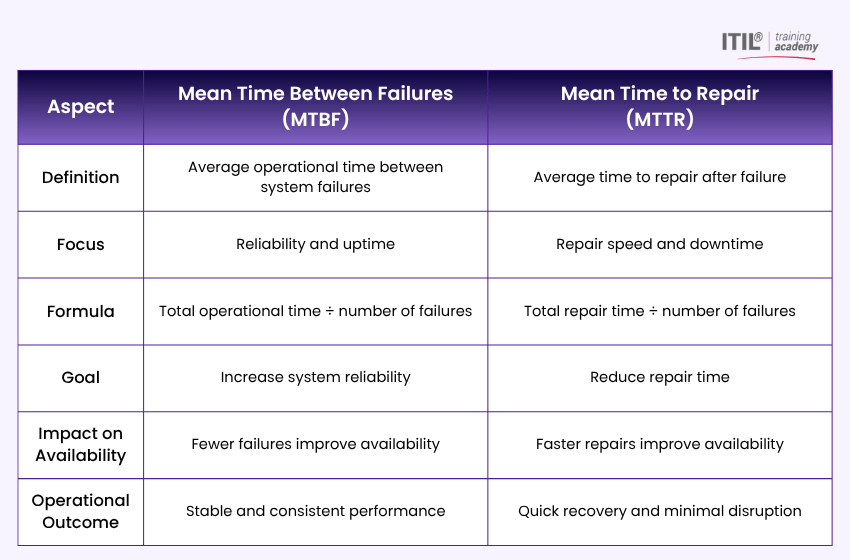
Understanding the difference between MTTR and MTBF highlights system performance, where MTBF focuses on reliability and MTTR on repair speed. This comparison helps improve efficiency and reduce downtime, as explained below:
1) Differences in Formula and Calculation (MTBF vs MTTR)
MTBF and MTTR are calculated using different formulas that reflect their purpose. MTBF is calculated by dividing total operating time by the number of failures, while MTTR is calculated by dividing total repair time by the number of failures.
These calculations show a clear difference between MTBF vs MTTR. MTBF focuses on uptime and reliability, showing how long systems run before failure, whereas MTTR focuses on downtime, showing how quickly systems are repaired and restored.
2) MTTR vs MTBF: Measuring Reliability Against Repair Speed
MTBF and MTTR measure two important aspects of system performance. MTBF focuses on reliability by showing how long a system operates without failure, while MTTR focuses on repair speed by measuring how quickly issues are resolved after failure.
This difference highlights how MTBF and MTTR support operations. A higher MTBF means fewer breakdowns, while a lower MTTR means faster recovery. Together, they help organisations balance system stability with efficient problem resolution.
Enhance IT service performance with practical ITIL Service Management expertise through the
ITIL® 5 Service Certification
– Register today!
3) Role of MTBF and MTTR in System Availability
MTBF and MTTR both play a key role in determining system availability. MTBF improves availability by increasing the time between failures, while MTTR improves availability by reducing the time required to repair and restore systems.
When MTBF is high and MTTR is low, systems remain available for longer periods. This balance ensures consistent performance, reduces service interruptions, and helps organisations maintain reliable operations across systems and services.
4) Actionable Strategies to Improve MTTR and MTBF
Improving MTBF and MTTR requires different but connected strategies. MTBF can be improved through preventive maintenance, quality components, and monitoring systems, while MTTR can be reduced through better training, tools, and faster response processes.
Organisations that focus on both MTBF and MTTR can achieve better results. Increasing MTBF reduces failure frequency, while reducing MTTR shortens recovery time, helping teams minimise downtime and maintain smooth and efficient operations.
5) MTTR vs MTBF Example
Consider a system where MTBF is 200 hours, and MTTR is 10 hours. This means the system runs for long periods before failing and can be repaired quickly, showing a balance between reliability and repair efficiency.
In this example, MTBF and MTTR together help evaluate performance clearly. A higher MTBF reduces how often failures occur, while a lower MTTR ensures quick recovery, helping organisations maintain consistent uptime and improve service reliability.
Ways to Improve Mean Time Between Failures
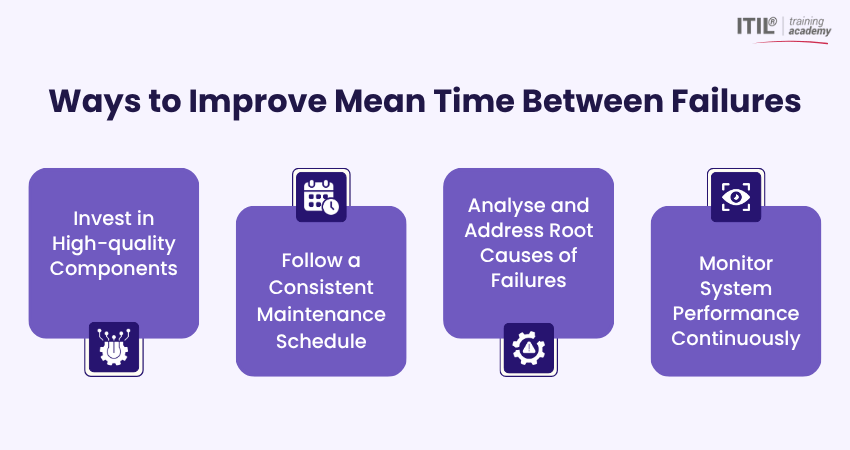
Improving MTBF focuses on reducing failures and strengthening system reliability. A proactive approach helps systems run longer with fewer interruptions. The following strategies can help improve MTBF effectively:
1) Invest in High-quality Components
Using high-quality components improves system reliability and lowers the risk of unexpected failure. Strong and durable parts usually last longer, perform better, and handle stress more effectively, helping systems run smoothly for longer periods without frequent breakdowns or costly interruptions.
2) Follow a Consistent Maintenance Schedule
Following a consistent maintenance schedule helps detect and fix small issues before they turn into major failures. Regular inspections, cleaning, servicing, and updates keep equipment in good condition, improve performance, and reduce the chances of sudden breakdowns that affect operations.
3) Analyse and Address Root Causes of Failures
Analysing and addressing root causes of failures is essential for improving MTBF over time. Instead of only fixing visible issues, teams should identify why the problem happened, remove the underlying cause, and take corrective action to prevent repeated failures in the future effectively.
4) Monitor System Performance Continuously
Monitoring system performance continuously helps teams spot warning signs before a failure occurs. Using monitoring tools and real-time data makes it easier to detect unusual behaviour, respond early, improve system stability, and keep equipment operating efficiently without unnecessary downtime.
Step up to ITIL 5 and unlock smarter Service Management practices with the
ITIL® Version 5 Foundation Bridge Training
– Join now!
How to Reduce Mean Time to Repair?
Reducing Mean Time to Repair (MTTR) helps restore systems quickly and minimise downtime. It focuses on faster detection, efficient processes, and skilled teams to ensure smooth recovery. The following strategies can help reduce repair time effectively:
1) Real-time Monitoring:
Using monitoring tools and IoT devices helps detect issues early. Quick alerts allow teams to respond faster and fix problems before they become major failures.
2) Standardised Procedures:
Clear repair procedures and checklists guide technicians step by step. This improves consistency, reduces errors, and speeds up the repair process.
3) Mobile Documentation:
Giving technicians access to manuals and procedures on mobile devices helps them diagnose and fix issues quickly without delays.
4) Skills Training:
Regular training improves technician expertise. Skilled teams can identify problems faster and complete repairs more efficiently.
5) Parts Availability:
Keeping critical spare parts ready prevents repair delays. This ensures faster fixes and quicker system recovery.
6) Data Collection and Analysis:
Tracking failures helps identify patterns and improve repair processes. This supports continuous improvement and reduces MTTR over time.
Conclusion
Understanding MTTR vs MTBF helps organisations balance reliability and repair efficiency in system performance. Focusing on both reduces downtime, improves stability, and ensures consistent operations. Strengthening maintenance practices and repair processes supports better performance and long-term operational success.
Build strong ITIL knowledge for efficient, value-driven service management with the ITIL® Version 5 Foundation Certification – Join today!
Frequently Asked Questions?
A good MTTR value is as low as possible, as faster repairs reduce downtime and business impact. It also helps predict outage duration. While values vary by industry, many aim to keep MTTR below five hours to maintain efficient and reliable system performance.
The 10% Rule of Preventive Maintenance states that a task is compliant if completed within 10% of its scheduled time. This allows some flexibility while ensuring maintenance is done on time, helping maintain system reliability and reduce the risk of unexpected failures.
No, a high MTBF does not guarantee a long product life. It only measures the average time between failures in repairable systems. It shows how often a system may break, not how long it will last before permanent wear or failure occurs.
Most Recent
Date - Aug 1, 2026
Date - Jul 18, 2026
Date - Jul 11, 2026