


 Back to
Topics
Back to
Topics



Author-David Walter

Last updated-Jan 24, 2026
Ever wondered why some organisations deliver seamless IT services while others struggle with recurring system issues and inefficient workflows? From slow IT support to repeated errors, these challenges are familiar to many teams. Often, the real issue is not technology itself, but the lack of a structured approach to managing services and processes.
So, how can these challenges be addressed? ITIL and Six Sigma provide proven frameworks for improvement. This blog explores ITIL vs Six Sigma, highlighting the key differences and similarities to help you choose the right approach for stronger service quality and better business performance.
What is an Information Technology Infrastructure Library (ITIL)?
The Information Technology Infrastructure Library (ITIL) is an internationally recognised framework for IT Service Management (ITSM). It provides best practices that help organisations align IT services with business needs, improve service quality, manage risks, and optimise operational costs.
ITIL offers a structured approach to managing the whole IT service lifecycle, from planning and design to delivery and continuous improvement. By standardising processes and focusing on value creation, ITIL ensures that IT teams deliver reliable services that support business objectives and enhance customer experience.
Benefits of ITIL
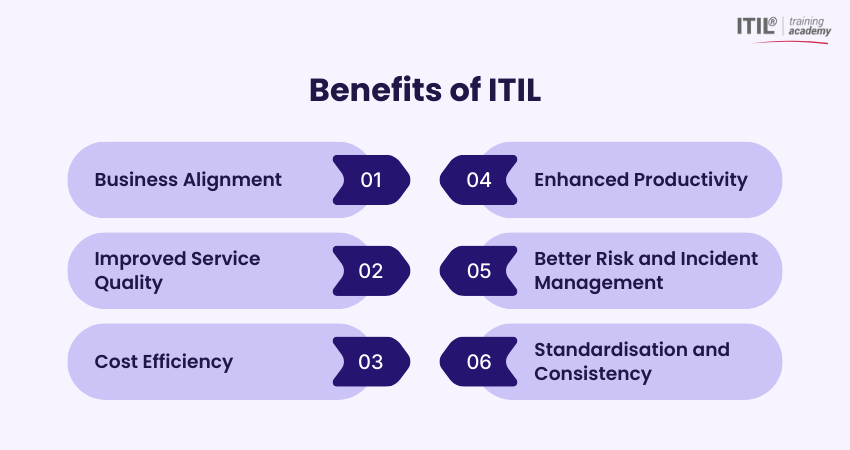
ITIL helps organisations align IT with business goals, improve service quality, and drive continuous improvement through structured processes that enhance efficiency, reduce risks, and deliver consistent value.
Key Benefits of ITIL:
1) Business Alignment:
Ensures IT services directly support organisational goals and strategic objectives.
2) Improved Service Quality:
Delivers reliable, consistent, and customer-focused IT services.
3) Cost Efficiency:
Optimises IT resources, reduces waste, and lowers operational expenses through standardised processes.
4) Enhanced Productivity:
Streamlines workflows, minimises errors, and enables IT teams to focus on value-driven activities.
5) Better Risk and Incident Management:
Strengthens the ability to manage risks, incidents, and changes effectively, reducing disruptions and service downtime.
6) Standardisation and Consistency:
Establishes unified processes and a common language for effective collaboration across teams.
7) Continuous Improvement Culture:
Encourages ongoing evaluation and enhancement of IT services and processes.
8) Competitive Advantage:
Strengthens organisational performance and customer satisfaction through efficient IT enablement.
What is Six Sigma?
Six Sigma is a data-driven and statistical approach used to improve business processes by reducing errors, defects, and variations. Initially developed for manufacturing, it is now widely used across industries such as IT, finance, healthcare, and services to enhance efficiency, quality, and performance.
It focuses on measurable results using analytics and structured Project Management methods. Six Sigma also offers certification levels, including White Belt, Yellow Belt, Green Belt, Black Belt, and Master Black Belt, helping professionals develop expertise in process improvement and quality management.
Benefits of Six Sigma
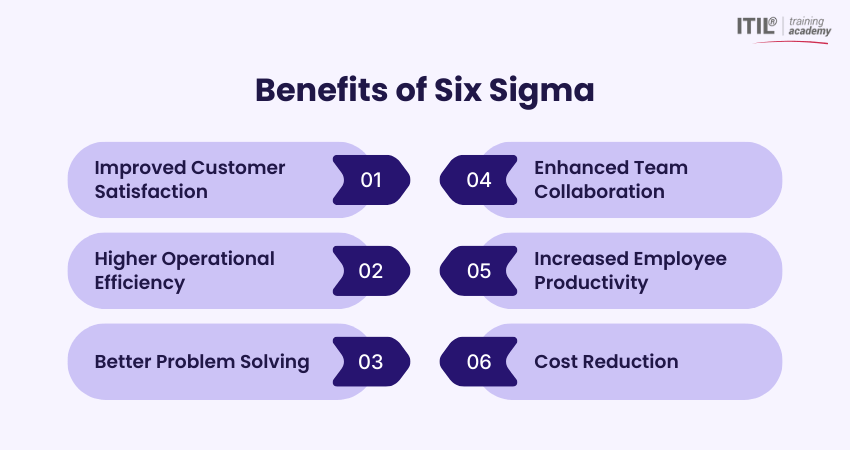
Six Sigma improves process quality, boosts customer satisfaction, and enhances organisational efficiency by using data-driven methods to identify root causes, optimise operations, and reduce costs.
Key Benefits of Six Sigma:
1) Improved Customer Satisfaction:
Identifies and resolves root causes of issues, reducing defects and improving product and service quality.
2) Higher Operational Efficiency:
Streamlines processes and eliminates inefficiencies, leading to smoother workflows and faster project delivery.
3) Better Problem Solving:
Uses analytics and structured methodologies to identify risks and implement effective solutions.
4) Enhanced Team Collaboration:
Builds cross-functional teams to address critical challenges and improve project outcomes.
5) Increased Employee Productivity:
Empowers staff with tools and skills, boosting motivation and performance.
6) Cost Reduction:
Minimises waste and inefficiencies, significantly lowering operational expenses.
7) Data-driven Decision Making:
Supports informed decisions using measurable performance metrics and statistical analysis.
8) Consistent Process Improvement:
Uses the Define, Measure, Analyse, Improve, Control (DMAIC) model to continuously refine processes and reduce defects to near-perfect levels.
Build advanced Release Management expertise with
ITIL® 4 Practitioner: Release Management Training
- Join today!
ITIL vs Six Sigma: Key Differences
ITIL focuses on IT Service Management, while Six Sigma improves processes and reduces defects. Understanding the difference between ITIL and Six Sigma helps organisations choose the right approach. The table below highlights the key distinctions between the two frameworks.
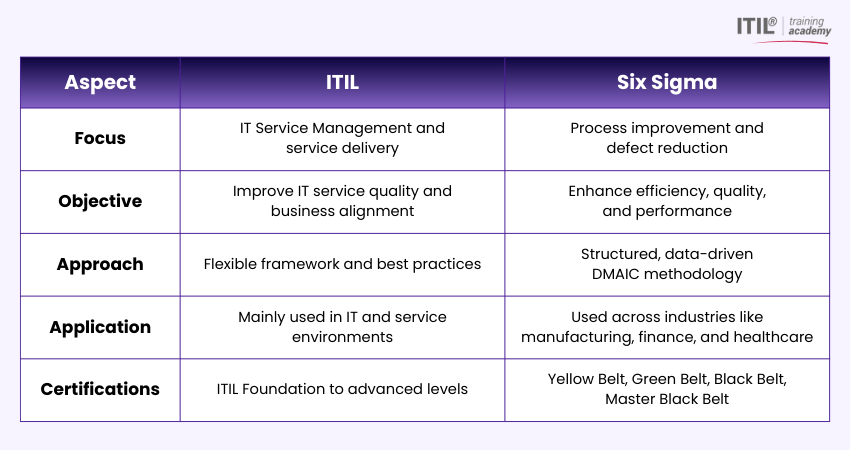
1) Focus and Purpose
ITIL:
ITIL is mainly focused on IT Service Management. It provides structured guidelines and best practices to design, deliver, and continuously improve IT services in alignment with business objectives and organisational needs.
Six Sigma:
Six Sigma focuses on improving overall process quality across various business areas. It aims to optimise processes, reduce waste, and support data-driven decision-making beyond IT environments.
2) Objectives
ITIL:
The primary objective of ITIL is to improve the quality and reliability of IT services while ensuring alignment with business goals. It also enhances customer satisfaction and supports long-term organisational success.
Six Sigma:
The main objective of Six Sigma is to minimise process variation and eliminate defects. It improves operational efficiency and quality across organisational processes and business outcomes in a measurable way.
3) Implementation Approach
ITIL:
ITIL follows a flexible approach, offering best practices that organisations can adapt to their specific requirements. It emphasises continuous service improvement and gradual implementation of IT Service Management processes.
Six Sigma:
Six Sigma uses a structured and systematic approach based on the DMAIC methodology. It relies on data analysis, statistical tools, and disciplined problem-solving to drive measurable process improvements.
4) Scope of Application
ITIL:
ITIL is most effective in organisations where IT services play a critical role, such as IT departments, service providers, and technology-driven businesses across various industries and sectors.
Six Sigma:
Six Sigma can be applied across multiple industries, including manufacturing, healthcare, finance, and services. It is suitable for improving both operational and service-oriented processes.
5) Certifications
ITIL:
ITIL Certifications range from foundational to advanced levels and validate knowledge in IT Service Management practices and frameworks. They help professionals build practical skills, improve career prospects, and demonstrate expertise in delivering effective IT services.
Six Sigma:
Six Sigma Certifications include Yellow Belt, Green Belt, Black Belt, and Master Black Belt. These certifications demonstrate skill in process improvement and quality management methodologies.
Strengthen your IT Service Management skills with the
ITIL® 4 Managing Professional (MP) Certification Path
– Join now!
The Similarities of ITIL and Six Sigma
Although ITIL and Six Sigma serve different purposes, both improve efficiency, quality, and customer satisfaction through structured approaches. Understanding Six Sigma vs ITIL highlights how these frameworks complement each other in driving continuous improvement.
Key Similarities:
1) Focus on Improvement:
Both ITIL and Six Sigma aim to optimise processes, reduce inefficiencies, and enhance overall performance.
2) Customer-centric Approach:
Both frameworks prioritise customer satisfaction by ensuring services and processes meet business and user expectations.
3) Process-oriented Thinking:
Both view organisational activities as interconnected processes, making it easier to apply Six Sigma techniques within ITIL-based service improvement efforts.
4) Data-driven Decision Making:
Both rely on measurement and analysis to identify issues and monitor improvements, with Six Sigma using more advanced statistical methods.
5) Structured Methodology:
Both follow defined frameworks to achieve goals, such as ITIL practices and Six Sigma’s DMAIC model.
6) Complementary Nature:
ITIL defines what should be done in IT Service Management, while Six Sigma explains how to improve those processes can be improved using analytical and performance-focused tools.
Which is Better: Six Sigma or ITIL?
There is no single best choice between ITIL and Six Sigma. ITIL improves IT Service Management, while Six Sigma enhances process quality and reduces defects. The right choice depends on organisational goals and industry needs, helping organisations determine whether ITIL or Six Sigma is more suitable.
1) Purpose:
ITIL focuses on IT Service Management, while Six Sigma focuses on process improvement and defect reduction.
2) Organisational Goals:
ITIL is suitable for improving IT services and aligning IT with business needs; Six Sigma is ideal for enhancing quality and operational efficiency.
3) Industry Use:
ITIL is mainly used in IT-driven organisations; Six Sigma is applied across multiple industries such as manufacturing, healthcare, and finance.
4) Methodology:
ITIL uses best-practice frameworks and continual improvement; Six Sigma uses structured, data-driven methods like DMAIC.
5) Best Choice:
The right framework depends on business priorities, and combining both can deliver comprehensive improvement.
Conclusion
Understanding the difference between ITIL vs Six Sigma helps organisations and professionals decide whether ITIL or Six Sigma is the right framework for Service Management and process improvement. ITIL enhances IT service delivery, while Six Sigma improves efficiency and quality. Together, they drive continuous improvement, stronger performance, and sustainable long-term business growth.
Strengthen your knowledge in modern IT Service Management with our
ITIL® Foundation Level Training
– Join now!
Frequently Asked Questions?
The seven principles of ITIL include:
1) Focus on Value
2) Start Where You Are
3) Progress Iteratively with Feedback
4) Collaborate and Promote Visibility
5) Think and Work Holistically
6) Keep It Simple and Practical
7) Optimise and Automate
Five stages of ITIL include:
1) Service Strategy: Define service goals and value
2) Service Design: Plan and design IT services
3) Service Transition: Implement new or changed services
4) Service Operation: Manage daily service delivery
5) Continual Service Improvement: Continuously enhance services
The 80/20 Rule in Six Sigma or the Pareto Principle, states that about 80% of problems come from 20% of causes. It helps organisations identify and focus on the most critical issues, enabling faster and more effective improvements in quality and performance.
Most Recent
Date - Oct 23, 2026
Date - Aug 1, 2026
Date - Jul 18, 2026