


 Back to
Topics
Back to
Topics



Author-David Walter

Last updated-Feb 23, 2026
Have you ever experienced work coming to a halt because a system crashed, a request remained unresolved, or recurring IT issues kept resurfacing without a clear solution? These challenges are more common than many organisations realise, and they often disrupt productivity and frustrate employees. This is where the Benefits of IT Service Management (ITSM) become evident, bringing structure and reliability to IT operations.
As organisations rely more heavily on digital systems, structured service management becomes critical. ITSM introduces standardised processes and measurable performance practices that reduce disruptions and improve service reliability. An IT Service Manager plays an important role in applying these practices to align IT services with business needs.. In this blog, we explore how ITSM enhances operational efficiency, controls costs, strengthens governance, and enables sustainable business growth.
Benefits of IT Service Management (ITSM)
IT Service Management uses structured processes and continuous improvement to manage IT services efficiently. These ITSM benefits make it essential for modern organisations. Let’s explore the key advantages that help businesses improve performance and service delivery:
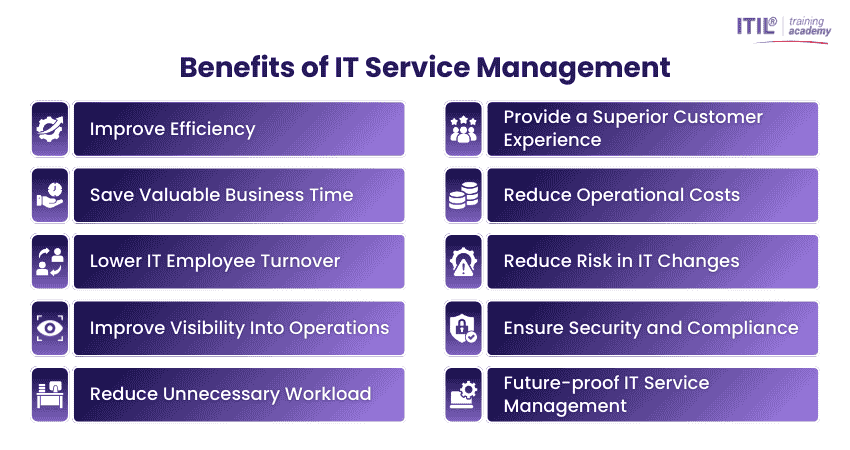
1) Improve Efficiency
Efficiency means making the best use of resources such as time, people, and technology. IT Service Management supports this by introducing structured processes that optimise how IT services and assets are managed. For example, IT asset management ensures technology resources are used effectively and maintained in a cost-efficient way.
Frameworks such as the Information Technology Infrastructure Library (ITIL) also emphasise continual service improvement. Services are regularly reviewed and refined to remove inefficiencies, enhance performance, and streamline operations. Over time, this ongoing optimisation helps organisations work more productively and deliver better IT outcomes.

2) Save Valuable Business Time
One of the key advantages of IT Service Management is its ability to help organisations save time through structured and well-defined processes. Many ITSM practices are designed to streamline how information is handled, shared, and accessed across the business, reducing delays and improving response times.
Knowledge management is a strong example, as it captures and organises information so teams do not repeatedly solve the same problems. A central knowledge base helps IT quickly access solutions, share insights, and resolve issues faster, reducing time spent searching for answers and enhancing overall productivity.
3) Lower IT Employee Turnover
IT Service Management helps create a more supportive and efficient work environment for IT professionals, which can improve job satisfaction and reduce employee turnover. When teams have structured processes, clear workflows, and the right tools, their work becomes more manageable and less stressful.
ITSM systems also provide better support, automation, and streamlined service delivery, making daily tasks easier and more rewarding. When IT employees feel equipped to do their jobs effectively, they are more likely to stay with the organisation, improving retention and team stability.
4) Improve Visibility Into Operations
As IT environments become more complex, organisations need clear insight into how services, assets, and processes interact. IT Service Management provides this visibility by introducing structured processes and standardised workflows that make IT operations easier to monitor, manage, and evaluate.
As processes become more defined and measurable, organisations can track performance using data and service metrics. This allows teams to understand how systems are performing, identify inefficiencies, and make informed improvements. Over time, this growing visibility helps organisations optimise service delivery and continuously enhance operational performance.
5) Reduce Unnecessary Workload
IT Service Management reduces unnecessary workload by automating routine processes and streamlining operations. Many IT tasks involve repetitive manual effort that takes time and increases the risk of human error. ITSM tools automate these activities, ensuring consistent and efficient performance with minimal manual intervention.
Automation also makes it easier to manage and adjust workflows without complex technical changes. As routine tasks become automated, IT teams spend less time on repetitive work and more time on innovation, problem-solving, and strategic activities that add real business value.
6) Provide a Superior Customer Experience
In an increasingly digital world, customers expect fast, reliable, and responsive support. IT Service Management helps organisations meet these expectations by delivering structured and consistent service experiences. With defined processes and efficient service handling, issues are resolved more quickly and with greater accuracy.
Modern ITSM tools support integrated service delivery, real-time updates, and more personalised interactions. Users stay informed about their requests and receive timely resolutions, leading to smoother service experiences, greater reliability, and higher overall customer satisfaction.
7) Reduce Operational Costs
As IT operations expand and become more complex, organisations often face rising costs due to increasing workloads and hiring requirements. Managing routine tasks manually can consume significant time and resources, placing pressure on budgets and making it harder to maintain efficient and cost-effective service delivery.
IT Service Management helps reduce these expenses by introducing automation, standardised workflows, and efficient resource management. By streamlining operations and minimising manual effort, organisations can scale their IT services without excessive hiring, improving productivity while keeping operational costs under control.
8) Reduce Risk in IT Changes
Change is essential for innovation, but poorly managed updates can disrupt systems, affect users, and create operational risks. Without proper planning and communication, even small changes can lead to service failures, security issues, or unexpected downtime that impacts overall business performance.
IT Service Management reduces these risks through structured change management processes. Teams can assess potential impacts, test updates, and communicate changes clearly before implementation. This controlled approach enables organisations to introduce improvements confidently while maintaining system stability and minimising service disruption.
9) Ensure Security and Compliance
Security is a critical priority for modern organisations, especially when managing sensitive data and digital services. IT Service Management supports strong protection by applying structured processes, security controls, and regular system updates. This proactive approach helps reduce risks and ensures IT environments remain secure and reliable.
ITSM platforms also include built-in tools for audit tracking, compliance monitoring, and policy documentation. These features help organisations meet regulatory requirements and maintain clear records of their IT activities. By supporting consistent governance, ITSM enables businesses to stay compliant while delivering secure and dependable services.
Upgrade your ITIL knowledge and master modern service practices with
ITIL® Version 5 Foundation Bridge Training
- Join now!
10) Future-proof IT Service Management
As organisations grow and technology evolves, IT systems must be able to adapt without disrupting operations. IT Service Management supports this by providing scalable and flexible processes that can adjust to changing business needs, new technologies, and expanding service demands over time.
Modern ITSM solutions are designed to grow alongside the organisation. They can scale to support increasing workloads, adapt to new processes, and remain effective as teams and requirements change. This flexibility ensures IT services continue delivering value, helping organisations stay prepared for future challenges and growth.
11) Improved Return on Investment (ROI)
IT Service Management improves return on investment by increasing efficiency across IT operations and reducing costly downtime. When incidents are resolved faster, employees remain productive and disruptions are minimised. This allows IT teams to spend less time handling urgent issues and more time supporting strategic business initiatives.
Modern ITSM platforms also help organisations maximise value from technology investments. By managing assets, projects, and services within a single system, businesses can control costs, optimise resources, and support continuous improvement. This ensures technology delivers long-term value and supports ongoing business growth.
12) Improve Accountability Through Standardisation
Standardisation is a core feature of IT Service Management that strengthens accountability across IT operations. By establishing clearly defined processes and structured service delivery methods, organisations ensure that IT teams follow consistent procedures that align with internal policies, regulatory requirements, and organisational standards.
ITSM tools also enable managers to monitor service activities, track incident handling, and review performance records. This visibility ensures services are delivered consistently and correctly. With clear processes and measurable actions, organisations can maintain compliance, improve transparency, and hold teams accountable for service quality and outcomes.
13) Clear Communication Channels
IT Service Management improves communication by creating structured and flexible channels that connect IT teams with the rest of the organisation. Employees can request support through ticketing systems or their preferred communication methods, making it easier to report issues and receive timely assistance without confusion or delays.
ITSM also supports collaboration through familiar tools such as chat platforms and workplace messaging systems. By integrating with existing communication tools, employees can seek help without switching applications. Faster interactions and smoother information flow help teams resolve issues quickly and improve overall service coordination.
14) Greater Scalability and Flexibility
As business needs evolve, organisations must ensure their IT services adapt without disruption. IT Service Management frameworks support scalability by providing structured systems that grow with demand. Cloud-based ITSM platforms, for example, enable organisations to adjust capacity quickly without significant infrastructure investments.
This flexibility enables organisations to extend IT services to new users, locations, or markets without rebuilding existing Service Management systems. It is especially valuable for businesses experiencing rapid growth or seasonal demand, allowing them to respond quickly while maintaining consistent and reliable service delivery.
15) Increase Self-service Productivity
IT Service Management improves self-service productivity by giving users the tools and information they need to resolve common issues independently. Instead of relying entirely on traditional help desk support, employees can handle routine service requests or incidents themselves, which saves time and reduces support workload.
A well-designed self-service portal, supported by a structured service catalogue and knowledge base, makes this possible. Advanced tools such as AI-powered chatbots further enhance the experience, helping users find quick solutions. This improves efficiency, lowers ticket resolution costs, and increases overall user satisfaction.
Conclusion
The Benefits of IT Service Management extend beyond operational improvements, enabling organisations to enhance efficiency, reduce risks, and deliver reliable IT services that support business goals. By strengthening processes, improving service quality, and promoting continuous improvement, ITSM helps businesses remain competitive, adapt confidently to change, and achieve sustainable long-term growth.
Develop core IT Service Management skills and build a future-ready career with
ITIL® Foundation Level Training
– Join now!
Frequently Asked Questions?
The five stages commonly associated with IT service lifecycle management are Service Strategy, Service Design, Service Transition, Service Operation, and Continual Service Improvement. These stages guide the planning, delivery, and ongoing enhancement of IT services.
The main goal of IT Service Management is to ensure IT services align with business needs and deliver value to users. It focuses on improving service quality, enhancing efficiency, and supporting organisational objectives through structured processes.
The four Ps of IT Service Management are People, Processes, Products (or Technology), and Partners. These elements work together to support effective service delivery and ensure IT operations function efficiently.
Most Recent
Date - Aug 1, 2026
Date - Jul 18, 2026
Date - Jul 11, 2026