


 Back to
Topics
Back to
Topics



Author-Maria Thompson

Last updated-Jan 30, 2026
ITIL has long been the global standard for managing IT services, helping organisations improve performance, reliability, and value delivery. With the release of ITIL® (Version 5), the framework has evolved to reflect today’s digital, product-driven, and AI-enabled business environments.
The latest ITIL version goes beyond traditional service management, connecting strategy with execution and supporting faster, smarter decision making. In this blog, we explore what has changed, how the certification structure works, and what professionals need to know to stay relevant in a rapidly changing world.
Table of Contents
1) What is New in ITIL® (Version 5)?
2) What Remains Unchanged in ITIL® (Version 5)?
3) Why was the ITIL® Latest Version Required?
4) Certification Scheme for ITIL® (Version 5)
5) Conclusion
What is New in ITIL® (Version 5)?
ITIL® (Version 5) introduces several important enhancements designed to reflect how modern organisations manage services and digital products in fast-changing environments. Let’s discuss them in detail: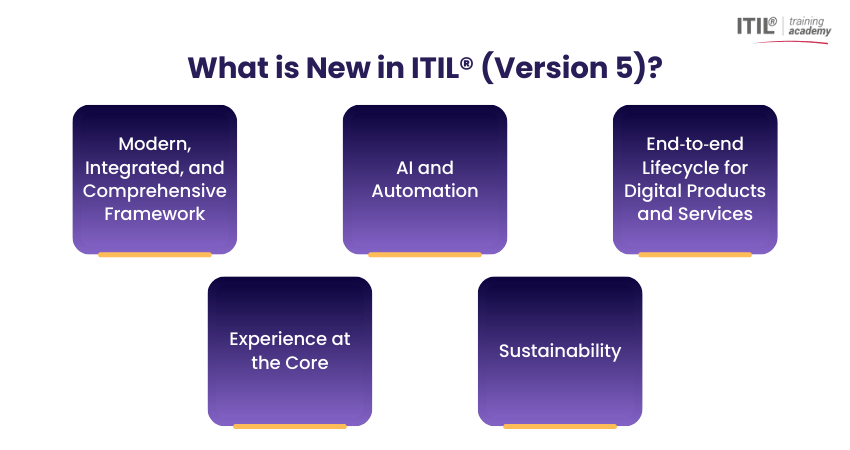
1) Modern, Integrated, and Comprehensive Framework
One of the most notable changes in ITIL® (Version 5) is its broader scope. Earlier versions focused primarily on IT service management, whereas Version 5 expands to fully support digital product management alongside services.
The ITIL framework now offers a unified approach that links strategy, development, delivery, and operations. This integration enables organisations to manage products and services together using shared language and consistent practices, strengthening collaboration between business and technology teams.
2) AI and Automation
Artificial Intelligence (AI) and automation are now integral to many IT environments, and ITIL® (Version 5) reflects this reality. The framework provides structured guidance on adopting AI responsibly, including evaluating risks, identifying opportunities, and establishing appropriate governance.
Automation is positioned as a key enabler for faster delivery, improved responsiveness, and informed decision-making. By embedding AI and automation into everyday practices, ITIL® (Version 5) helps organisations achieve efficiency while maintaining ethical and controlled use of emerging technologies.
3) End‑to‑end Lifecycle for Digital Products and Services
Another major enhancement is the strengthened focus on managing the full lifecycle of digital products and services. ITIL® (Version 5) addresses every stage, from initial discovery and design through delivery, support, and continual improvement.
This end-to-end perspective reduces silos and encourages consistency across teams. It ensures that products and services are developed with long-term value in mind, supporting reliability, adaptability, and alignment with organisational objectives throughout their lifecycle.
4) Experience at the Core
ITIL® (Version 5) places greater emphasis on experience as a driver of value. Instead of concentrating solely on processes, it encourages organisations to design and manage services around user needs and desired outcomes.
This shift highlights the importance of clear roles, accountability, and continual improvement, all aimed at delivering meaningful experiences. By focusing on how services are perceived and used, organisations can improve satisfaction, strengthen trust, and create stronger long-term relationships with users and stakeholders.
5) Sustainability
Sustainability is embedded across ITIL® (Version 5) rather than treated as a standalone concept. The framework encourages organisations to consider long-term environmental, operational, and ethical impacts when designing and improving services.
By aligning people, processes, and technology with sustainable goals, ITIL® (Version 5) supports resilient service value systems. This approach helps organisations deliver immediate value while contributing to responsible growth and long-term stability.
What Remains Unchanged in ITIL® (Version 5)?
While ITIL® (Version 5) introduces meaningful enhancements, it retains essential elements from earlier versions such as ITIL® v3 and 4. The focus on value creation, defined roles and responsibilities, and continual improvement remains central. Established concepts such as governance principles and the service value system continue to provide stability, allowing professionals to transition smoothly without losing familiar foundations.
Why was the ITIL® Latest Version Required?
Let’s explore the key reasons why an updated ITIL® version was required and how it addresses modern organisational challenges:
1) Great Interconnection and Value Focus
Modern organisations need a clearer connection between business goals and the delivery of services and digital products. The updated ITIL® version strengthens this alignment to ensure value is created consistently across strategy and operations.
This stronger alignment helps organisations to:
1) Strengthen the link between strategic objectives and service and product delivery
2) Shift focus toward measurable, outcome-driven results
3) Encourage unified, value-oriented decision-making across teams
2) Adaptability
With rapid changes in ways of working, organisations require a framework capable of supporting flexible, fast-moving, and continuously improving environments. The updated ITIL® framework enables teams to respond effectively to change while maintaining stability.
This improved adaptability helps organisations to:
1) Support agile working models and iterative delivery
2) Respond more quickly to evolving business and technological demands
3) Build a resilience during disruptions and operational changes
3) Simpler and Clearer Qualification Scheme
Professionals and organisations needed a more intuitive and structured learning path. The latest ITIL® version introduces a streamlined qualification scheme that improves clarity and progression.
This clearer structure helps professionals to:
1) Navigate certification pathways with greater confidence
2) Plan development and career progression more effectively
3) Build consistent service management capability across teams
4) Digital Landscape
The pace and scale of digital transformation required guidance aligned with cloud-first and digitally driven operating models. The updated ITIL® version reflects these realities while maintaining control and consistency.
This updated guidance helps organisations to:
1) Align with cloud adoption, automation, and continuous delivery practices
2) Support rapid digital innovation without losing stability
3) Operate effectively in modern, high-velocity service environments
5) The AI Revolution
Artificial Intelligence has become a core part of modern service delivery, bringing both opportunity and risk. The updated ITIL® framework provides guidance on responsible AI adoption, governance, and risk management, helping organisations use AI effectively while maintaining ethical and controlled service practices.
Certification Scheme for ITIL® (Version 5)
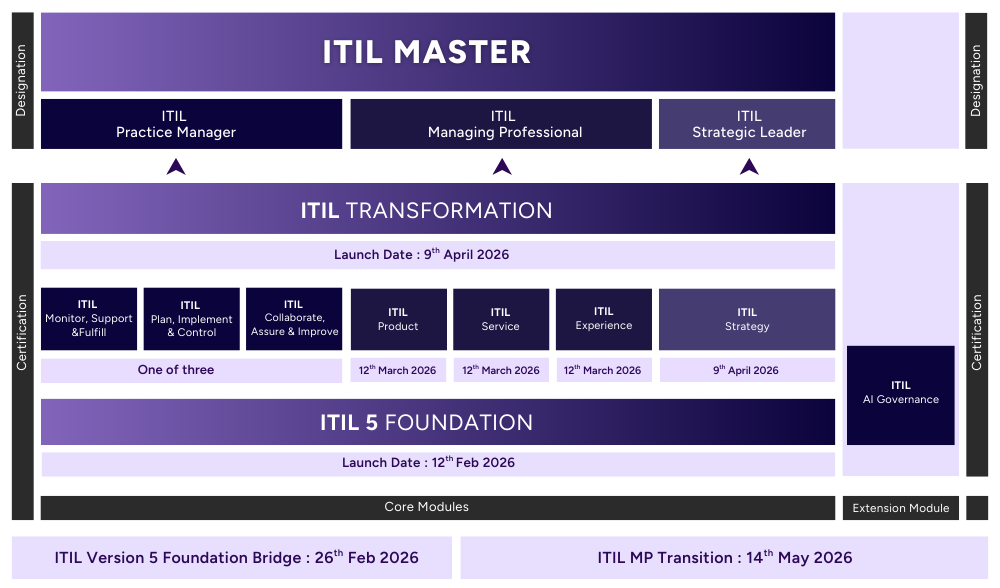
The ITIL® (Version 5) certification structure is designed to support progressive learning, from foundational understanding to advanced leadership capability. It consists of nine core modules and one extension module focused on AI governance.
Here is the launch schedule for ITIL® (Version 5) courses:
1) ITIL® Foundation: 12 February 2026
2) ITIL® Version 5 Foundation Bridge: 26 February 2026
3) ITIL® Product, ITIL® Service, ITIL® Experience: 12 March 2026
4) ITIL® Strategy: 9 April 2026
5) ITIL® Transformation: 9 April 2026
6) ITIL® Managing Professional (MP Transition): 14 May 2026
ITIL® Foundation
![]()
The Foundation level introduces core concepts, terminology, and principles of value creation. It explains how value is delivered to customers and organisations, outlines key roles, and introduces continual improvement. This level is suitable for beginners and acts as the entry point for advanced pathways.
ITIL® Practice Manager
The ITIL® Practice Manager designation is designed for professionals applying ITIL® practices in operational environments. Candidates begin with the ITIL® Foundation, then complete one of the following modules: Monitor, Support and Fulfil (MSF); Plan, Implement and Control (PIC); or Collaborate, Assure and Improve (CAI), followed by ITIL® Transformation. These modules group related practices to build practical capability for managing services in daily operations.
ITIL® Managing Professional
This pathway targets professionals involved in managing digital services and driving improvement. Candidates begin with the ITIL® Foundation, then complete ITIL® Product, ITIL® Service and ITIL® Experience, and conclude with ITIL® Transformation. It focuses on ITIL Service Delivery, experience management, and end-to-end value creation.
ITIL® Strategic Leader
The ITIL® Strategic Leader designation is aimed at senior professionals shaping ITIL service strategy. Candidates start with ITIL® Foundation, "then complete ITIL® Service Strategy, followed by ITIL® Transformation." This pathway focuses on aligning service management with organisational vision, governance, and long-term value creation.
ITIL® Transformation
ITIL® Transformation is a core module required across all ITIL® (Version 5) designations. It focuses on managing sustainable change by aligning people, processes, and technology. The module supports organisations in designing, implementing, and embedding improvements across the service value system.
An additional AI Governance extension module supports ethical and responsible AI adoption. Achieving ITIL® Master requires completion of the Practice Manager, Managing Professional, and Strategic Leader pathways.
Conclusion
ITIL® (Version 5) builds on trusted principles while responding to modern demands such as digital delivery, AI adoption, and sustainable practices. By offering a clearer structure and stronger focus on value, it supports organisations and professionals in managing services while remaining adaptable to change. This makes it a valuable framework for navigating future challenges with confidence.
Frequently Asked Questions?
After the ITIL® (Version 5) rollout, ITIL® 4 and Version 5 will run in parallel for a defined transition period. This allows organisations and professionals to complete existing learning paths while planning upgrades. Clear guidance will be provided before any formal retirement of earlier versions.
The ITIL® (Version 5) certification scheme follows a structured, progressive model. Learners start with Foundation and then pursue role-based pathways such as Practice Manager, Managing Professional, or Strategic Leader. All pathways include the Transformation module, with an optional AI Governance extension for advanced capability.
Most Recent
Date - Aug 1, 2026
Date - Jul 18, 2026
Date - Jul 11, 2026