


 Back to
Topics
Back to
Topics



Author-Maria Thompson

Last updated-Jan 3, 2026
Digital transformation has raised the bar, and IT services are now measured by the value they create instead of their availability. Businesses expect IT to support strategy, improve customer experience, and adapt quickly to change, rather than simply keeping systems running. This shift has changed how services are designed, delivered, and measured.
If you are wondering how this works in practice, you are in the right place. The ITIL® Service Value System addresses this new reality. It shows how all parts of a business work together to turn demand into value. In this blog, you can explore what the ITIL® 4 Service Value System is, how it works, and why it is essential for modern Service Management. Let's dive in!
What is ITIL®4 Service Value System (SVS)?
The ITIL® 4 Service Value System (SVS) is a conceptual model that explains how all components and activities of an organisation work together to enable value creation. It shows how demand and opportunities are transformed into value through the delivery of products and services.
The main purpose of the SVS is to make sure every activity, whether technical or business-related, contributes to overall business value. It encourages organisations to look beyond IT teams and involve customers, users, and stakeholders in delivering better services.
Importance of the Service Value System in ITIL®4
The ITIL® Service Value System plays a central role in ITIL® 4 because it reflects how modern organisations actually operate. Below are the key reasons why it is important for businesses and organisations:
1)Matches Modern Work Styles:
The ITIL® 4 SVS reflects how businesses work today, with teams working together and services changing as customer needs change over time.
2) Connects IT With Business Goals:
SVS helps make sure IT services support business goals instead of working in isolation.
3) Encourages Ongoing Improvement:
It helps organisations keep improving their services over time to meet customer expectations.
4) Supports Quick Changes:
SVS allows businesses to respond quickly to change without losing their structure.
5) Balances Flexibility and Control:
It gives teams the freedom to work efficiently while still managing risks properly.
6) Creates Clear Focus on Value:
SVS helps everyone understand how their work adds value to customers and the business.
7) Improves Teamwork and Responsibility:
By focusing on value, SVS encourages better collaboration and clearer responsibility across teams.
Elements of ITIL®4 Service Value System
The ITIL® 4 Service Value System is made up of five main elements that work together to help businesses deliver value from their services. These elements explain how services are planned, delivered, managed, and improved in a practical way. The following are the elements:
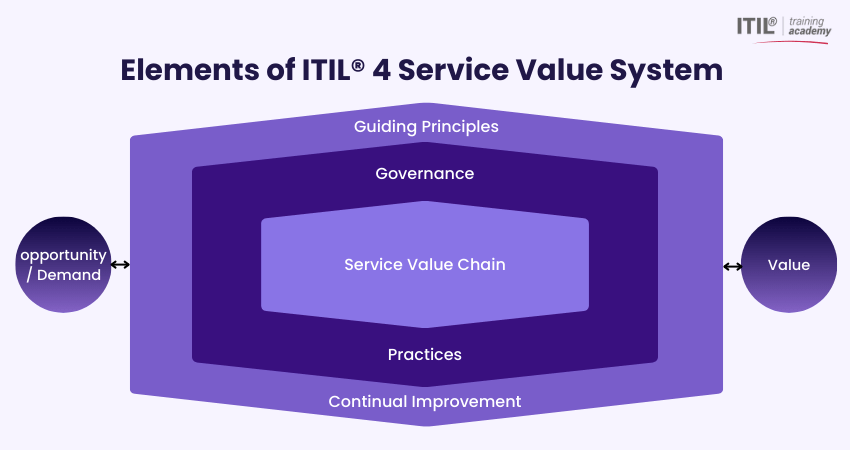
1) Guiding Principles
The
ITIL® 4 guiding principles
are basic recommendations that help organisations make better decisions in any situation. They apply to all types of work, regardless of the size or type of business. They help teams stay focused on value, avoid unnecessary work, and work together more effectively. There are seven principles and they are:
1) Focus on Value:
Always think about how your work benefits customers and the business.
2) Start Where You are:
Use what already exists instead of starting from scratch.
3) Progress Step-by-Step With Feedback:
Work in small steps and improve using feedback.
4) Work Together and Stay Visible:
Share information and involve the right people.
5) Think About the Whole Picture:
Understand how different teams and activities connect.
6) Keep it Simple:
Do only what is needed and avoid overcomplicating things.
7) Improve and Automate:
Make processes better first, then automate where helpful.
2) Governance
Governance ensures the organisation is moving in the right direction. It sets rules, policies, and guidance so everyone understands what needs to be achieved. It also helps leaders make sure services support business goals while managing risks and responsibilities properly. Its key roles include:
1) Setting clear goals and direction
2) Defining roles and responsibilities
3) Checking performance and compliance regularly
Take control of service performance and delivery with our
ITIL® 4 Specialist: Plan, Implement and Control Training
– Register today!
3) Service Value Chain
The Service Value Chain sits at the core of the ITIL® Service Value System. It is an operating model that outlines the key activities required to respond to demand and create value through services. There are six activities in it and those are:
1) Plan:
Decide priorities and future improvements.
2) Improve:
Make services and processes better over time.
3) Engage:
Understand customer and stakeholder needs.
4) Design and Transition:
Build and release services that meet expectations.
5) Obtain or Build:
Get or create the components needed for services.
6) Deliver and Support:
Deliver services and provide ongoing support.
4) Practices
One of the main changes in ITIL® 4 is the shift from focusing on processes to practices. This reflects a broader and more realistic view of how work is done in organisations. A practice includes not just procedures, but also people, skills, tools, information, and partners required to achieve specific objectives. There are 34 practices, grouped into three types such as:
1) General Management Practices: Support overall business management, such as risk and ITIL Knowledge Management.
2) Service Management Practices:
Focus on delivering and improving services, such as incident and Service Level Management.
3) Technical Management Practices:
Support technical work, such as infrastructure and Software Management.
5) Continual Improvement
Continual improvement is a core element of the ITIL® 4 Service Value System and a mindset that runs through all ITIL Best Practices and activities. It means that services, processes, and management practices need to be checked often and improved regularly, so they continue to work well as things change. It involves:
1) Understanding the vision and objectives
2) Assessing the current state
3) Defining the desired future state
4) Planning how to get there
5) Taking action
6) Reviewing results
7) Learning and improving continuously
Learn how to ensure service quality with our
ITIL® 4 Specialist Collaborate, Assure and Improve Training
– Join soon!
Service Value System vs Service Value Chain
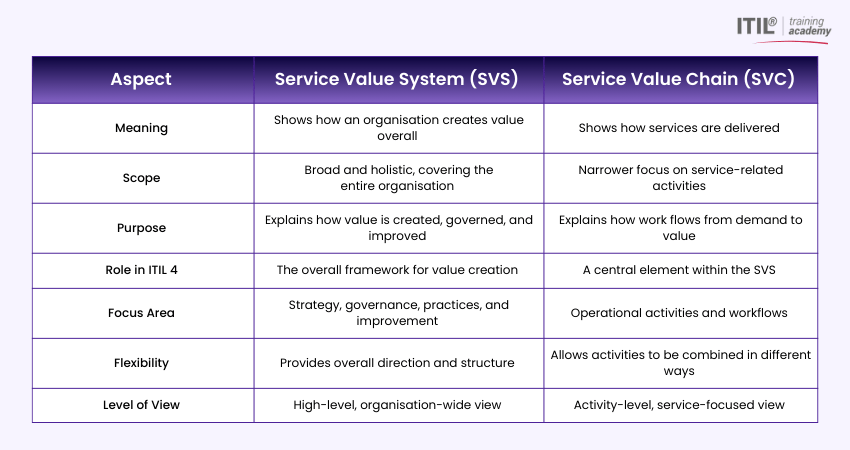
Although closely related, the Service Value System and Service Value Chain serve different purposes and are often confused. The ITIL® 4 Service Value System is the overall framework. Within this framework, the ITIL® Service Value Chain is one element of the SVS.
In simple terms, the SVS answers the question of how the organisation creates value as a whole, while the Service Value Chain explains how value is created through specific service activities. Now, let us look at their differences in detail:
Conclusion
The ITIL® 4 Service Value System represents a major evolution in Service Management thinking. It moves away from rigid processes and focuses on flexibility, collaboration, and continuous value creation. For organisations looking to improve service quality, adapt to change, and deliver consistent value, applying the Service Value System will be a change-maker.
Ready to move beyond theory? Join the
ITIL® 4 Practice Manager (PM) Course
and apply ITIL practices with confidence!
Frequently Asked Questions?
SVS stands for Service Value System. It describes how all parts of an organisation work together to create value through services.
There is no difference between ITIL®4 and ITIL® v4. Both terms refer to the same version of ITIL®. ITIL® 4 is simply the commonly used name, while v4 indicates the version number.
The six key Service Value Chain (SVC) activities are:
1) Plan
2) Improve
3) Engage
4) Design and transition
5) Obtain or build
6) Deliver and support
Most Recent
Date - Aug 1, 2026
Date - Jul 18, 2026
Date - Jul 11, 2026