


 Back to
Topics
Back to
Topics



Author-David Walter

Last updated-Feb 23, 2026
Have you ever struggled to manage IT services while also tracking countless systems, applications, and devices? Many organisations face uncertainty about where service management ends and configuration tracking begins. This is why the discussion around CMDB vs ITSM matters, as it helps teams distinguish between managing services and managing the infrastructure that supports them.
Understanding CMDB vs ITSM brings clarity to how services are delivered and how the underlying environment is structured and controlled. While ITSM governs service processes and performance, a CMDB provides visibility into configuration items and their relationships. In this blog, you will explore their key differences, how they work together, and the benefits and challenges of using them effectively.
What is ITSM?
IT Service Management (ITSM) is a systematic approach to designing, delivering, operating, and continually improving IT services. It focuses on aligning IT services with business needs to support daily operations and long-term goals. ITSM ensures services are reliable, efficient, and valuable to users.
ITSM includes key processes, such as Incident Management, Problem Management, and
Change Management
. These processes help resolve issues quickly, manage change smoothly, and maintain service quality. With continuous performance review and adapting to business needs, ITSM helps organisations deliver consistent IT services.

What is Configuration Management Database (CMDB)?
A Configuration Management Database (CMDB) is a centralised repository that stores and manages information about Configuration Items (CIs) within an organisation’s IT environment. These items may include hardware, software, applications, networks, and related components. The
CMDB
provides visibility into how these elements are configured and how they relate to one another.
A CMDB works within IT Service Management (ITSM) and may integrate with
IT Asset Management (ITAM)
, but it primarily focuses on tracking configuration items and their relationships rather than managing the financial lifecycle of assets.
Difference Between CMDB vs ITSM
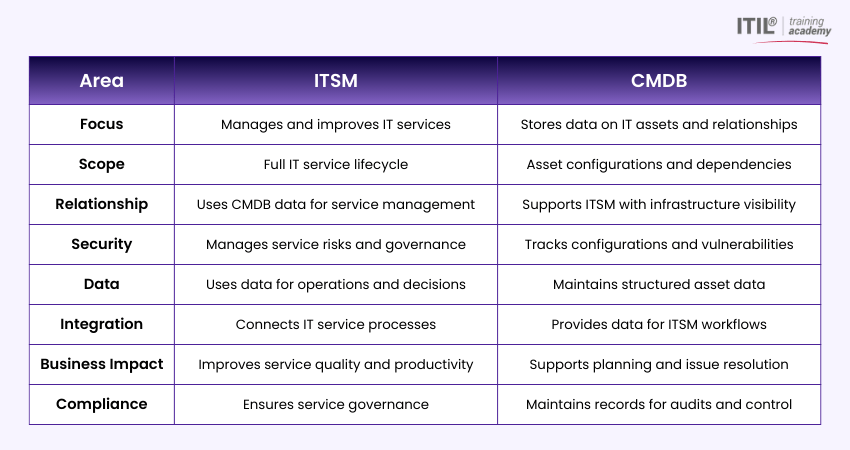
Understanding the difference between CMDB vs ITSM helps organisations see how IT services are managed and how the underlying infrastructure is tracked. Let’s look at their differences below:
1) Core Focus and Functionality
ITSM focuses on managing and improving IT services to meet business goals and user needs. It includes structured processes and practices that ensure services are delivered consistently and effectively.
On the other hand, CMDB focuses on detailed information about IT assets, including their configurations, attributes, and relationships. It acts as a central repository of data that maps how infrastructure components are connected.
2) Scope and Overall Coverage
ITSM covers the full lifecycle of IT services, from design and delivery to monitoring and continuous improvement. It includes processes, such as
ITIL Incident Management
, Change Management, and Service Management.
In contrast, CMDB is more specific. It focuses on maintaining accurate records of IT assets, their configurations, and their dependencies. This is useful for supporting operational and change-related decisions.
3) Interdependence and Collaboration
ITSM is dependent on the accurate data stored in the CMDB to manage incidents, analyse impacts, and make informed decisions about service delivery. Without reliable configuration data, Service Management becomes less effective.
On the other hand, the CMDB supports ITSM by providing visibility into how systems and assets are linked. This helps teams identify affected components during incidents or changes. This leads to collaboration between both to ensure faster responses and reduced service disruptions.
4) Cybersecurity and Risk Reduction
ITSM aims to protect services through structured governance and control processes. It helps organisations manage operational risks, enforce policies, and maintain a secure and reliable
ITIL Service Delivery
.
In contrast, CMDB strengthens Risk Management by keeping detailed records of configurations, vulnerabilities, and system relationships. This visibility helps organisations monitor changes, maintain compliance, and identify potential risks proactively.
5) Data Management
ITSM uses data to support service delivery processes, such as performance monitoring and incident resolution. The focus is to utilise information to improve service quality and make informed operational decisions.
On the other hand, CMDB is responsible for storing and organising detailed configuration data about IT assets. It maintains information on attributes, relationships, and dependences between systems. This structured data helps teams to understand how companies interact.
6) Integration With Related Processes
ITSM integrates with multiple service-related processes to ensure smooth and coordinated IT operations. It connects IT processes to create a structured workflow. This integration improves collaboration and helps to maintain consistent service delivery.
In contrast, CMDB supports these processes by acting as a central source of accurate configuration data. It feeds reliable information into ITSM workflows, ensuring teams understand system relationships before making any decision.
7) Impact on Business Operations
ITSM has a direct impact on business operations by ensuring IT services meet organisational needs and user expectations. This leads to improved productivity, enhanced customer satisfaction, and better business continuity.
On the other hand, CMDB supports business operations by providing visibility into the IT environment. Understanding how systems are connected, organisations can identify risks, plan changes, and resolve issues more effectively to minimise disruptions and maintain stable operations.
8) Role in Compliance and Risk Management
ITSM helps organisations follow structured processes and service standards, which support regulatory compliance. Also, it manages operational risks by enforcing governance and consistent service practices.
In contrast, CMDB strengthens compliance by maintaining accurate records of assets, configurations, and changes. This documentation helps organisations demonstrate control, track modifications, and monitor vulnerabilities, playing an important role in audits and risk reduction.
Build strong foundation in modern IT Product Management with the
ITIL® 5 Product Certification
– Sign up now!
Key ITSM Processes and Their Effect on Efficiency
ITSM includes several core processes that help organisations deliver reliable services and improve operational efficiency. Let’s look at the most important processes below:
1) Incident Management
Incident Management focuses on detecting, reporting, and resolving service disruptions to restore normal operations with minimal impact. Reducing downtime and speeding up resolution times helps maintain productivity and service reliability. When supported by CMDB, teams can identify affected systems faster and respond efficiently.
2) Problem Management
Problem Management
identifies and eliminates the root causes of recurring incidents. Analysing patterns and preventing future disruptions improves long-term service stability. This proactive approach reduces recurring problems, minimises risks, and helps organisations maintain smooth and efficient operations.
3) Change Management
Change Management controls how updates, upgrades, and system modifications are planned, approved, and implemented. It ensures changes are introduced in a structured way without causing unexpected service interruptions. Reducing risks and improving coordination helps organisations maintain service continuity and operational stability.
Benefits of Using a CMDB in ITSM Strategy
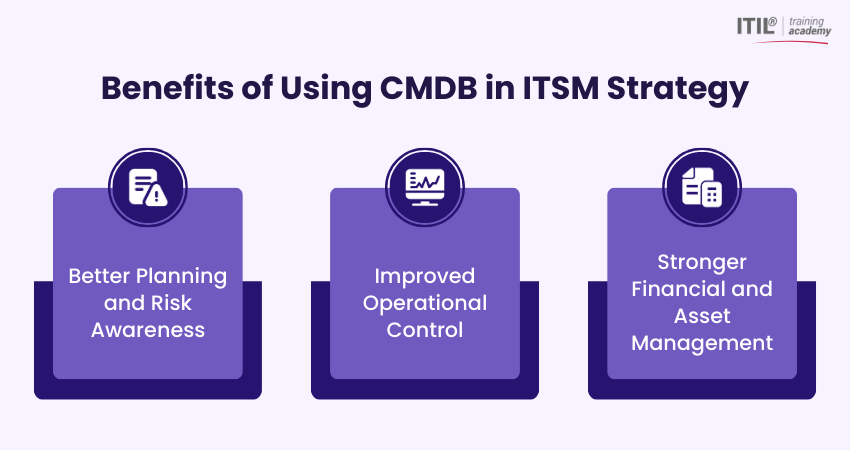
A CMDB forms the foundation of an effective ITSM strategy because it provides the central repository of data about configuration items and their relationships. Let's look at the benefits of using the CMDB in the ITSM strategy below:
1) Better Planning and Risk Awareness
A CMDB helps organisations organise and track relationships between configuration items, reducing manual, and process-related errors. It improves Risk Management by identifying vulnerable assets, enabling teams to assess potential impacts, plan changes, and manage infrastructure with accuracy.
2) Improved Operational Control
The information stored in a CMDB helps organisations monitor their IT environment effectively, including detecting unauthorised software or unexpected changes. Also, it supports faster root cause analysis by showing how systems are connected, helping teams identify problems proactively, reduce downtime, and maintain stable service performance.
3) Stronger Financial and Asset Management
A CMDB supports financial and Asset Management by maintaining accurate records of IT components and their configurations. This helps organisations manage billing, budgeting, and cost allocation effectively while improving asset tracking, resource utilisation, and long-term planning for IT investments.
Design and deliver high-performing IT services with the
ITIL 4 Specialist Create, Deliver and Support (CDS) Course
now!
Challenges in Implementing a CMDB
A well-maintained CMDB provides significant value, but managing and implementing one can be a complicated process. Let's look at the challenges organisations face when implementing CMDB:
1) Ensuring Data Quality and Accuracy
Maintaining accurate and updated data is one of the biggest challenges in managing a CMDB. Since its effectiveness is reliant on the information it contains, incomplete or outdated records can lead to poor decisions and operational risks. Organisations must establish strong data governance and verification processes, including regular audits and updates, to ensure the CMDB remains reliable.
2) Gaining Stakeholder Buy-in
Securing support from different departments can be difficult because teams such as IT, operations, and finance have different priorities. To encourage adoption, organisations must clearly demonstrate how the CMDB benefits each group, from improving incident resolution to supporting financial tracking. Showing practical value helps to build collaboration and maintain long-term commitment.
3) Mapping Relationships and Dependencies
Identifying and maintaining the relationships between IT assets can be time-consuming and technically demanding. Creating a complete and accurate view of how systems interact requires significant effort and continuous updates. For this, using automated CMDB tools can help simplify this process by mapping dependencies, updating relationships, and keeping the data accurate.
Conclusion
Understanding the difference between CMDB vs ITSM is crucial for building an organised and efficient IT environment. ITSM focuses on delivering and improving services, while CMDB provides structured data to make services easier to manage. When combined, they give organisations better visibility and reliable operations. This leads to reducing the number of risks, enhancing performance, and building resilient IT ecosystems.
Learn advanced IT Service leadership skills with
ITIL® Managing Professional Courses
now!
Frequently Asked Questions?
The five stages of ITSM include:
1) Service Strategy: Defines goals and service value
2) Service Design: Plans how services will work and meet user needs
3) Service Transition: Deploys services safely for live use
4) Service Operations: Manages delivery and support
5) Continual Service Improvement: Reviews performance and enhances services
No, ITSM is not the same as ITIL. ITSM is the broader approach to managing IT services. ITIL is a specific framework that provides the best practice guidance for implementing ITSM. To put it simply, ITSM defines what needs to be managed, while ITIL explains how to manage effectively.
The seven principles of ITIL include:
1) Focus on value
2) Start where you are
3) Progress iteratively with feedback
4) Collaborate and promote visibility
5) Think and work holistically
6) Keep it simple and practical
7) Optimise and automate
Most Recent
Date - Aug 1, 2026
Date - Jul 18, 2026
Date - Jul 11, 2026