

 Back to
Topics
Back to
Topics



Author-Maria Thompson

Last updated-Feb 10, 2026
Imagine having expert Project Management support available exactly when you need it, without committing to permanent roles or long-term overheads. Project Management as a Service (PMaaS) offers flexible access to experienced professionals, proven governance, and the right tools on demand. It helps organisations stay in control while adapting quickly to growth, change, and complex delivery needs.
In this blog, we will explain what Project Management as a Service is and how it works in practice. You will explore why organisations choose PMaaS and when it becomes a smarter alternative to traditional Project Management models, helping teams deliver projects with greater confidence and efficiency.
What is Project Management as a Service?
Project Management as a Service (PMaaS) is a flexible delivery model that gives organisations on-demand access to professional Project and Programme Management expertise. It allows organisations to access skilled Project Managers without the administrative burden of hiring, onboarding or offboarding.
Unlike traditional resourcing models, PMaaS delivers the flexibility needed to respond to changing business conditions. Organisations can quickly scale Project Management capacity up or down to meet evolving requirements, removing the complexities associated with permanent recruitment.

Key Features of Project Management as a Service (PMaaS)
Here are the key features that make PMaaS such a powerhouse:
1) Continuous Support and Improvement
Operating in a highly competitive as-a-service environment, PMaaS providers continually enhance their offerings using industry insights and client feedback. This is done while maintaining consistent programme oversight and providing round-the-clock support.
2) Specialised Tools
PMaaS providers leverage leading Project and Programme Management platforms such as JIRA, ServiceNow and Oracle Primavera P6, alongside modern technologies and frameworks. This delivers best-in-class visibility, control and reporting across portfolios.
3) Tailored Methodology
PMaaS supports project success by applying Agile, Waterfall or hybrid approaches based on the unique requirements of each initiative, thus ensuring both adaptability and structured execution.
4) On-demand Services
PMaaS provides Project and Programme Management support precisely when required. Organisations can engage services for individual projects, defined timeframes or specific activities, thus enabling flexible and cost-effective resourcing.
Key Considerations for Choosing a PMaaS Provider
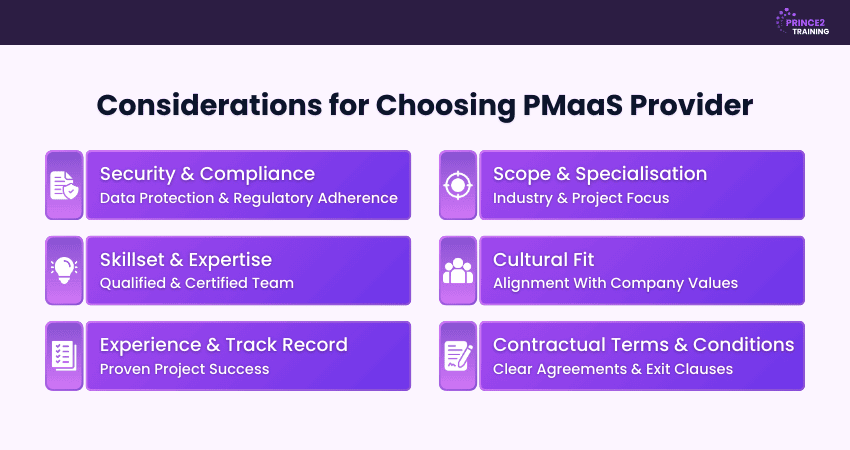
Although PMaaS is increasingly seen as a forward-looking delivery model, it may not be the right fit for every organisation. A thorough assessment is essential. Before selecting a PMaaS provider, the following factors must be carefully evaluated:
1) Security and Compliance
As hybrid working environments increase exposure to cyber risks, it is critical to ensure the provider operates within robust security frameworks and complies with relevant industry standards and regional regulatory requirements.
2) Skillset and Expertise
Verify that the provider offers a qualified and certified team with strong proficiency in specialised Project and Programme Management methodologies, tools, and supporting technologies.
3) Experience and Track Record
Review the provider’s history of successful project execution through case studies, references, and client feedback. Confirm their ability to manage complex, high-value or large-scale programmes.
4) Scope and Specialisation
Assess the nature and scale of your projects. Some PMaaS providers focus on specific industries such as Information Technology (IT), construction or finance, while others are better suited to managing enterprise-level programmes or smaller, discrete initiatives.
5) Cultural Fit
Gauge how well the provider’s working style, values, and communication approach align with your organisation. Strong cultural fit supports effective collaboration, transparency, and long-term partnership success.
6) Contractual Terms and Conditions
Examine contract structures, including duration, exit terms, and any early termination conditions. Pay close attention to clauses covering data ownership, intellectual property rights and confidentiality obligations.
Benefits of Using Project Management as a Service
Here are the major benefits of employing PMaaS services:
1)Time and Cost Efficiency
PMaaS removes the need to take on Project Management responsibilities internally, freeing leadership teams to focus on strategic priorities such as business growth and investment planning while avoiding the costs of permanent hires.
2) Expert-driven Approach
Experienced Project Managers apply proven techniques, tools and frameworks to maintain coordination and momentum. This improves team productivity and driving projects towards clearly defined outcomes.
3) Efficiency
With clear structures, defined workflows, and disciplined execution, teams remain focused on their core expertise, enabling faster delivery and consistently higher-quality results.
4) Effective Risk Control
Even well-planned initiatives can face uncertainty. PMaaS proactively identifies potential risks, addresses issues early and reduces their impact on timelines, budgets and delivery quality.
5) Client Assistance
PMaaS ensures continuous stakeholder engagement through regular updates, progress discussions and milestone reviews. Clients receive sprint summaries and demonstrations, thus allowing for timely feedback and informed decision-making throughout the project lifecycle.
Gain substantial Project Management edge and stay ahead of your competition with our PRINCE2® Practitioner Training – Register now!
Critical Success Factors for Implementing PMaaS
Proper adoption of Project Management as a Service depends on an approach that aligns with organisational objectives and unlocks its full value. Here are the critical success factors you must consider:
Stakeholder Alignment and Engagement: Securing commitment from senior leadership and project teams is essential. Strong stakeholder support reduces resistance, improves decision-making, and ensures resources are aligned to support the PMaaS model.
Thorough Provider Selection: A disciplined evaluation process is vital when choosing a PMaaS partner. Assess expertise, delivery history, toolsets, and cultural compatibility. The right provider boosts efficiency and collaboration, while a poor fit can introduce delays and execution risks.
Clear and Consistent Communication: Ambiguity can undermine success. Defined communication structures and escalation paths ensure shared expectations, timely feedback and rapid issue resolution between internal teams and the PMaaS provider.
Strong Data Security Practices: Confirm that the provider adheres to strong data protection and privacy standards that meet organisational, industry and regional compliance requirements.
Defined Performance Measures: Establish clear KPIs to monitor service effectiveness, measure return on investment, identify improvement opportunities and ensure ongoing value delivery from the PMaaS engagement.
Build strong project foundations with the power of agile flexibility in our PRINCE2 Agile® Foundation Course - Sign up now!
Risks and Challenges of PMaaS and How to Mitigate Them
As a people- and process-led service model, PMaaS presents distinct risks compared to technology-centric models such as SaaS or PaaS. Recognising these challenges early and applying appropriate mitigation measures is key to successful adoption:
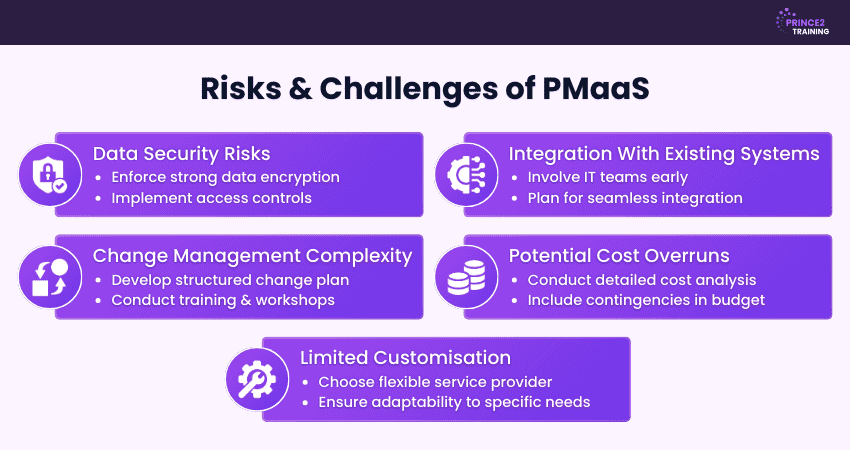
1) Data Security Risks
Sharing sensitive project and organisational data with an external provider can introduce security and privacy concerns, particularly in an environment of rising cyber threats. Enforce strong data encryption, role-based access controls, regular security audits and ongoing reviews of the provider’s security framework.
2) Integration With Existing Systems
Challenges may arise when PMaaS platforms need to work alongside legacy tools and internal systems. Involve IT teams at an early stage to assess compatibility, plan integrations and ensure seamless alignment with existing technology landscapes.
3) Change Management Complexity
Transitioning to an external Project Management model can face resistance and adoption barriers across teams. Implement a structured Change Management plan supported by training sessions and workshops that articulate the value and impact of PMaaS.
4) Potential Cost Overruns
Unanticipated expenses such as system integration, configuration or customisation can affect budgets. Carry out detailed cost assessments in advance, account for hidden or indirect costs and include contingency provisions within financial planning.
5) Limited Customisation
Standard PMaaS offerings may not fully reflect an organisation’s specific workflows or governance models. Select a provider that offers flexible configuration options and the ability to tailor services to organisational requirements.
Conclusion
Project Management as a Service redefines how organisations can deliver change, replacing rigid structures with flexibility and expertise on demand. When strategy joins hands with scalable execution, project risks shrink and outcomes sharpen. More than a service model, PMaaS is a smarter, more adaptive way to turn ideas into measurable results.
Secure future-ready Project Management success with our range of PRINCE2® Courses - Sign up now!
Frequently Asked Questions?
No FAQs available for this blog.
Most Recent
Date - Feb 10, 2026
Date - Feb 6, 2026
Date - Jan 30, 2026