


 Back to
Topics
Back to
Topics



Author-Maria Thompson

Last updated-Feb 6, 2026
Have you ever struggled to keep track of laptops, software licences, or cloud tools across your organisation? This is where IT Asset Management becomes important. As organisations expand and rely on technology, assets can become scattered, underused, or forgotten. Without clear visibility, organisations face higher costs, increased security risks, and compliance challenges.
It is important since it helps organisations stay in control by tracking every IT Asset from purchase to its retirement. It ensures the right tools are available to the right people, reduces unnecessary spending, and supports smarter planning. In this blog, you will learn about IT Asset Management, its importance, types, process, and more!
What is IT Asset Management?
IT Asset Management (ITAM) is the process of tracking and managing an organisation’s IT Assets throughout their entire lifecycle. It ensures that assets, such as hardware, software, servers, licences, and cloud tools, are properly recorded, used, maintained, and retired at the right time. This helps to gain visibility into what they own, how assets are used, and the cost of ownership.
As IT environments keep expanding and growing more complex, IT Asset Management becomes crucial for controlling costs, reducing risks, and supporting clear decisions. Also, with the rise of subscription software and employee-selected tools, ITAM provides a single source of truth for optimising budgets and managing lifecycles efficiently.

Why is ITAM Important?
The importance of IT Asset Management is immense. It centralises every asset information, reducing errors, improving accuracy, and helping IT and management to make informed decisions with confidence. Also, it ensures accurate and updated visibility to support informed decision-making, allowing IT teams to focus on strategic work instead of manual tracking.
IT Asset Management improves asset utilisation and supports modern IT operations. Identifying unnecessary assets cuts down costs, keeps organisations compliant, and reduces security risks. This enables teams to move faster, manage cloud and on-demand services, and deliver value across the business.
Types of IT Asset Management
IT Asset Management is divided into different types based on the kind of assets being tracked and managed. Let’s look at its types below:
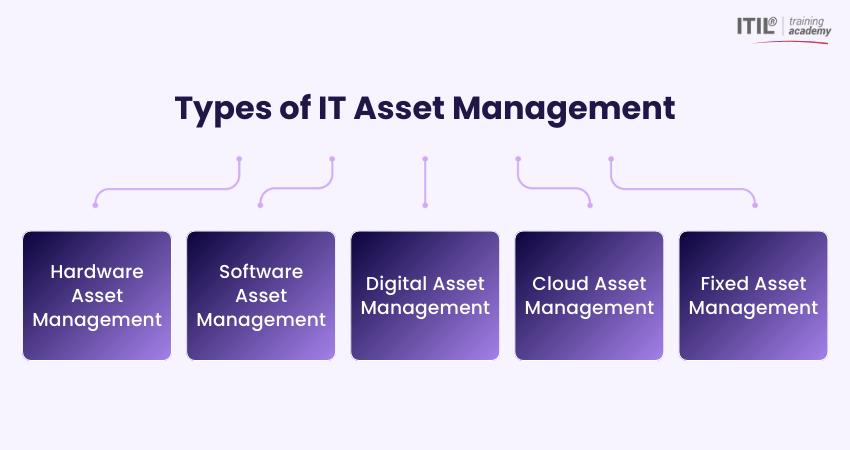
1) Hardware Asset Management
Hardware Asset Management focuses on tracking and managing physical IT devices, such as laptops, servers, mobile devices, and workstations. This helps organisations to maintain accurate inventories and manage asset lifecycle effectively.
2) Software Asset Management
Software Asset Management deals with managing software applications, licences, subscriptions, and usage rights. It helps organisations stay compliant with licensing agreements, leading to reduced software costs and efficient application usage.
3) Digital Asset Management
Digital Asset Management is used to manage digital content, such as images, videos, and documents. It helps to track licences, formats, metadata, and access. This makes it easier to store, retrieve, and manage digital assets.
4) Cloud Asset Management
Cloud Asset Management supports tracking and controlling of cloud-based services from providers, such as Microsoft and Amazon. This improves visibility into cloud usage, prevents over-provisioning, and manages cost in cloud environments.
5) Fixed Asset Management
Fixed Asset Management focuses on non-movable IT Assets, such as printers, networking cabinets, and service room infrastructure. It ensures these long-term assets are properly tracked, maintained, and accounted for.
Strengthen service visibility and respond faster with
ITIL® 4 Practitioner: Monitoring and Event Management Training
now!
IT Asset Management Process
The IT Asset Management process must be reviewed and updated regularly. This ensures organisations have accurate visibility and control throughout the asset lifecycle. Let's look at its process below:
1) Inventory Assets
The first step is to create a complete inventory of all IT Assets. This includes what assets the organisation owns, where they are located, when they were purchased, and how much did they cost the organisation.
2) Calculate Lifecycle Costs
The next step is to calculate the total lifecycle cost of each asset. This must cover purchase, maintenance, upgrades, and disposal costs. This helps organisations to understand the true value and cost of ownership.
3) Tracking
The third step requires tracking the assets using an IT Asset Management tool. Through effective tracking, it helps organisations to monitor usage, contracts, licences, and warranty expiry dates, ensuring nothing is excluded.
4) Maintenance
The process of maintenance involves repairing, upgrading, or replacing assets required. All maintenance activities should be recorded so teams can assess the asset performance and reliability over time.
5) Financial Planning
In the final step, accurate asset and cost data are used to plan future budgets. Financial planning ensures the right level of service is maintained for critical assets and helps to allocate resources effectively based on business needs.
Keep delivering consistent service value with
ITIL® 4 Practitioner Service Level Management Training
now!
Key Stages of the IT Asset Lifecycle
Every asset has a limited lifespan, and IT Asset Management focuses on managing each stage of that lifecycle to bring out the most value and productivity. Let’s look at the key stages of the IT Assets lifecycle below:
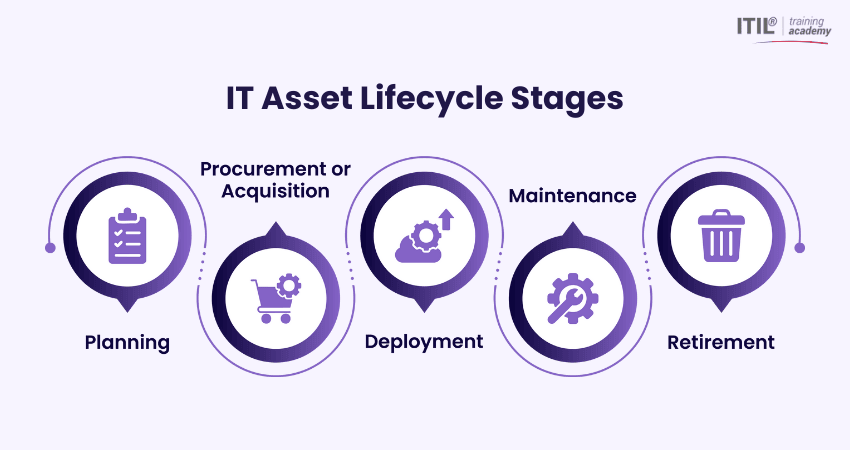
1) Planning
This stage involves identifying what assets the organisation needs, how they will be used, and the best way to acquire them. Teams evaluate alternatives, assess costs, and conduct total cost of ownership, and cost-benefit analysis before making decisions.
2 Procurement or Acquisition
In this stage, assets are acquired through purchasing, licensing, building, or subscribing to services, such as Software-as-a-service (SaaS). This focus is on securing the right assets at the right cost and terms.
3) Deployment
Deployment involves installing and configuring assets. Then, it proceeds to integrate them with existing systems, providing user access and offering technical support. This ensures that assets are ready for effective and secure usage.
4) Maintenance
Once assets are in use, regular maintenance, upgrades, or repairs are required. Proper maintenance extends asset lifespan, reduces risks, and helps organisations to get maximum value while keeping costs under control.
5) Retirement
Assets are retired when maintenance becomes too costly, performance declines, or better alternatives are available. This stage involves disposing of assets securely, updating records, ending licences, and planning the transition to new assets.
Resolve root causes, reduce repeat incidents, and improve service stability with
ITIL® 4 Practitioner: Problem Management Training
today!
Benefits of IT Asset Management
IT Asset Management creates structure, asset visibility, and delivers maximum value throughout its lifecycle. Let's look at some of the key benefits ITAM provides below:
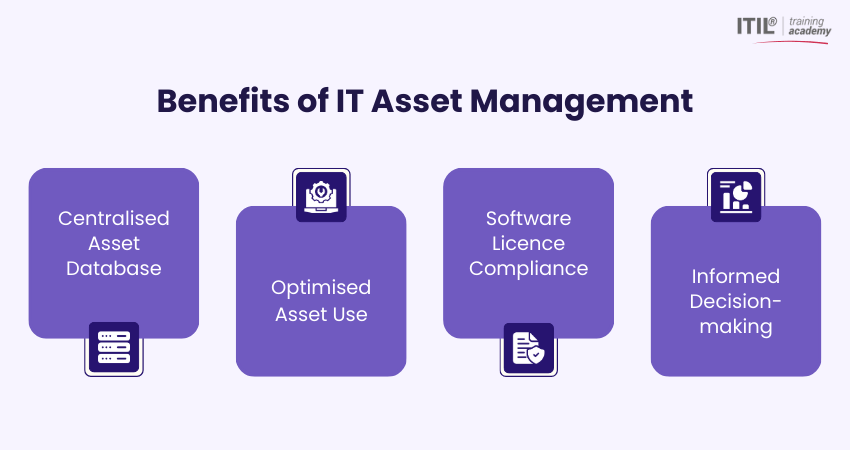
1) Centralised Asset Database
IT Asset Management creates a single, accurate inventory of every IT Asset. This is helpful for organisations since it helps them to view everything in a centralised place, making it easier to identify assets that need upgrading, optimising, or retiring.
2) Optimised Asset Use
With real-time visibility into asset status and usage, IT Asset Management reduces waste, eliminates unnecessary effort, and controls costs. It helps organisations avoid unnecessary purchases and ensures resources are used where they deliver the greatest value.
3) Software Licence Compliance
ITAM supports compliance with software licensing agreements by tracking installed software and usage. This reduces the risk of audit failure, penalties, and fines while ensuring licences are used correctly and in a cost-effective manner.
4) Informed Decision-making
Accurate IT Asset Management data enables organisations to review past asset purchases and deployments. These insights improve future planning, purchasing decisions, and overall IT and business processes.
Challenges of IT Asset Management
Although IT Asset Management provides many benefits, it comes with its own set of challenges that organisations must be aware of. Let’s look at them below:
1) High Initial Costs:
Implementing IT Asset Management can be expensive due to the high cost of ITAM software, tools, and employee training.
2) Complex and Time-consuming Implementation:
Setting up an ITAM programme involves system configuration, data collection, training, and ongoing maintenance, needing extra effort and time.
3) Data Accuracy Issues:
Gathering and maintaining accurate asset data can be challenging, especially in large or fast-moving IT environments.
4) Integrating Challenges:
Integrating IT Asset Management tools with existing systems and processes can be technically complex and may require additional resources.
Turn strategy into action with structured planning and control with
ITIL® 4 Specialist: Plan, Implement and Control Training
– Join now!
ITAM Best Practices
Let’s look at the best ITAM practices for bringing the maximum value out of assets in your organisation below:
1) Choose the Right ITAM Tool:
Start by selecting an IT Asset Management tool that fits your organisation’s size, complexity, and asset management needs. The right tool should support visibility, tracking, and reporting without added complexity.
2) Establish a Clear ITAM Policy:
Create a formal IT Asset Management policy that defines roles, responsibilities, and governance. This ensures consistency and accountability.
3) Define Standard Operating Procedures:
Set clear procedures for asset tracking, documentation, and system usage. This will help teams to record asset data accurately.
4) Use a Consistent Tracking Method:
Apply the same tracking approach for all relevant assets to ensure nothing is excluded. Consistency improves data accuracy and makes reporting reliable.
5) Perform Regular Asset Audits:
Conduct scheduled audits to review, update, and verify asset information. Regular audits help to identify unused, outdated, or missing assets proactively.
6) Track Critical Asset Data:
Ensure the system captures important details, such as purchase dates, licences, warranty information, expiration dates, and vendor contracts, for effective IT Asset Management.
ITAM Software Tools
There are many IT Asset Management tools available, offered as both on-premises enterprise solutions and cloud-based SaaS platforms. These tools help organisations to track, manage, and optimise IT Assets effectively across their lifecycle. Some commonly utilised tools include:
1) Asset Panda
2) Freshservice
3) GoCodes
4) Ivanti IT Asset Management Suite
5) ManageEngine
6) Asset Explorer
7) ServiceNow
8) SysAid
Using the right IT Asset Management tool improves visibility and control over IT Assets. Also, it provides accurate asset data during incidents, problems, or changes, enabling faster troubleshooting and smarter and informed business decisions.
Deliver smooth, low-risk deployments with
ITIL® 4 Practitioner: Deployment Management Training
– Join today!
Conclusion
IT Asset Management plays an important role in helping organisations stay in control of their technology, costs, and risks. Adopting a systematic approach is useful for organisations to gain visibility into their assets, improve decision-making and adapt to change. When assets are managed effectively, ITAM turns complex IT environments into organised, value-driven systems.
Learn multiple practices for leading service management confidently with
ITIL® 4 Practice Manager (PM) Course
now!
Frequently Asked Questions?
Yes, ITAM is part of the ITIL framework, specifically ITIL 4. It is recognised as a core practice that supports service management by tracking, controlling, and optimising IT Assets across their lifecycle. This improves visibility, reduces risks, and supports reliable service delivery.
An IT Asset Management Database is a central repository that stores detailed information about an organisation’s hardware and software assets throughout their entire lifecycle. It acts as a single source of truth, showing asset location, ownership, usage, financial value, and licence.
IT Asset Management is asset-centric and mainly focuses on managing the full lifecycle of IT Assets, from purchase and disposal to costs and compliance. On the other hand, IT Service Management is a service-centric approach that focuses on delivering, supporting, and continuously improving IT services to meet business and user needs.
Most Recent
Date - Aug 1, 2026
Date - Jul 18, 2026
Date - Jul 11, 2026