


 Back to
Topics
Back to
Topics



Author-Maria Thompson

Last updated-Jan 6, 2026
Managing IT services can be a complicated process without the right systems in place. From handling incidents to meeting service level expectations, IT teams need systematic support to deliver consistent results. This is where Information Technology Infrastructure Library (ITIL) tools play a major role in streamlining processes, improving visibility, and delivering reliable IT services that support wider business operations.
To understand this in practice, this blog explains how ITIL tools help IT teams manage incidents, problems, changes, and service requests. It explores the most widely used ITIL® Tools and highlights the key benefits they provide across IT Service Management. Let’s get started!

Key Categories of ITIL® Tools
ITIL® Tools are designed to support the processes defined in the ITIL framework and help organisations manage IT services in a structured way. Let’s look at the key categories of ITIL® Tools below.
1) Service Strategy Tools
Under this category, the following tools are included:
1)Financial Management Tools:
Helps with budgeting, accounting, and managing the financial aspects of IT services.
2)Service Portfolio Management Tools:
Support managing services in development, live services, and retired services.
2) Service Design Tools
Under this category, the following tools are included:
1)Service Catalogue Management Tools:
Help to create and maintain a clear list of available IT services.
2) Service Level Management Tools:
Supports the definition, monitoring, and management of service level agreements.
3)Capacity Management Tools:
Helps in the process of planning and optimising IT infrastructure capacity.
3) Service Transition Tools
Under this category, the following tools are included:
1) Change Management Tools:
Helps in planning, assessing, and authorising changes to IT services.
2) Configuration Management Tools:
Help maintain accurate information about configuration items and their relationships, supporting impact analysis and change control.
3) Release Management Tools:
Assist in planning, testing, and deploying IT service releases.
4) Service Operation Tools
Under this category, the following tools are included:
1) Incident Management Tools:
Helps to log, prioritise, and resolve any IT service disruptions.
2) Problem Management Tools:
Support in identifying the root causes of recurring incidents.
3) Event Management Tools:
Monitor IT systems to identify and manage events.
5) Continual Service Improvement Tools
Under this category, the following tools are included:
1) Performance Analytics Tools:
Provides data insights to assess and improve service performance.
2) Service Measurement and Reporting Tools:
Supports the collection and reporting of metrics to evaluate the overall service quality.
Best ITIL® Tools to Use
Let’s discuss some of the most effective ITIL® Tools utilised by businesses:
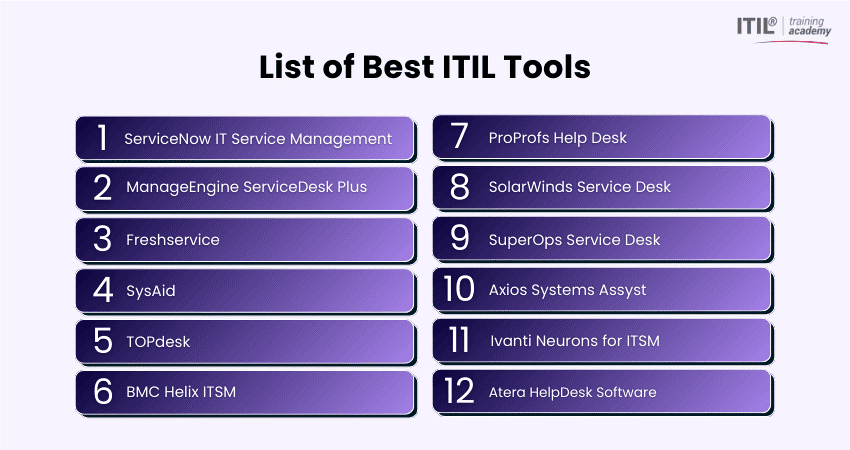
1) ServiceNow IT Service Management
ServiceNow ITSM is an enterprise IT Service Management platform that supports ITIL‑aligned practices across the service lifecycle. It helps organisations standardise processes, automate workflows, and improve service visibility at scale.

Key Features:
1) Incident, Problem and Change Management
2) Service Catalogue and Request Fulfilment
3) Workflow automation
4) Reporting and dashboards
5) Integration with other enterprise systems
2) ManageEngine ServiceDesk Plus
ManageEngine ServiceDesk Plus is an ITSM tool designed to help organisations manage IT services using structured ITIL practices. It supports service desk operations along with integrated IT asset management.
Key Features:
1) Incident and Service Request Management
2) Problem and Change Management
3) Asset and configuration tracking
4) Service catalogue
5) SLA monitoring and reporting
Turbocharge your ITIL knowledge and build practical skills with the
ITIL® 4 Managing Professional Transition Module Course
– Register today!
3) Freshservice
Freshservice is a cloud-based ITSM solution that helps IT teams manage services efficiently using ITIL‑aligned processes. It is designed to improve responsiveness, visibility, and collaboration within IT operations.
Key Features:
1)Incident, Problem, and Change Management
2) Asset and CMDB management
3) Automation and orchestration
4) Self-service portal
5) Analytics and reporting
4) SysAid
SysAid is an IT service management tool focused on simplifying service desk operations and automation. It helps IT teams manage incidents, requests, and assets with minimal complexity.
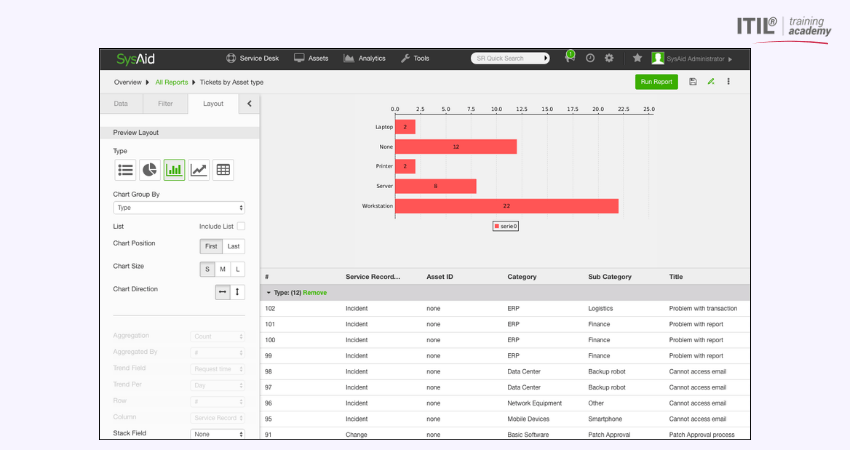
Key Features:
1) Ticket and request management
2) Workflow automation
3) Asset management
4) Knowledge base
5) Reporting and dashboards
5) TOPdesk
TOPdesk is an ITSM tool that supports structured service management across IT and other service departments. It helps organisations manage incidents, changes, and service requests in a consistent way.
Key Features:
1) Incident and Change Management
2) Service catalogue
3) Asset and configuration management
4) Self-service portal
5) Reporting and analytics
6) BMC Helix ITSM
BMC Helix ITSM is an enterprise-grade IT Service Management solution for complex IT environments. It supports ITIL practices with advanced automation and analytics capabilities.
Key Features:
1) Incident, Problem, and Change Management
2) Service request fulfilment
3) Automation and AI-driven workflows
4) Performance analytics
5) Integration with monitoring tools
7) ProProfs Help Desk
ProProfs Help Desk is a service desk tool that helps IT teams manage tickets and user communication efficiently. It is commonly used by small teams to support basic service desk functions, though it does not offer full ITIL process coverage.
Key Features:
1) Ticket management
2) Knowledge base
3) Email and portal-based requests
4) SLA tracking
5) Reporting tools
8) SolarWinds Service Desk
SolarWinds Service Desk is a cloud-based ITSM tool that supports ITIL-aligned service management practices. It helps organisations improve service delivery through automation and visibility.
Key Features:
1) Incident, Problem, and Change Management
2) Asset and configuration management
3) Service catalogue
4) Automation rules
5) Reporting and dashboards
Lead IT Service operations confidently and efficiently with the
ITIL® 4 Managing Professional (MP) Certification Path
now!
9) SuperOps Service Desk
SuperOps Service Desk is designed for IT teams and managed service providers to manage service desk operations efficiently. It supports structured workflows and visibility across multiple IT environments.
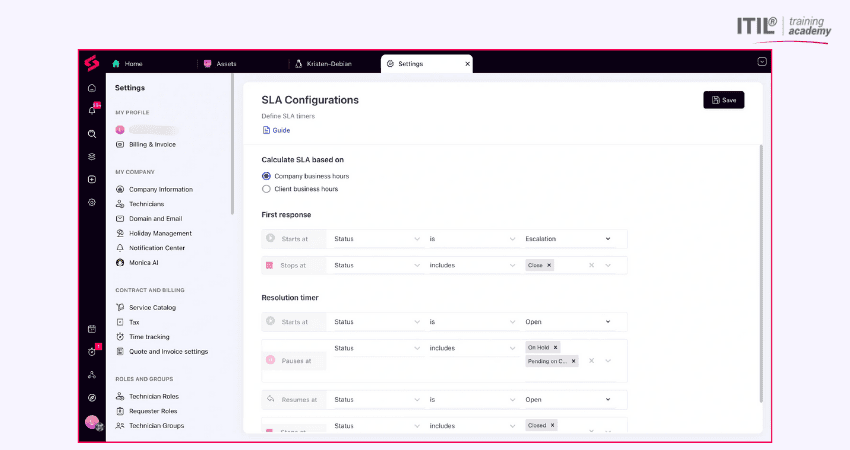
Key Features:
1) Ticket and request management
2) Asset tracking
3) Workflow automation
4) Monitoring integration
5) Reporting and analytics
10) Axios Systems Assyst
Assyst by Axios Systems is an ITSM tool built specifically around ITIL principles. It supports consistent service management through strong governance and process control.
Key Features:
1) Incident, Problem, and Change Management
2) IT Service Catalogue and requests
3) Configuration management
4) Reporting and compliance support
5) Workflow automation
11) Ivanti Neurons for ITSM
Ivanti Neurons for ITSM is an IT service management platform that supports ITIL‑aligned processes across IT operations. It uses automation and insights to improve service efficiency and decision-making.
Key Features:
1) Incident, Problem, and Change Management
2) Asset and configuration management
3) Automation and workflow orchestration
4) Self-service capabilities
5) Reporting and analytics
12) Atera HelpDesk Software
Atera is a service desk and IT management tool primarily used by IT teams and managed service providers. It combines ticketing with monitoring and automation to support IT service delivery.
Key Features:
1) Ticket and service request management
2) Remote monitoring and management
3) Automation and scripting
4) Asset tracking
5) Reporting and dashboards
Develop strategic IT Leadership capabilities by registering for
ITIL® 4 Leader: Digital and IT Strategy Certification
now!
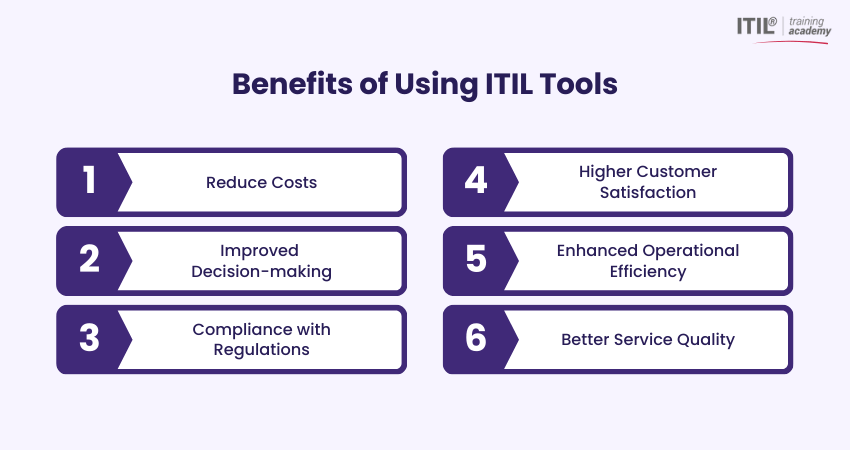
Benefits of Using ITIL® Tools
ITIL® Tools help businesses deliver services in an efficient and consistent manner. Let’s look at their key benefits:
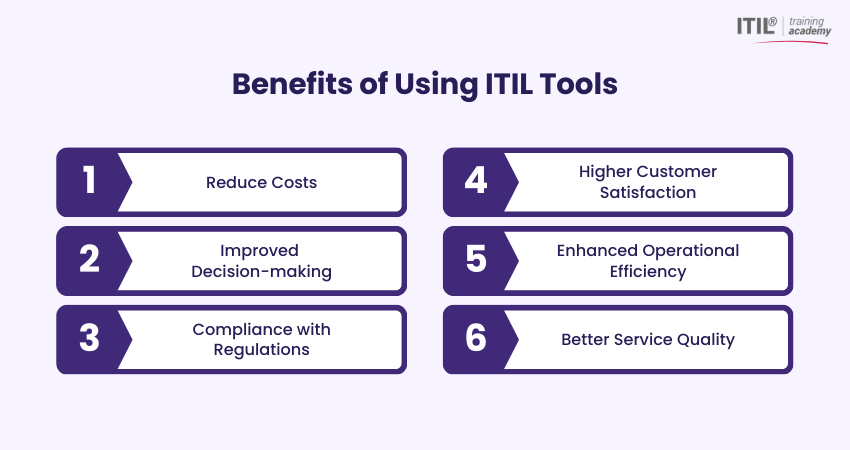
1) Reduce Costs
Through capacity management, asset tracking, and change control, ITIL® Tools help businesses optimise resources and avoid unnecessary spending. This reduces the risk of service disruption and helps to prevent costly outages.
2) Improved Decision-making
ITIL® Tools provide performance analytics, dashboards, and reports that provide clear visibility into service performance. These insights help leaders identify improvement areas and track trends, helping to make informed decisions.
3) Compliance with Regulations
ITIL® Tools maintain detailed audit trails and check policy compliance. This supports regulatory requirements, improves accountability, and ensures IT Service Management practices meet compliance standards.
4) Higher Customer Satisfaction
ITIL® Tools help resolve incidents faster and foster transparent communication to improve the overall experience. Also, features such as self-service portals, knowledge bases, and automated notifications help to resolve customer issues and boost satisfaction levels.
5) Enhanced Operational Efficiency
ITIL® Tools automate routine tasks, such as ticket routing, approvals, and reporting. Such standardised processes across IT services reduce manual effort, eliminate errors, and boost efficiency, fostering rapid problem resolution and better coordination.
6) Better Service Quality
ITIL® Tools support structured incident, problem, and service level management. They help IT teams resolve issues faster, identify root causes, and manage service level agreements. This leads to reduced downtime and consistent service delivery.
Conclusion
Selecting the right ITIL® Tools can transform how organisations deliver and manage IT services. From improving service quality and efficiency to supporting data-driven decisions and continual improvement, these tools are essential to ensure success. It helps IT teams align with long-term business goals and sustain efficiency in performance levels. The right ITIL® tools turn service management into a strategic advantage.
Drive value-focused IT strategy and align it with business goals with
ITIL® 4 Strategist: Direct, Plan and Improve Course
– Join today!
Frequently Asked Questions?
The types of ITIL® include:
1) ITIL® Foundation
2) ITIL® Managing Professional
3) ITIL® Strategic Leader
4) ITIL® Practice Manager
5) ITIL® Master
The main differences between ITIL 3 and ITIL® 4 tools lie in their approach and structure. ITIL 3 tools are process-driven and aligned to the service lifecycle, while ITIL® 4 tools are practice-focused, support the Service Value System, and emphasise flexibility, continual improvement, and integration with Agile, DevOps, and Lean ways of working.
Yes, ITIL® is a globally recognised framework for IT Service Management. It offers best practices and guidelines to help IT services align with business needs. It improves service delivery, manages risks and supports the IT service lifecycle.
Most Recent
Date - Aug 1, 2026
Date - Jul 18, 2026
Date - Jul 11, 2026