


 Back to
Topics
Back to
Topics



Author-Maria Thompson

Last updated-Jan 3, 2026
Behind every seamless IT experience is the ITIL® Service Desk, which acts as a central point of contact between users and IT services. It connects people, processes, and technology to support daily operations and maintain service continuity. By managing incidents, service requests, and communication, the Service Desk plays a key role in delivering value and supporting effective IT Service Management.
In this blog, you will explore the roles, processes, and benefits of the ITIL® Service Desk, explaining how it supports service delivery and user satisfaction. Read on to understand how the Service Desk contributes to consistent and reliable IT services.
What is an ITIL® Service Desk?
An Information Technology Infrastructure Library (ITIL) Service Desk is the central point of contact between users and the IT service provider. It manages incidents, service requests, and user communications to ensure issues are resolved efficiently and services run smoothly. The Service Desk also coordinates with technical teams, tracks service performance, and supports continual improvement.
By aligning people, processes, and technology, the ITIL® Service Desk plays a key role in maintaining service quality. It also helps improve user satisfaction and enable reliable IT Service Management across the organisation.
ITIL® Service Desk Framework
Service Desk teams handle Incident Management and request fulfilment to restore normal service as quickly as possible. Key Service Desk responsibilities include:
1) Logging, categorising, and prioritising all contacts
2) Conducting initial investigation and diagnosis
3) Resolving issues at first contact where possible
4) Escalating unresolved incidents and requests within agreed timeframes
5) Closing completed cases
6) Keeping users informed about progress, changes, and planned service interruptions
Types of ITIL® Service Desk
The most effective Service Desk setup depends on organisational requirements such as size, budget, user expectations, and geographic distribution. Selecting the right type is essential to delivering efficient, reliable user support and applying relevant ITIL Best Practices. Below are the key types:
1) Centralised Service Desk
A centralised Service Desk consolidates multiple desks into one location. This reduces staffing and infrastructure costs while supporting standardised processes and consistent service delivery. Any limitations in local knowledge can be managed through strong documentation and effective communication practices.
2) Local Service Desk
A local Service Desk operates close to the users it supports and is common in organisations where in-person assistance is important. It offers strong local knowledge and personalised support, but can be costly to maintain across multiple locations.
3) Virtual Service Desk
A virtual Service Desk appears as a single unit while operating from multiple locations worldwide. Enabled by modern collaboration technologies, it offers global talent access and multilingual support, which makes it well-suited to remote and geographically distributed organisations.
4) Follow the Sun Service Desk
The follow-the-sun approach delivers continuous 24/7 support by rotating responsibility between Service Desk teams in different time zones. It ensures constant live assistance and is ideal for large, global organisations that require uninterrupted service availability.
ITIL® Service Desk Stages
Here are the five essential stages of ITIL® Service Desk:
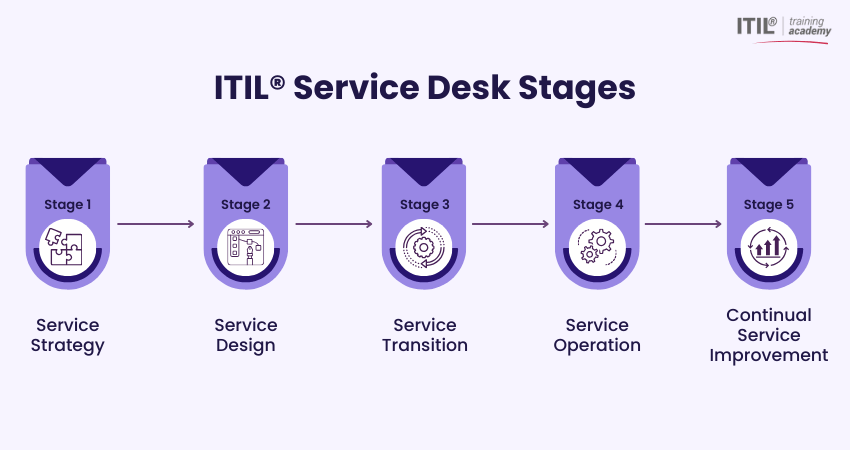
1) Service Strategy
Service Strategy focuses on defining the organisation’s approach to IT services. It ensures services are aligned with business goals, customer needs, and financial constraints. This stage helps decide which services should be offered, to whom, and how value will be created.
2) Service Design
Service Design translates strategic objectives into practical service solutions. It covers the design of services, processes, policies, architectures, and metrics to ensure services meet quality, capacity, availability, and security requirements.
3) Service Transition
Service Transition ensures that new or changed services are built, tested, and deployed successfully. It manages risks, controls changes, and ensures services can be supported effectively once they go live.
4) Service Operation
Service Operation focuses on the day-to-day management of services. It ensures services are delivered efficiently, incidents are resolved quickly, and users receive consistent support to maintain normal service operation.
5) Continual Service Improvement
Continual Service Improvement evaluates service performance and identifies opportunities for improvement. It uses metrics, feedback, and reviews to enhance service quality, efficiency, and alignment with changing business needs.
Your path to IT Service excellence is just a click away. Sign up for our
ITIL® 4 Practice Manager (PM) Course
now!
IT Service Desk Processes
While ITIL defines five Service Management processes, only two fall directly under the responsibility of Service Desk teams:
1) Incident Management
Incident Management focuses on restoring normal service as quickly as possible following a service disruption. The Service Desk acts as the primary point of contact, logging, categorising, and coordinating the resolution of incidents.
a) Login failures
b) Network connectivity problems
c) Data corruption
d) Security breaches
e) Service outages
The primary objective is to restore normal service as quickly as possible.
2) Request Fulfilment
Request fulfilment, also known as Service Request Management, focuses on managing routine, non-disruptive user requests rather than resolving faults. Typical requests include:
a) Application access
b) Password resets
c) New equipment
d) Software licences
These requests are generally less urgent than incidents. Service Desk tools help manage request prioritisation, track progress, and keep users informed throughout the fulfilment process.
ITIL® Service Desk Roles and Responsibilities
An effective ITIL® Service Desk relies on a committed team with clearly defined roles that support high-quality service delivery. Here are the main roles and responsibilities:
1) Service Desk Manager
a) The Service Desk Manager oversees the entire Service Desk function.
b) This role involves managing staff, monitoring performance against Service Level Agreements and reporting key metrics to senior IT stakeholders.
c) They provide strategic direction and ensure the Service Desk consistently delivers business value.
d) Strong leadership and analytical capability are essential.
2) Service Desk Team Leader / Supervisor
a) The Team Leader or Supervisor manages daily Service Desk activities.
b) They coach Analysts, handle escalations and ensure processes are followed correctly.
c) Their focus is on operational efficiency, team engagement, and maintaining service quality.
d) This role plays a vital part in team motivation and consistent performance.
3) Service Desk Analyst (First-line Support)
a) Service Desk Analysts act as the first point of contact for users.
b) They log incidents and requests, carry out initial troubleshooting and resolve common issues.
c) When necessary, they escalate more complex problems to specialist teams.
d) This role requires excellent customer service, patience and a structured approach to problem-solving.
What are the Benefits of a Service Desk?
Here are the benefits of ITIL® Service Desk:
a) It acts as a single, central point of contact for users to raise issues and queries
b) It enables efficient handling of IT requests and incidents through a skilled support team
c) It boosts user experience with quicker resolutions and clear communication
d) It supports IT security by logging, monitoring and escalating security-related incidents
e) It improves productivity by ensuring reliable access to IT tools and services
f) It helps reduce IT costs by optimising processes and preventing unnecessary spending
Best Practices for an IT Service Desk
Here are some best practices related to ITIL® Service Desk:
a) Establish a single point of contact for all end users
b) Deliver timely, practical support for service requests
c) Continuously review and improve Service Desk processes
d) Align Service Desk operations with business objectives
e) Understand user needs and expectations, including ease of use
f) Define a clear ITIL Service Catalogue and service level agreements
Conclusion
More than just support, ITIL® Service Desk is the heartbeat of trusted IT services. With clear roles and user-focused benefits, it turns issues into quick solutions and requests into lasting value. When aligned with business goals, a strong Service Desk builds trust and keeps organisations confidently moving forward in an always-connected digital world.
Learn how to gain full control over your IT environment with ease in our
ITIL® 4 Practitioner: Service Configuration Management Training
- Sign up now!
Frequently Asked Questions?
No FAQs available for this blog.
Most Recent
Date - Aug 1, 2026
Date - Jul 18, 2026
Date - Jul 11, 2026