


 Back to
Topics
Back to
Topics



Author-Maria Thompson

Last updated-Jan 5, 2026
Almost every task at work depends on IT, from emails and file access to customer service and payments. When systems stop, deadlines slip, customers wait, and teams feel unsure how to respond. This is exactly where IT Service Continuity Management becomes essential, helping organisations stay prepared and respond with confidence.
This blog explains the topic clearly, covering the objectives, scope, and key principles. It also outlines the implementation steps and the IT Service Continuity Management framework that supports resilience during disruptions.
What is IT Service Continuity Management (ITSCM)?
IT Service Continuity Management (ITSCM) is a key part of the Information Technology Infrastructure Library (ITIL) framework that helps organisations prepare for serious incidents that may disrupt IT services. It focuses on preventing incidents where possible, identifying potential risks, and managing disruptions effectively to keep essential IT services available.
The main aim of ITSCM is to ensure IT services continue or are restored quickly before, during, and after major incidents such as system failures, cyberattacks, or natural disasters. By planning ahead and aligning IT recovery with business needs, ITSCM reduces downtime, limits business impact, and supports overall business continuity.

Objectives of IT Service Continuity Management
The objectives of IT Service Continuity Management focus on ensuring IT services can support the business during disruptions. These objectives guide how organisations plan, prepare, and improve their continuity and recovery capabilities.

1) Provide Continuity and Recovery Guidance:
Offer advice and support on IT service continuity and recovery issues, helping teams respond quickly and effectively during incidents.
2) Support Business Continuity Plans:
Maintain IT service continuity and recovery plans that align with overall business continuity plans, supported by regular business impact and risk analysis.
3) Minimise Unavoidable Costs:
Reduce financial losses that cannot be fully avoided by planning recovery actions in advance and limiting service downtime.
4) Ensure Suitable Continuity Solutions:
Implement continuity and recovery mechanisms that meet or exceed agreed business continuity targets for critical IT services.
5) Assess the Impact of Changes:
Review how changes to systems, processes, or suppliers affect IT service continuity plans and update them when required.
6) Improve Service Availability Proactively:
Introduce cost-effective proactive measures that increase service availability and reduce the risk of disruptions.
7) Manage Supplier Recovery Capability:
Agree and manage supplier contracts to ensure required recovery support and service restoration capabilities are in place.
Scope of IT Service Continuity Management
The scope of IT Service Continuity Management defines the key activities needed to ensure critical IT services can continue or recover within agreed timeframes during disruptions. It focuses on reducing downtime and business impact, and includes the following areas:
1) Risk Identification and Assessment:
Identify potential threats such as cyber incidents, system failures, and human error that could disrupt IT services.
2) Business Impact Analysis:
Assess how IT service outages affect business operations to prioritise recovery based on business needs.
3) Continuity Strategy Development:
Develop recovery strategies such as backups, redundancy, and alternate systems to meet recovery time and data objectives.
4) Recovery Plan Documentation:
Create and maintain clear recovery plans for IT infrastructure, applications, and services, defining actions and responsibilities.
5) Testing and Ongoing Maintenance:
Regularly test recovery plans and update them to reflect changes in technology, services, or business requirements.
6) Coordination and Supplier Management:
Work closely with business continuity teams and manage third-party suppliers to ensure recovery support meets agreed service levels.
Learn practical Problem Management techniques with
ITIL® 4 Practitioner: Problem Management Training. Join today!
Principles and Basic Concepts of IT Service Continuity Management
To understand ITSCM clearly, it is important to know the key concepts that support it. These principles help organisations plan and manage continuity effectively.
1) Business Continuity Plan (BCP)
A Business Continuity Plan explains the steps an organisation must take to restore business processes after a disruption. It defines required actions, responsible teams, and clear conditions for activating the plan to ensure an organised response.
The plan also sets communication rules during incidents, including who must be informed and how updates are shared. Since most operations rely on technology, IT Service Continuity Management plans form a vital part of an effective and reliable BCP. Technology Business Management can provide additional insight into how technology resources support critical business processes.
2) Business Continuity Management (BCM)
Business Continuity Management is an ongoing approach that identifies risks that could disrupt the business and reduces their impact to acceptable levels. It ensures the organisation is prepared to continue operations or recover key processes during disruptions.
BCM includes planning, regular reviews, and continuous improvement of continuity arrangements. IT Service Continuity Management supports BCM by ensuring IT systems and services are ready to enable business recovery when incidents occur.
3) Business Impact Analysis (BIA)
Business Impact Analysis helps organisations understand how the loss of IT services affects business activities. It measures the impact on areas such as revenue, customer service, compliance, and daily operations to guide recovery planning.
BIA identifies critical processes, required resources, and acceptable recovery timeframes. It also sets recovery priorities, helping organisations focus efforts on restoring essential services quickly and maintaining minimum operational levels.
IT Service Continuity Management Process
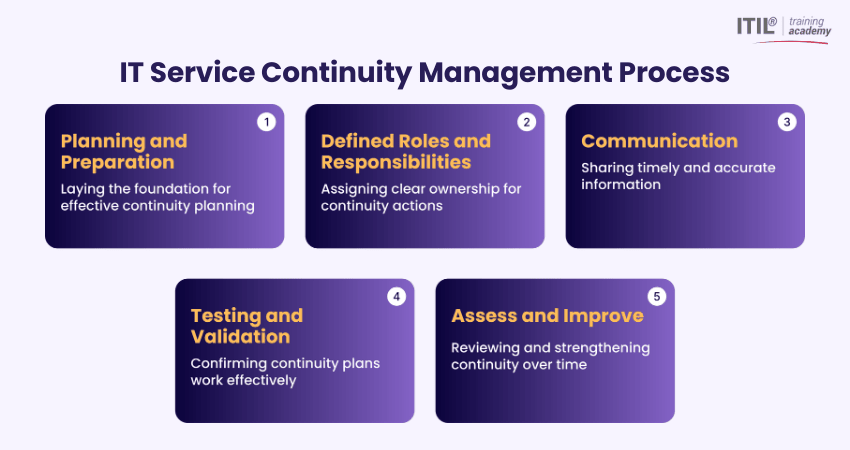
The IT Service Continuity Management process provides a structured approach to ensure critical IT services can continue or be restored quickly during disruptions. It aligns with Business Continuity Management to reduce downtime and business impact through the following stages:
1) Planning and Preparation
Planning and preparation form the foundation of the ITSCM process. This stage defines the scope, objectives, and policies for IT Service Continuity Management. It also involves identifying critical IT services that support essential business activities.
During this stage, organisations carry out Business Impact Analysis and risk assessments to understand potential threats and service dependencies. Based on this information, suitable continuity and recovery strategies are planned.
2) Defined Roles and Responsibilities
Clear roles and responsibilities ensure an organised response during disruptions. This stage defines who is responsible for decision-making, plan activation, communication, and service recovery.
By assigning responsibilities in advance, organisations avoid confusion and delays during incidents. Everyone involved understands their role and knows what actions to take when continuity plans are invoked.
3) Communication
Effective communication is essential throughout the ITSCM process. This stage focuses on how information is shared before, during, and after disruptions. It ensures that the right information reaches the right people at the right time to support quick decision-making.
Communication plans define who needs to be informed, how updates are delivered and how escalation is managed. Clear communication helps coordinate recovery efforts and keeps stakeholders informed.
4) Testing and Validation
Testing and validation ensure that IT service continuity plans work as expected. This includes regular testing through simulations, walkthroughs, or technical recovery exercises. These activities help confirm that procedures are practical and can be followed during real incidents.
Testing helps identify gaps or weaknesses in plans and improves staff readiness for real incidents and disruptions. Validation ensures recovery objectives can be met within agreed timeframes.
5) Assess and Improve
IT Service Continuity Management is an ongoing process that requires regular review and improvement. After tests or real incidents, organisations assess performance and identify lessons learned.
Plans are updated to reflect changes in technology, services, or evolving business needs. Continuous improvement ensures ITSCM remains effective and aligned with organisational goals.
Gain strong Service Level Management expertise with
ITIL® 4 Practitioner Service Level Management Training. Secure your seat now!
Implementation Procedure of IT Service Continuity Management
Implementing IT Service Continuity Management is an ongoing process that improves over time as organisations better understand their services, risks, and recovery needs. The following steps explain how effective IT service continuity can be built in practice.
Step 1: Identify Critical Services and Assets
The first step is to identify critical IT services and the assets that support them, such as systems, software, networks, and people. This helps organisations understand what must be protected and restored first to keep essential operations running during disruptions.
Step 2: Assess Risks and Potential Threats
This step focuses on identifying risks that could disrupt IT services and the threats that may cause them. By understanding possible issues such as system failures, cyber incidents or staff absence, organisations can prepare effective responses and reduce the impact of disruptions.
Step 3: Develop Contingency Plans
Contingency plans explain how IT services will be restored during disruptions by setting recovery priorities, creating backups, and using secure storage locations. These measures help reduce downtime and keep critical services running.
Step 4: Document and Maintain the Recovery Plan
The recovery plan should be clearly documented and regularly updated to reflect changes in systems or services. It must be shared with key staff and recovery teams and stored securely so it remains accessible and effective during emergency situations.
IT Service Continuity Management Roles and Responsibilities
Clear roles ensure an effective response and coordination during incidents. The following roles are commonly involved in ITSCM.
Service Continuity Manager (SCM)
The IT Service Continuity Manager is responsible for planning and managing IT service continuity across the organisation. This role oversees continuity plans, ensures risks are reviewed, and confirms recovery arrangements support business needs during disruptions.
The Service Continuity Manager also leads testing activities and coordinates responses during major incidents. This role ensures plans are kept up to date and that IT services can be restored quickly and reliably when unexpected events occur.
IT Service Continuity Recovery Team
The IT Service Continuity Recovery Team supports the Service Continuity Manager in carrying out continuity and recovery activities. The team helps test plans, prepare for incidents, and restore IT services when disruptions happen.
This team usually includes technical staff and representatives from different departments. Their role is to carry out recovery tasks, share updates, and maintain clear communication between IT teams and the wider organisation during incidents.
Learn effective service configuration practices with
ITIL® 4 Practitioner: Service Configuration Management Training
. Register today!
IT Service Continuity Management Framework
The IT Service Continuity Management framework provides a structured approach to prepare IT services for disruptions and support quick recovery. It helps reduce downtime and ensures IT services continue to support important business activities. The framework includes the following key elements:
1) Risk Assessment and Business Impact Analysis:
Identify possible risks and understand how IT service failures would affect business operations, helping set clear recovery priorities.
2) Recovery Strategy Development:
Define practical recovery approaches, such as backups or alternative systems, to ensure services can be restored within agreed time limits.
3) Recovery Plan Creation:
Develop clear recovery plans that outline steps to follow, assigned responsibilities, and communication methods during incidents.
4) Implementation of Recovery Measures:
Put preventive and recovery solutions in place to support service restoration when disruptions occur.
5) Testing and Ongoing Maintenance:
Regularly test recovery plans and update them to reflect changes in technology or business needs, ensuring continued effectiveness.
Conclusion
IT Service Continuity Management helps organisations stay prepared for unexpected disruptions by protecting critical IT services. Through clear planning, regular testing, defined roles, and continuous improvement, organisations can reduce downtime and limit business impact. These practices support resilience, build customer confidence, and ensure long-term operational stability.
Transform your IT Management approach with
ITIL® 4 Practice Manager (PM) Training. Join and grow your skills
Frequently Asked Questions?
The 4 P's of ITIL® Service Management are People, Processes, Products, and Partners. Together, they ensure that services are designed, delivered, and supported effectively.
Service Management focuses on delivering value to customers through services. IT Service Management is a subset of Service Management that applies these principles specifically to IT services.
IT Service Management is the practice of designing, delivering, managing, and improving IT services to meet business needs in a structured and reliable way.
Most Recent
Date - Aug 1, 2026
Date - Jul 18, 2026
Date - Jul 11, 2026