


 Back to
Topics
Back to
Topics



Author-Maria Thompson

Last updated-Jan 5, 2025
Server disruptions are a common challenge faced by IT teams. When systems slow down, applications fail, or users report issues, teams need to respond quickly while also keeping long-term stability. This is where Incident Management vs Problem Management becomes an important topic. Although they are closely linked, they serve different purposes and require different approaches.
It is significant to understand Incident Management vs Problem Management for helping organisations respond better to issues and prevent them from happening again. They matter since 90% of mid-size and large enterprises report that a single hour of downtime costs them over £228K . So, in this blog, you will learn about Incident Management and Problem Management, their benefits, components, and more.
What is Incident Management?
Incident Management is used by IT operations and DevOps teams to respond to unplanned events that disrupt normal services. These issues range from minor issues, such as printer errors or slow applications, to major problems, such as network outages or data loss. The primary purpose is to restore services as quickly as possible while minimising business impact.

Goals of Incident Management
Some key goals of Incident Management include:
1) Rapid Restoration of Service:
Restoring normal services proactively. Every minute of downtime affects user’s productivity, and affects customer trust, making speed a priority.
2) Minimising Business Impact:
Containing an issue rather than finding a perfect solution immediately. Limiting disruption helps to protect business operations and continuity.
What is Problem Management?
Problem Management is the process of identifying, managing, and resolving the root causes of incidents within IT services. It is a core practice within IT Service Management (ITSM) that focuses on preventing recurring issues instead of offering temporary fixes. The primary purpose is to take a deeper approach in analysing incidents, identifying known errors, and applying long-term solutions to improve service stability.
Goals of Problem Management
Some key goals of Problem Management include:
1) Root Cause Identification:
Understanding why issues occur, what is the cause of failure, and focusing on finding out the underlying issues to effectively resolve them.
2) Long-term Resilience:
Eliminates recurring issues by addressing their root causes. This is to strengthen stability, reduce incidents, and improve service reliability.
3) Proactive Prevention:
Identify and address potential risks before they escalate. Analysing trends and system weaknesses helps to stay ahead of systemic risks and prevent disruptions.
ITIL® Incident Management vs Problem Management
Under the ITIL® framework, Incident Management and Problem Management are closely linked, but each has its own set of purposes, objectives, and working approaches. Understanding the difference between Incident Management vs Problem Management helps IT teams improve long-term stability and continuous improvement.
1) Objective
The objective of Incident Management is to restore normal services proactively. Here, speed is the priority even if the root cause is unknown. On the other hand, Problem Management aims to identify the underlying issue and remove it, so the issues do not repeat in the future.
2) Trigger
Incident Management is triggered when a service disruption impacts users, such as a system outage or application failure. These triggers are urgent and direct. In contrast, Problem Management is triggered by repeating incidents, patterns, or trend analysis. These develop overtime and contain underlying issues.
3) Time Sensitivity
Incident Management is highly time-sensitive and requires immediate action to reduce downtime and meet Service Level Agreements (SLAs). On the other hand, Problem Management enables more time for thorough investigation, analysis, and long-term solutions.
4) Example
An incident example can be a user being unable to log in, leading to work disruption and a need for an immediate fix to restore system access. An example of a problem can be repeated login failures caused by a misconfigured authentication service, indicating a deeper issue.
5) Responsible
Incident Management is handled by the service desk or Tier 1 support teams, who are focused on service restoration. In contrast, Problem Management is handled by Tier 2 or Tier 3 Site Reliability Engineers (SREs), or specialists, who investigate and address root causes.
Optimise asset lifecycle and gain control over IT assets effectively with
ITIL® 4 Practitioner: IT Asset Management Training
today!
Benefits of Incident Management
Let’s look at some key benefits of Incident Management:
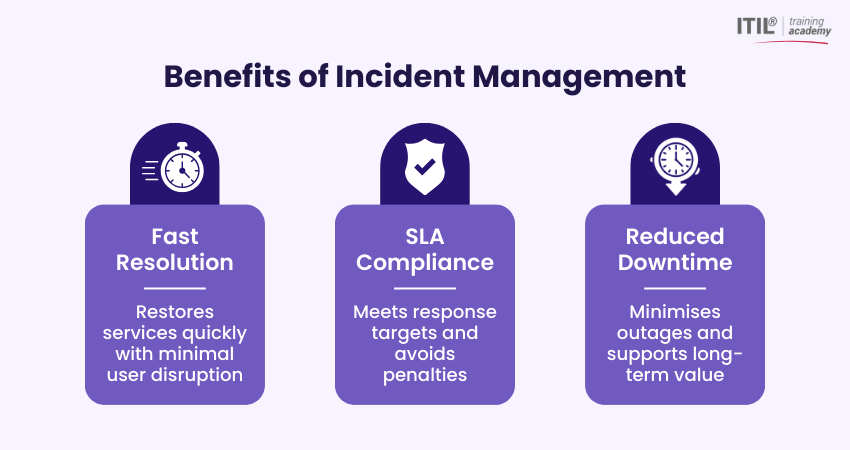
1) Fast Resolution:
Enables teams to respond quickly and restore services with minimal delays. Here, rapid action reduces user disruption, maintains customer trust, and lowers stress across teams.
2) SLA Compliance:
Prioritising timely responses and clear escalation helps organisations meet Service Level Agreements. This protects credibility, prevents penalties, and emphasises reliability during high-pressure situations.
3) Reduce Downtime:
Shortens service outages time and limits their impact on operations. With fewer disruptions to manage, teams can focus more on improving systems and delivering long-term business value.
Benefits of Problem Management
Let’s look at some key benefits of Problem Management:
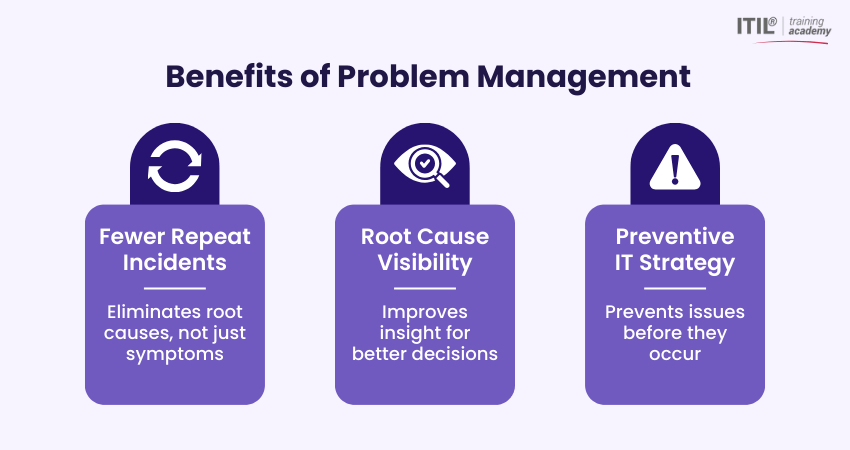
1) Fewer Recurring Incidents:
Focuses on identifying and removing root causes instead of applying temporary fixes. This reduces repeating disruptions, lowers support workload, and improves long-term stability.
2) Root Cause Visibility:
Analysing why issues occur provides organisations with insight into deeper problems. This visibility helps teams and leaders make informed decisions and eliminate unexpected failure risks in the future.
3) Preventive IT Strategy:
Allows teams to learn from past incidents and prevent similar issues from repeating. It supports a proactive approach to IT, where systems are built to withstand risk and prevention is valued compared to rapid resolution.
Manage change with confidence and control with
ITIL® 4 Practitioner: Change Enablement Training
– Join today!
Key Components of Incident and Problem Management
Understanding Incident Management vs Problem Management requires thorough knowledge of its key components. Let's look at them in detail.
1) Components of Incident Management
1) Incident Identification:
Incidents must be detected first before they are resolved. This is done through automated monitoring tools that trigger alerts and are supported by human validation to confirm the issues and preventive actions.
2) Incident Reporting:
After identification, the incident is formally logged. This involves categorising the issue, assigning ownership, recording services affected, and tracking timelines for resolution.
3) Incident Prioritisation:
Incidents are assessed based on their urgency and impact. Here, teams prioritise issues that can cause the biggest disruption to daily business operations and users.
4) Incident Response and Containment:
Response teams troubleshoot the issue to limit its spread and reduce service disruption. This involves IT teams, operations staff, or external service providers.
5) Incident Resolution:
The primary goal is to restore services. Resolution involves applying patches, executing workarounds, restarting systems, and replacing any faulty hardware.
6) Incident Documentation and Communication:
Every action and outcome is documented for future reference. Clear communication keeps stakeholders informed and helps to identify recurring incidents.
2) Components of Problem Management
1) Problem Assessment:
Organisations determine whether an incident represents a deeper, recurring issue that must be managed as a problem rather than a one-time recurrence.
2) Problem Logging and Categorisation:
When problems are identified, they are recorded and tracked over time. Every occurrence is recorded to support analysis and trend identification.
3) Root Cause Analysis:
Teams conduct a thorough investigation of root causes using structured techniques. This is to understand why the issues occur and prevent them from repeating.
4) Problem-solving:
Based on the analysis gathered, teams develop long-term solutions and implement them. These take time, depending on the complexity and risk of the problem.
5) Postmortem Review:
Teams conduct an open, blame-free review to discuss incidents, root causes, and responses. It helps to improve processes, strengthen team culture, and prevent similar issues from repeating in the future.
Strengthen monitoring and support capabilities with
ITIL® 4 Specialist: Monitor, Support, and Fulfil Training
now!
How do Incident Management and Problem Management Work Together?
Incident Management and Problem Management work together within IT Service Management to keep IT services stable and aligned with business needs. When an unexpected issue arises, it is treated as an incident, and Incident Management takes charge by restoring services rapidly. For example, if a server crashes due to heavy usage, the incident team temporarily limits access to reduce disruption and bring system stability.
If the issue keeps occurring repeatedly, it signals a deeper underlying problem. This is when Problem Management steps in under the ITIL® framework. Analysing incident patterns, system dependencies, and data helps teams to identify root causes and develop long-term solutions. Together, Incident Management is responsible for immediate recovery, while Problem Management prevents similar issues from repeating in the future.
Key Performance Indicators of Incident and Problem Management
Key Performance Indicators (KPIs) indicate how effectively organisations handle incidents and problems. These metrics provide visibility into response speed, service reliability, and recurring problems. Let’s look at the key KPIs.
1) Mean Time to Take Action:
This measures how quickly teams identify, acknowledge, respond, and fix incidents. Metrics, such as Mean Time to Acknowledge (MTTA), Mean Time to Respond (MTTR), and Mean Time to Repair, are the most used ones.
2) Mean Time Between Failures (MTBF):
MTBF tracks the time between recurring incidents affecting a service. A short MTBF can indicate a deeper root cause and signal the need for Problem Management and proactive prevention.
3) Uptime:
Uptime measures how long services remain available and operate as expected. Low uptime increases the risk of SLA breaches, customer dissatisfaction, and revenue loss.
4) Incidents and Problems Reported:
This KPI tracks the number of incidents and problems logged over a specific period. A rising trend may indicate systemic issues, while a reduced one can indicate effective incident resolution.
Conclusion
Understanding Incident Management vs Problem Management is integral for building reliable and resilient IT services. Incident Management ensures services are restored quickly, while Problem Management eliminates the root causes to prevent the same issue from repeating. Together, they create a balanced approach to maintain daily business operations while improving long-term service stability.
Advance practical ITIL® leadership skills and optimise IT service practices with
ITIL® 4 Practice Manager (PM) Courses
– Register today!
Frequently Asked Questions?
They are closely related practices within the ITIL® framework. Incident Management restores normal services quickly, while Problem Management fixes the root cause. Although they serve different purposes, both practices aim to improve service stability.
In ITIL® 4, Problem Management is the process of identifying, analysing, and eliminating the root causes of incidents to prevent them from repeating. It involves addressing problems before incidents occur and spotting potential issues before they result in incidents.
In ITIL®, an incident turns into a problem when the issue identified is more than a one-time disruption. Also, if the cause of an incident is unknown or the same issue keeps repeating, it is logged and treated as a problem to be analysed and resolved.
Most Recent
Date - Aug 1, 2026
Date - Jul 18, 2026
Date - Jul 11, 2026