

 Back to
Topics
Back to
Topics



Author-Maria Thompson

Last updated-Jan 2, 2026
Think about how many IT services your organisation uses every day, from email and internal tools to customer platforms and cloud services. Over time, these services grow and overlap, making it harder to see which ones truly add value. This is where ITIL Service Portfolio Management helps, providing clarity and ensuring IT investments support real business needs.
This blog breaks down ITIL Service Portfolio Management in a clear and simple way. It covers how it works, its key elements, benefits, links to ITIL practices, and the difference between the Service Portfolio and catalogue. Let’s dive in.
What is ITIL Service Portfolio Management?
ITIL Service Portfolio Management (SPM) is the practice of managing all IT services across their entire lifecycle, from initial idea and development to live operation and eventual retirement. Its main goal is to ensure the IT department delivers the right mix of services that meet business needs and support organisational strategy.
By providing a complete view of planned, active, and retired services, Service Portfolio Management supports informed decisions on investment, improvement, and retirement. It balances cost, risk, and value, helping IT deliver measurable business outcomes.
How Does ITIL Service Portfolio Management Work?
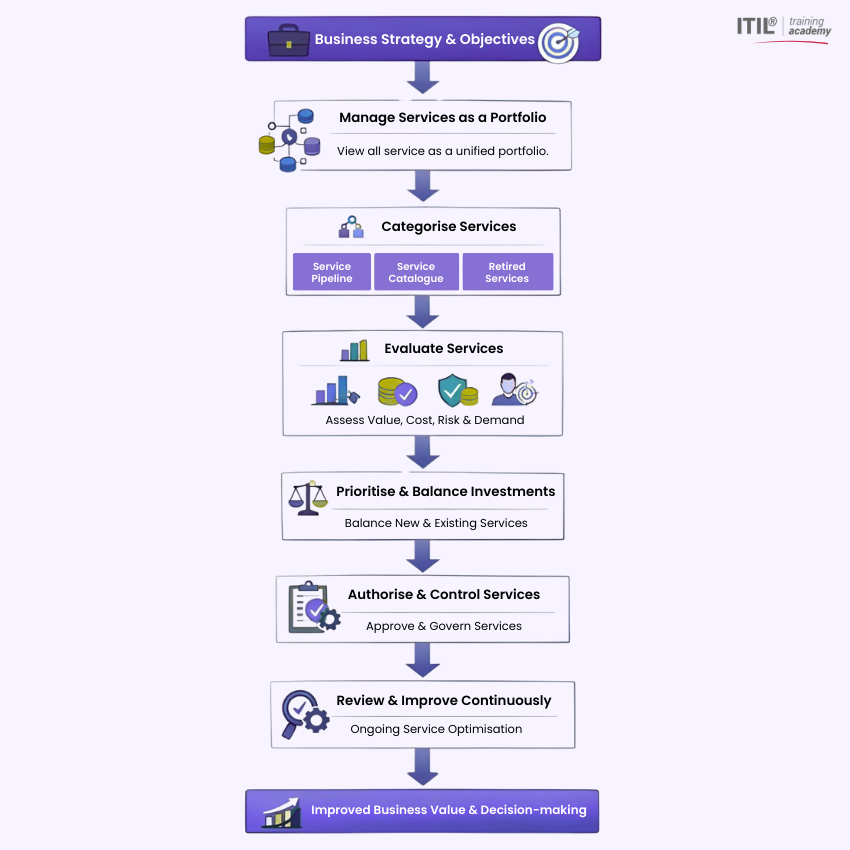
ITIL Service Portfolio Management (SPM) manages all IT services as one portfolio to ensure they align with business goals and deliver value. It helps organisations decide which services to invest in, improve, maintain, or retire based on strategy, cost, risk, and demand. Here is how it works step by step:
1) Manage Services as a Portfolio
ITIL Service Portfolio Management treats all services like financial investments. Instead of managing services separately, organisations view them together to understand overall value, performance, and priorities.
2) Categorise Services into Three Areas
The Service Portfolio is divided into three key parts:
a) Service Pipeline: Services that are planned or under development
b) Service Catalogue: Services that are live and available to customers
c) Retired Services: Services that are no longer offered
This structure provides clear visibility across the full service lifecycle.
3) Evaluate Services
Services are assessed based on business value, cost and ROI, risk, customer demand, and strategic fit to decide which should continue, improve, or stop. This ensures decisions are based on evidence rather than assumptions.
4) Prioritise and Balance Investments
SPM balances new and existing services, innovation and stability, and cost and value to use resources wisely and support long-term goals. This helps organisations focus spending where it delivers the greatest impact.
5) Authorise and Control Services
Only approved services move into development or operation. Governance controls ensure services meet quality standards, budgets, and strategic requirements before progressing, reducing risk and unplanned costs.
6) Review and Improve Continuously
Service Portfolio Management is ongoing. Services are regularly reviewed to ensure they remain relevant, cost-effective, and aligned with changing business needs, supporting continuous improvement over time.
The Three Elements of the Service Portfolio
The Service Portfolio is made up of three core elements, each representing a different Stage of the Service Lifecycle. Here are the three elements of the ITIL Service Portfolio: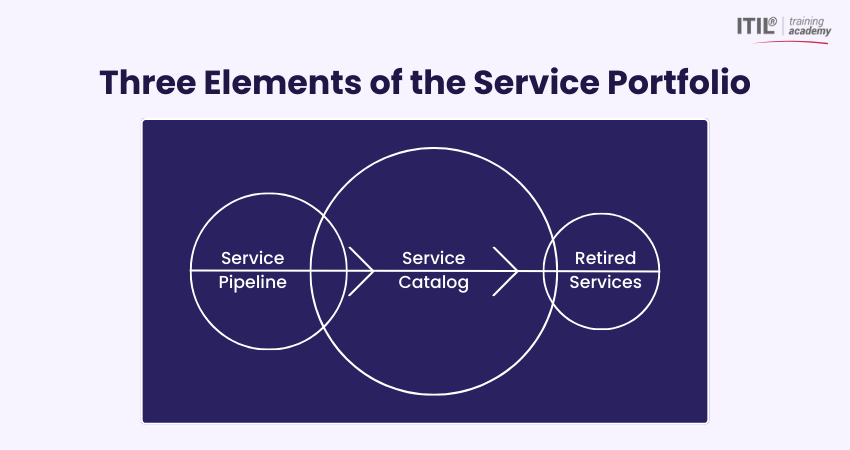
1) Service Pipeline
The Service Pipeline includes services that are planned or currently under development. These services are not yet available to customers but represent future investments. Managing the pipeline helps organisations prioritise initiatives and avoid spending on services that do not deliver value.
2) Service Catalogue
The Service Catalogue lists all live services that are currently available to customers and users. It provides clear information about what each service offers, who can use it, and how to request it. The catalogue improves transparency and sets clear expectations.
3) Retired Services
Retired Services are those that are no longer delivered. Keeping a record of retired services helps organisations avoid re-introducing outdated solutions and supports knowledge retention for future planning.
The ITIL Service Portfolio Management Process
The ITIL Service Portfolio Management process follows a structured approach to ensure services remain aligned with business priorities.
1) Define:
At this stage, organisations identify business needs and opportunities. Service ideas are documented, and objectives are clearly defined to ensure alignment with strategic goals.
2) Analyse:
Each proposed or existing service is analysed based on value, cost, demand, risk, and resource requirements. This helps decision-makers understand the impact of each service.
3) Approve:
Based on the analysis, services are approved, rejected, or deferred. Approval ensures that only valuable and viable services move forward.
4) Charter:
Approved services are authorised for development or continued delivery. Resources are allocated, and responsibilities are assigned to enable effective execution.
5) Review:
Services are regularly reviewed to ensure they continue to deliver value. If a service no longer meets business needs, it may be improved, replaced, or retired.
Advance your career by becoming an expert in Service Desk Management with ITIL® 4 Practitioner: Service Desk Training – Join now!
Benefits of ITIL Service Portfolio Management
Service Portfolio Management in ITIL provides a range of benefits for both IT teams and the wider business. These benefits include: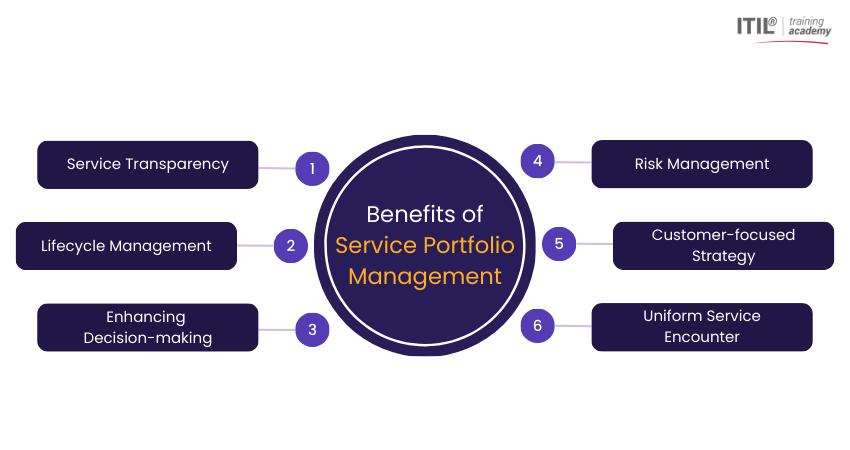
1) Service Transparency
Service transparency means making sure customers, users, and stakeholders can easily see and understand the IT services available to them. The Service Portfolio stores clear, up-to-date information about services, including what they do, their status, cost, and support.
2) Lifecycle Management
The Service Portfolio helps manage IT services from the first idea through development, live use, and finally retirement. This ensures services are planned, delivered, reviewed, and closed in a structured way.
3) Enhancing Decision-making
By grouping services as planned, active, or retired, organisations can make better decisions about where to spend time and resources. This clear structure helps leaders prioritise what matters most.
4) Risk Management
The Service Portfolio helps organisations understand how services depend on each other clearly. This makes it easier to identify risks, plan for disruptions, and prepare effective backup solutions.
5) Customer-focused Strategy
ITIL Service Portfolio Management focuses on meeting customer and stakeholder needs effectively. Services are regularly reviewed and improved based on feedback, demand, and business priorities.
6) Uniform Service Encounter
Using a Service Portfolio encourages standard service definitions, processes, and documentation across teams. This helps create a consistent experience for users across all services.
ITIL Service Portfolio Management Challenges
ITIL Service Portfolio Management (SPM) can face challenges with alignment, visibility, resources, and stakeholder buy-in, which may lead to poor prioritisation and reduced business value. Key challenges include:
1) Strategic Alignment:
Services may fail to support changing business goals, and unclear value definitions make it difficult to demonstrate outcomes and return on investment.
2) Data and Visibility:
Service information is often spread across disconnected tools, creating data silos, limited transparency, and slow, less informed decision-making.
3) Resource and Prioritisation:
Too many active services can overload teams, while inconsistent prioritisation delays high-value initiatives and increases staff burnout.
4) Process and Governance:
Weak governance, unclear selection criteria, and resistance to change reduce the adoption of Service Portfolio Management and limit its effectiveness.
5) Execution and Ongoing Management:
Managing risk, improving cross-team collaboration, and keeping service information current remain ongoing operational challenges.
Develop practical skills to streamline and deliver service requests with ITIL® 4 Practitioner: Service Request Management Certification – Join now!
How Does Service Portfolio Management Relate to Other ITIL Practices?
ITIL Service Portfolio Management (SPM) supports other ITIL practices by improving visibility, prioritisation, and alignment across services:
1) Problem Management:
The Service Portfolio helps identify affected services quickly. A prioritised service list enables teams to focus on resolving issues in critical services first.
2) Change Enablement/Change Management:
The service pipeline improves visibility into service dependencies and relationships. This helps teams assess change impact, manage risk, and reduce the likelihood of service disruption.
3) Service Level Management:
The Service Portfolio increases awareness of service commitments and SLAs across the organisation. Clear documentation supports consistent monitoring, reporting and delivery of agreed service levels.
Service Portfolio vs Service Catalogue
A Service Portfolio covers all services across their lifecycle to support strategic decisions, while a service catalogue lists only active, customer-facing services. The table below highlights the key differences between them.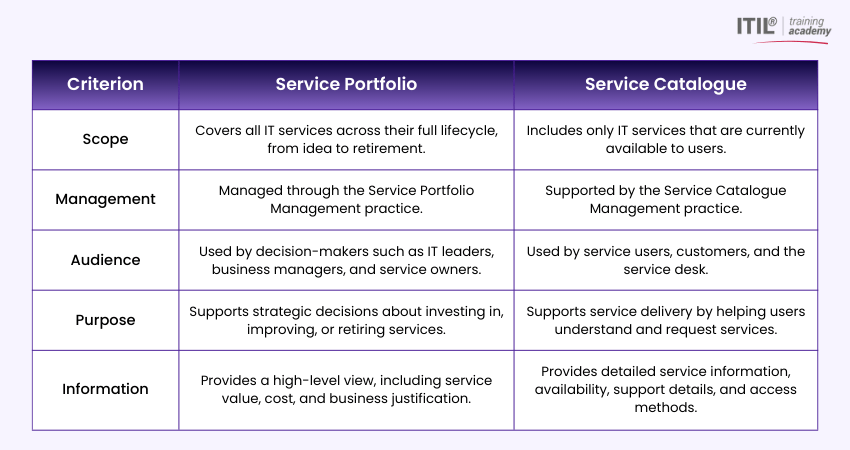
Conclusion
ITIL Service Portfolio Management is a powerful practice that helps organisations take control of their IT services. By providing visibility, structure, and strategic alignment, it ensures that every service delivers measurable value. When implemented effectively, it improves decision-making, reduces risk, and supports long-term business success.
Develop strategic ITIL skills and progress your career with ITIL® 4 Practice Manager (PM) Training – Join now!
Most Recent
Date - Jan 6, 2026
Date - Jan 5, 2025
Date - Jan 6, 2026