

 Back to
Topics
Back to
Topics



Author-James Smith

Last updated-Dec 31, 2025
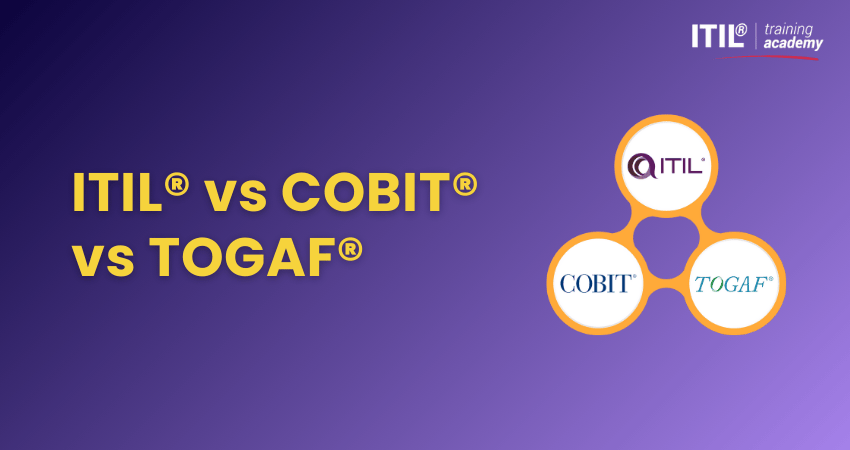
Information technology plays a critical role in how organisations deliver services, manage risks, and plan long-term digital growth. To manage this complexity effectively, many organisations rely on structured frameworks that guide decision-making and execution. Among the most widely used are ITIL®, COBIT®, and TOGAF®, each addressing a different aspect of IT management.
While they serve distinct purposes, these frameworks often work together to strengthen IT capability across the organisation. This blog explores the key differences between ITIL® vs COBIT® vs TOGAF® and shows how they complement one another in building a resilient, future-ready IT environment. Let’s get started!
What is Information Technology Infrastructure Library (ITIL®)?
ITIL® is a globally trusted framework that shapes how organisations manage and deliver IT services effectively. Here are some key points to remember:
1) ITIL® is adopted worldwide as a leading methodology for IT Service Management.
2) Its universal acceptance means ITIL® remains a respected framework across industries and regions.
3) It enhances professional credibility and supports career progression in IT Service Management roles.
4) ITIL® ensures that IT services are perfectly in sync with business goals.
5) It closes the traditional gap between technology teams and organisational needs.
6) It acts like a finely tuned mechanism, ensuring every part works seamlessly together for efficient and effective operations.
7) Beyond maintenance, ITIL® focuses on strategic improvement.
8) By optimising IT processes and keeping them in line with business objectives, organisations can drive innovation, boost performance and achieve measurable growth.
9) It turns IT from a support function into a catalyst for success.
What is Control Objectives for Information and Related Technologies (COBIT®)?
COBIT® is a proven roadmap for IT governance and management. It helps organisations strengthen their IT processes and keep them in line them with business goals. Here are the key points to remember:
1) COBIT® functions like a well-stocked toolkit. It offers businesses practical methods to shape and improve their IT governance.
2) It focuses on building structured and sustainable systems that support long-term success.
3) COBIT® ensures that IT services are designed to meet stakeholder expectations. It gives each stakeholder a voice and ensures the technology genuinely supports business objectives.
4) Adopting COBIT® can help any business streamline operations, reduce downtime and significantly improve customer satisfaction.
5) This results in a more resilient IT environment and a stronger industry reputation.
Turn asset data into actionable insights with our ITIL® 4 Specialist: IT Asset Management Training - Register now!
What is The Open Group Architecture Framework (TOGAF®)?
TOGAF® offers the blueprint for a company’s IT architecture. It serves as a strategic master plan for designing, implementing and continuously improving an organisation’s IT structure. Here are the key points to remember:
1) TOGAF® is a globally recognised certification built on the renowned TOGAF® Standard.
2) This framework is backed by decades of industry expertise. It provides a structured, proven approach to enterprise architecture.
3) It equips professionals with practical skills to maintain and apply architecture strategies effectively. It helps ensure that technology drives real-world business results.
4) TOGAF® principles can help any company that must manage disparate IT systems across different regions.
5) It helps the company create a unified IT architecture that improves data sharing and supports smarter decision-making at a global scale.
What are the Key Differences Between ITIL®, COBIT® and TOGAF®?
Here are the key differences between ITIL® vs COBIT® vs TOGAF®:
1) Scope and Focus
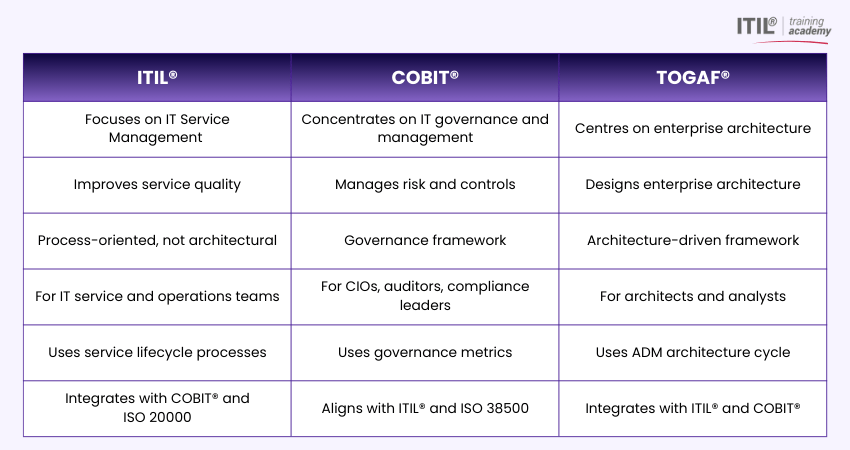
1) ITIL®: It focuses on IT Service Management (ITSM), emphasising delivering value to customers through efficient IT services.
2) COBIT®: It concentrates on IT governance and management. It ensures that IT aligns with business goals and delivers value while managing risks.
3) TOGAF®: It centres on enterprise architecture. It provides a comprehensive approach to designing, planning, implementing, and governing enterprise information architecture.
2) Goals and Objectives
1) ITIL®: Its primary aim is to improve IT Service quality, increase customer satisfaction and optimise resource utilisation.
2) COBIT®: Its aim is to establish control objectives, manage risks, and align IT activities with organisational objectives.
3) TOGAF®: TOGAF® aims to develop and maintain a well-defined Enterprise Architecture that supports business transformation. Its goal is to create a blueprint for aligning business processes, applications, data, and technology.
3) Design and Architecture
1) ITIL®: It's not architecture-focused. It's more about processes and service lifecycle such as service strategy, design, transition, operation, and continual improvement).
2) COBIT®: It offers a governance and management framework but does not provide detailed architectural models.
3) TOGAF®: It's strongly architecture-oriented, with the Architecture Development Method (ADM) guiding the creation of enterprise architectures.
4) Stakeholders and Target Audience
1) ITIL®: Its primary target includes IT Service Managers, support teams and operations personnel.
2) COBIT®: Its target includes CIOs, IT Auditors, Compliance Officers, and governance professionals.
3) TOGAF®: Its target audience comprises Enterprise Architects, Business Analysts, and IT Strategists.
Embed sustainability into digital strategies and make IT a force for good with our ITIL® 4 Specialist: Sustainability in Digital and IT Training (ITIL® SDIT) – Sign up now!
5) Compliance and Governance
1) ITIL®: It provides best practices, but it's not a compliance framework. It focuses on service quality and continual improvement.
2) COBIT®: It lays a strong emphasis on compliance, Risk Management and governance. It helps organisations align with regulatory requirements.
3) TOGAF®: It supports governance through architectural principles and frameworks. However, it is not a compliance standard.
6) Methods and Processes
1) ITIL®: It's structured around service lifecycle stages with defined processes like Incident Management, Change Management and Problem Management.
2) COBIT®: It uses a process-based model with governance and management objectives, performance metrics and maturity models.
3) TOGAF®: It employs the ADM cycle to guide the development of enterprise architecture, including phases like Preliminary, Architecture Vision, Business Architecture, etc.
7) Alignment with Other Frameworks
1) ITIL®: It can be integrated with COBIT®, ISO/IEC 20000, and other ITSM or governance frameworks.
2) COBIT®: It's designed to align with frameworks like ITIL®, ISO/IEC 38500 and COSO for comprehensive governance.
3) TOGAF®: It aligns perfectly with other architecture frameworks and can be integrated with ITIL® and COBIT® for holistic Enterprise Management.
Conclusion
Understanding the main differences between ITIL® vs COBIT® vs TOGAF® is vital because each brings unique strengths to the IT governance table. Together, they cover service management, governance oversight, and enterprise architecture. When applied in alignment, they support innovation, strengthen control, and enable strategic decision-making. Selecting the right combination helps organisations build an agile, resilient, and future-ready IT ecosystem.
Drive value at every touchpoint in the IT ecosystem with our ITIL® Foundation Level Training - Sign up now!
Most Recent
Date - Jan 6, 2026
Date - Jan 5, 2025
Date - Jan 6, 2026