

 Back to
Topics
Back to
Topics



Author-Maria Thompson

Last updated-Dec 31, 2025
Should your IT team prioritise stability or speed? In today’s digital era, IT teams are expected to deliver new solutions quickly while still keeping systems secure, reliable, and compliant. Moving too fast can cause risk, but moving too slowly can hold the business back. This creates a constant tension for IT leaders and teams alike.
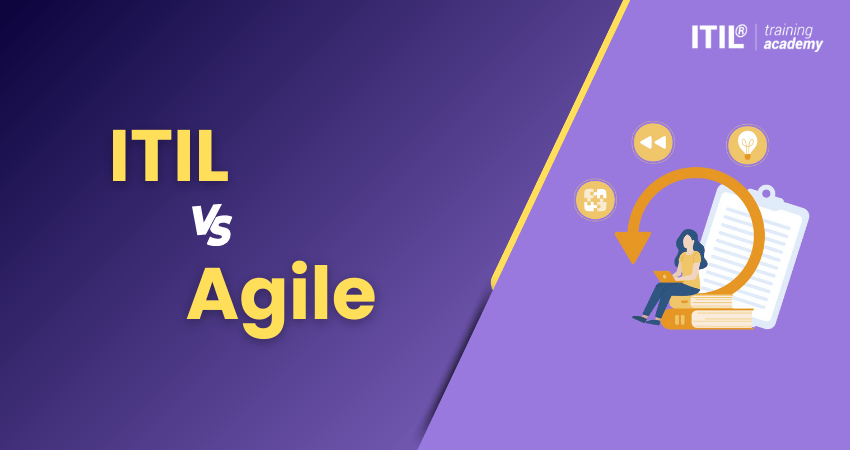
To handle this balance effectively, ITIL and Agile offer distinct approaches to managing IT work and change. By understanding how each one works and where they add the most value, you can decide which approach, or combination of both, best supports your team and business goals. In this blog, you will gain insights into ITIL vs Agile and how to choose the right fit. Let's begin!
What is ITIL?
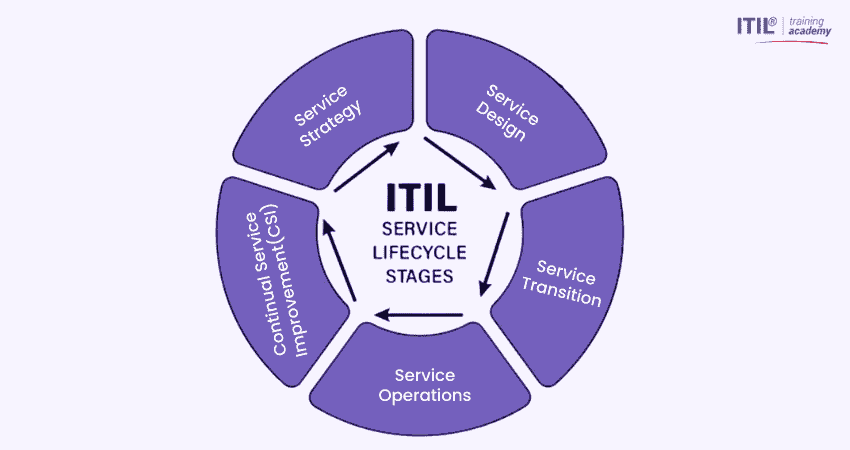
Information Technology Infrastructure Library (ITIL) is a structured framework for Information Technology Service Management (ITSM). Its primary goal is to ensure that IT services are aligned with business needs and delivered in a consistent, reliable, and measurable way.
Instead of focusing only on projects, ITIL looks at how IT services are planned, delivered, supported, and improved over time. It provides clear guidance on how to handle incidents, manage changes, reduce risks, and improve service quality.
Benefits of ITIL
Here are the benefits of ITIL:
1) Improves the quality and reliability of IT services
2) Reduces risks through structured change and Incident Management
3) Enhances customer and user satisfaction
4) Supports compliance and governance requirements
5) Improves efficiency and reduces operational costs

What is Agile?
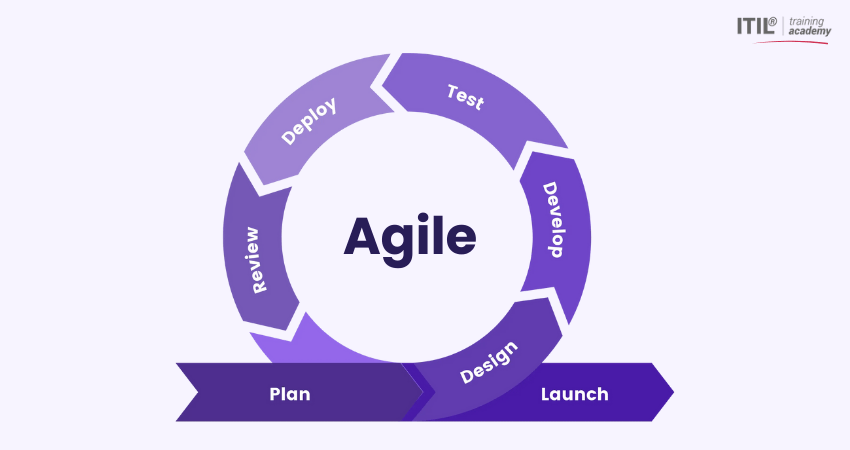
Agile is a flexible way of working that focuses on delivering value quickly and adapting to change. Though it was created primarily for Software Development, it is now used across many IT and business teams where needs change often.
Agile focuses on short iterations, continuous feedback, and rapid adaptation to change. Instead of detailed plans made far in advance, Agile teams plan their work in short cycles. This allows them to respond quickly when requirements change.
Benefits of Agile
Here are the benefits of Agile:
1) Enables faster delivery of working solutions
2) Adapts easily to changing requirements
3) Encourages strong collaboration and teamwork
4) Improves customer satisfaction through regular feedback
5) Reduces risk by delivering work in small increments
ITIL vs Agile: Key Difference
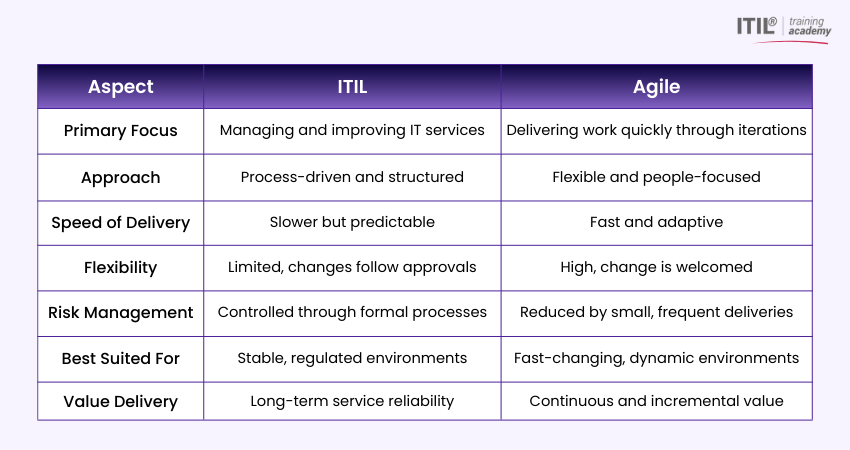
The main difference between ITIL and Agile is what they focus on. ITIL is designed to manage and improve IT services in a stable and controlled way. Agile is designed to deliver work quickly and adapt to change. These different goals shape how each framework is used in practice.
Let's check the difference in detail:
1) ITIL vs Agile: Approach to Managing Projects and Services
ITIL takes a service-centric view. It looks at how services are created, supported, and improved over time. Projects exist to support services, but the service lifecycle remains the main focus.
Agile, on the other hand, is project and product-oriented. It focuses on delivering increments of value through iterative cycles. Services may come later, but the main focus is on continuous delivery and improvement.
2)Agile vs ITIL: Methodologies and Practices
ITIL uses structured practices such as Incident Management, Change Management, and service request handling. These practices are designed to be repeatable and consistent.
In contrast, Agile uses simple practices like short planning cycles, daily check-ins, regular reviews, and feedback sessions. The focus is on learning and improving rather than following fixed rules.
3) Agile vs ITIL: Focus on Delivering Value
ITIL measures value through reliable services that meet business expectations. Success is often tracked using service levels, performance measures, and customer satisfaction.
On the other hand, Agile measures value through frequent delivery and user feedback. Value is checked regularly, allowing teams to change direction quickly if needed.
Protect business-critical data and support secure service delivery with our ITIL® 4 Practitioner Information Security Management Training – Register today!
4) Agile vs ITIL: Principles
ITIL Principles focus on delivering value, improving services, collaboration, and continual improvement, supported by governance and control.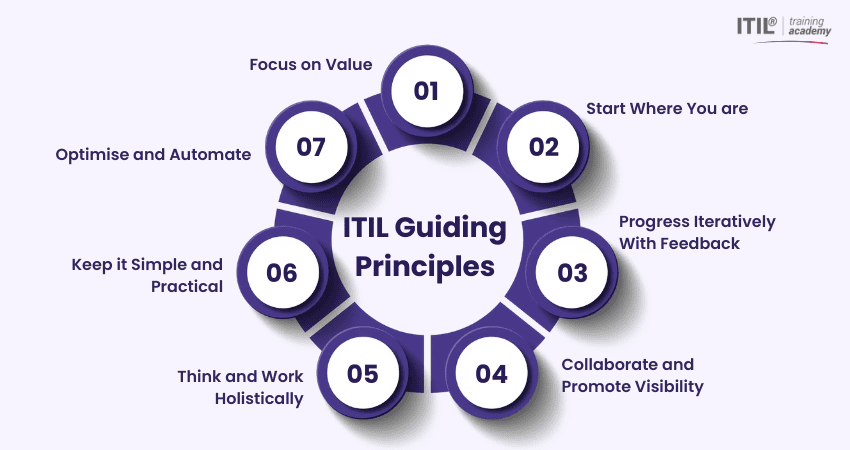
In contrast, Agile principles focus on individuals, customer collaboration, responsiveness to change, and delivering working solutions. Trust and empowerment play a central role in Agile thinking.
5) ITIL vs Agile: Approach to Risk Management
ITIL manages risk through structured planning, approvals, and controls. Risks are identified early and handled through formal processes.
On the other hand, Agile manages risk by delivering small increments of work often and gathering frequent feedback. This reduces the impact of mistakes and allows teams to learn quickly.
6) Agile vs ITIL: Level of Flexibility and Control
ITIL focuses on control and predictability. Changes are assessed, approved, and documented to minimise risk. This approach works well where failures are costly or unacceptable.
In contrast, Agile focuses on flexibility. Change is expected and encouraged. Control comes from visibility and teamwork rather than a formal approval procedure.
7) ITIL vs Agile: Flexibility Across Environment Types
ITIL works best in stable environments such as core IT systems, infrastructure, and regulated services. These areas need consistency and reliability.
On the other hand, Agile works best in changing environments like Software Development, digital products, and innovation projects where learning and speed are important.
8) Agile vs ITIL: Documentation and Communication Approach
ITIL relies on detailed documentation to support consistency, training, and audits. Written records are important for long-term Service Management.
In contrast, Agile prefers simple documentation and clear communication. Teams focus more on conversations and working results than on detailed documents.
Improve service performance and stakeholder expectations with ITIL® 4 Practitioner Service Level Management Training – Sign up Now!
ITIL vs Agile: Real-world Implications
In organisations, ITIL and Agile influence how IT teams operate, make decisions, and deliver outcomes on a daily basis.
1) ITIL in Operations: ITIL is commonly applied in operational areas such as Infrastructure Management, service desks, change control, and regulated IT services, where stability, documented processes, and predictable outcomes are essential.
2) Agile in Delivery: Agile is widely used in delivery-focused areas such as Software Development, digital product teams, and innovation initiatives, where requirements change frequently and fast feedback is critical.
Relying on only one framework can be limiting. ITIL may slow innovation through formal controls, while Agile can lack long-term service stability. As a result, many teams combine Agile for service development with ITIL Service Management for ongoing support and operation.
ITIL vs Agile: Which One to Choose?
The right choice of ITIL vs Agile depends entirely on your business needs. If your focus is on stable services, risk reduction, and compliance, ITIL is a strong option. If your focus is fast delivery, innovation, and flexibility, Agile is often the better choice.
In many cases, the best solution is not choosing one over the other. Agile can be used to build and improve services, while ITIL ensures those services are managed properly once they are in operation. So, you need to choose the one that best meets your requirements.
Conclusion
ITIL vs Agile are complementary approaches designed to solve different challenges within IT. The key to success lies in understanding your organisation’s needs. Many modern IT teams achieve the best results by combining Agile practices for development and innovation with ITIL principles for Service Management and operational stability.
Learn how to reduce risk and improve service stability with ITIL® 4 Practitioner: Change Enablement Training – Explore now!
Most Recent
Date - Jan 6, 2026
Date - Jan 5, 2025
Date - Jan 6, 2026