

 Back to
Topics
Back to
Topics


Author-James Smith

Last updated-Dec 31, 2025
Modern organisations depend heavily on IT services to stay competitive, efficient, and responsive to customer requirements. As systems grow more complex, managing IT in an unstructured way can lead to downtime, rising costs, and poor user experience. This is why many organisations adopt ITIL, a proven framework that helps deliver value-driven IT services aligned with business goals.
In this blog, we explain what ITIL is and its key benefits. We also highlight ITIL Best Practices and show how to measure ROI and business value. Let’s explore how ITIL turns IT services into consistent business value.
What is ITIL?
Information Technology Infrastructure Library (ITIL) is a globally recognised framework that provides best practices for managing IT services. It helps organisations align IT delivery with business needs while improving efficiency, reducing risk, and maximising value for customers.
It offers clear guidance across the entire IT Service Lifecycle, including service design, transition, operation, and continual improvement. By following ITIL, organisations can manage IT as a strategic asset that supports long-term business success.
Key Aspects of ITIL:
1) Service Value System (SVS): ITIL is built around a Service Value System that shows how components and activities work together to help value creation through services.
2) Practice-driven Structure: Rather than rigid processes, ITIL is organised into management practices that guide how work is carried out across service management activities.
3) Integrated Service Approach: ITIL views service management as an interconnected set of activities, linking planning, design, transition, delivery, and improvement into a unified system.
4) Context-based Application: The framework is designed to be applied differently depending on organisational context, maturity, and operating environment, allowing flexible adoption of practices.
5) Continuous Evaluation Mechanism: ITIL includes structured review and improvement models that support ongoing assessment of services, practices, and workflows.
15 ITIL Best Practices You Need to Prioritise
Below are the key ITIL Best Practices organisations should focus on to achieve efficient IT operations in 2026:
1) Establish Clear Goals
Begin by aligning your organisation’s mission and vision with SMART goals that are Specific, Measurable, Achievable, Relevant, and Time-bound. These goals provide clear direction and ensure ITIL initiatives remain focused on business priorities.
Involve stakeholders from across departments when defining objectives to reflect real business needs. Clearly communicate goals through action plans with defined responsibilities and timelines, while regularly monitoring progress to adapt to change.
2) Knowledge Management: Improving IT Operations and People
ITIL 4 highlights the importance of sharing knowledge across teams to create value. Employees should have the right tools and understanding to create, access, and share accurate information, supporting collaboration and continuous learning.
Organisations should modernise knowledge-sharing practices by identifying key knowledge assets, ensuring accuracy, and encouraging a learning culture. This helps information flow smoothly across departments and supports better decision-making.
3) Streamline Service Desk Operations
Effective service desk operations rely on clear communication channels between IT teams and business users. Structured workflows and defined escalation paths support faster resolution while ensuring accountability and consistent service delivery.
Regular training strengthens service desk performance by improving technical knowledge and soft skills. Cross-training team members builds flexibility, enabling staff to handle a wider range of issues and respond effectively to changing demands.
4) Problem Management
Problems represent the underlying causes of repeated or major incidents. While incident management focuses on restoring services quickly, problem management aims to prevent future disruptions by identifying root causes and improving long-term service stability.
Problem management helps organisations move from reactive firefighting to proactive service improvement. By analysing patterns and addressing causes, teams reduce recurring incidents and build a more resilient IT service environment.
5) Optimise Incident Management
Assess and rank incidents based on their business impact and urgency to ensure critical issues receive immediate attention. Automation can handle routine activities such as ticket assignment, updates, and alerts, allowing teams to focus on complex incidents.
Strong incident management relies on continuous improvement. Regular post-incident reviews help uncover root causes and highlight areas for process enhancement. Performance analytics, such as resolution time and incident trends, support data-driven improvements.
Strengthen asset tracking and optimisation with ITIL® 4 Practitioner: IT Asset Management Training – Register today!
6) Conveying the Value of ITIL
To communicate the value of ITIL Best Practices, focus on how they improve operational efficiency, streamline workflows, and enhance overall service quality. Emphasise ITIL’s role in aligning IT services with organisational goals.
Highlight how ITIL supports proactive problem-solving and improves end-user satisfaction. Using real-world examples and measurable outcomes helps demonstrate how ITIL contributes to a resilient, responsive, and well-managed IT environment.
7) Implement Capacity Management
Proactive capacity management ensures IT infrastructure can support both current operations and future growth without unnecessary overinvestment. It balances performance needs with cost control, helping prevent service slowdowns while avoiding wasted resources.
By tracking usage across computing, storage, and network components, organisations can identify patterns and anticipate demand. Capacity planning tools support accurate forecasting, allowing timely upgrades that maintain performance and protect user productivity.
8) Centralise Incidents and Requests
Bringing IT activities together requires a centralised service management platform. A robust ITSM tool enables organisations to manage incidents and service requests from a single system, with features such as automated workflows, smart categorisation, and priority-based handling.
A centralised service desk acts as the main connection between users and IT teams. By providing a single point of contact, it ensures consistent communication, accurate logging, and effective tracking of all IT issues.
9) Offering Self-service to End-users
Self-service enables users to resolve routine issues independently through tools such as knowledge bases, automated request forms, and chatbots. This approach provides quick access to information and reduces reliance on direct service desk support.
By lowering ticket volumes and speeding up resolutions, self-service allows IT teams to focus on complex issues. Users benefit from faster solutions, improved convenience, and greater control over their everyday IT needs.
10. Integrate ITIL Tools Strategically
ITIL tools support activities such as automation, monitoring, reporting, and workflow coordination. However, tools should always enable processes rather than dictate how services are managed.
Strategic integration ensures tools align with organisational objectives and existing systems. When implemented correctly, ITIL tools improve efficiency, enhance data accuracy, and provide better visibility across IT operations.
11) Implement Proactive Risk Management
Proactive risk management focuses on identifying potential threats before they disrupt IT services. These risks may relate to security vulnerabilities, capacity limitations, supplier dependencies or technology changes.
Regular risk assessments and mitigation planning reduce the likelihood and impact of incidents and disruptions. This approach strengthens service resilience and supports stable, long-term IT service delivery.
12) Monitor Metrics for Continuous Improvement
Monitoring performance metrics is crucial for understanding how well IT services are operating. ITIL promotes the use of Key Performance Indicators (KPIs) and Critical Success Factors (CSFs) to measure effectiveness.
Regular review of metrics provides insight into service quality, efficiency, and performance trends. These insights help teams identify improvement opportunities and make informed, data-driven decisions consistently.
13) Establish Service Catalogue Management
A service catalogue provides a structured view of available IT services, including service descriptions, delivery levels, and request processes. It acts as a reference point for both users and IT teams.
Managing the service catalogue improves transparency and sets clear expectations for users and stakeholders. It also helps standardise service delivery and manage service demand more effectively across the organisation.
14) Build Service Continuity Management
IT Service Continuity Management ensures critical IT services can be restored within agreed timeframes following major disruptions. It plays a vital role in supporting overall business continuity objectives.
This practice includes risk analysis, recovery planning, testing, and regular reviews. Strong continuity management reduces downtime, protects essential services, and enhances organisational resilience.
15) Establish Event Management Processes
Event Management involves monitoring IT systems and services to detect changes or potential issues early. Events may signal normal activity, warnings, or exceptions requiring timely investigation and action.
Effective event management supports faster response and automation. By identifying issues early, it helps prevent incidents and contributes to a proactive approach to service management.
What are the Benefits of Following ITIL Best Practices?
ITIL Best Practices help organisations deliver IT services in a structured, efficient, and value-focused way. They ensure IT supports business objectives while improving service quality, reducing risks, and enabling continuous improvement. The key benefits of adopting these practices include:
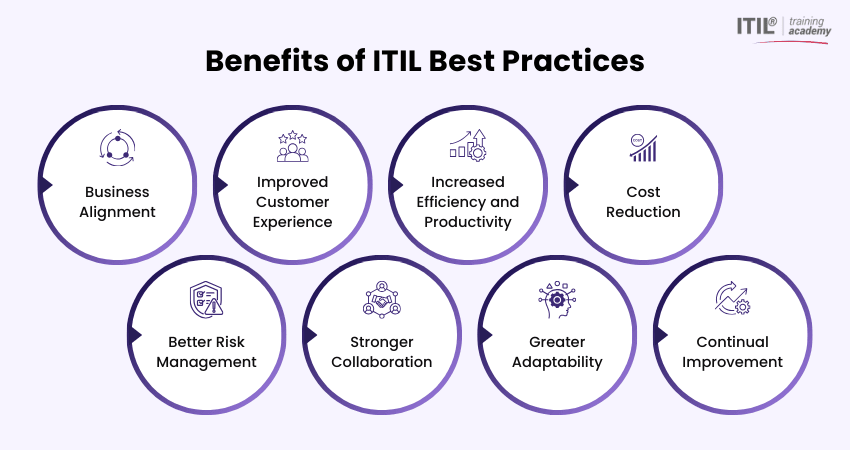
1) Business Alignment: Ensures IT services support business goals, turning IT into a value-adding strategic partner.
2) Improved Customer Experience: Delivers reliable, customer-focused services that increase satisfaction and trust.
3) Increased Efficiency and Productivity: Standardises processes, reduces waste, and improves resource utilisation.
4) Cost Reduction: Minimises downtime, avoids duplicate efforts, and optimises IT spending.
5) Better Risk Management: Identifies and manages risks effectively through structured ITSM practices.
6) Stronger Collaboration: Creates a common framework that improves communication between IT and business teams.
7) Greater Adaptability: Supports flexibility to respond to changing technology and business needs.
8) Continual Improvement: Encourages ongoing evaluation and enhancement of IT services.
Build strategic digital and IT planning expertise with ITIL® 4 Leader: Digital and IT Strategy Certification – Join now!
Integrating ITIL with Other Frameworks
ITIL works best when integrated with complementary frameworks that enhance efficiency and adaptability. These are the other integrating frameworks:
Six Sigma
Six Sigma strengthens ITIL by applying data-driven analysis to improve service quality and consistency. Using methods like DMAIC, organisations reduce defects, identify root causes, and implement controlled improvements across IT service management practices.
Lean
Lean complements ITIL by removing waste and improving flow within service processes. Techniques such as value stream mapping help streamline ITIL workflows, reduce delays, and deliver services more efficiently while maintaining structure and control.
Agile
Agile enhances ITIL by introducing flexibility, collaboration, and iterative delivery. While ITIL provides governance and stability, Agile enables rapid adaptation to change, helping organisations improve services quickly without compromising reliability.
Measuring the ROI of ITIL Best Practices
Measuring ITIL ROI shows the value gained from improved IT service management by comparing costs with measurable performance and service improvements. The steps below explain how to evaluate ITIL ROI effectively:
1) Define Clear Objectives: Set specific and measurable goals before implementation, such as improving resolution times or reducing downtime, to ensure ITIL initiatives align with business priorities.
2) Establish Baseline Metrics: Record current performance levels, including incident volumes, resolution times, service availability, and support costs, to provide a comparison point for measuring improvement.
3) Identify Implementation Costs: Document all expenses related to ITIL adoption, including tools, training, consultancy, internal effort, and ongoing operational costs.
4) Track and Quantify Benefits: Measure tangible benefits like reduced downtime, faster service delivery, and productivity gains, along with intangible benefits such as improved customer satisfaction and better decision-making.
5) Calculate ROI: Compare total benefits against total costs using a standard ROI formula to determine the financial value generated by ITIL Best Practices. Use: ROI (%) = (Benefits − Costs) ÷ Costs × 100
6) Review and Communicate Results: Monitor performance regularly and share results with stakeholders using reports or dashboards to highlight progress and support continuous improvement.
Conclusion
Adopting ITIL Best Practices empowers organisations to turn IT into a reliable engine for growth. With clear governance, proactive management, and continual improvement, teams deliver consistent services, adapt faster to change, and build resilience. The result is confident decision-making, stronger stakeholder trust, and sustained value from every IT investment across modern digital operations.
Elevate your impact with ITIL® 4 Strategic Leader (SL) Training for better IT planning and outcomes. Join Now!
Most Recent
Date - Jan 6, 2026
Date - Jan 5, 2025
Date - Jan 6, 2026